Fruit Attraction 2026: Mexico seeks greater value for its blueberries through segmentation, quality, and market.
By: Martin Carrillo
Large for one market, small for another. Sweeter for certain consumers, with a different presentation for those who shop differently. The competitiveness of blueberry Mexicans are starting to operate in an increasingly specific arena: there is no single fruit capable of responding in the same way to all markets.
From Fruit Attraction 2026 in Madrid, Blueberries Consulting spoke with Juan José Flores García, general manager of the National Association of Berry Exporters (Aneberries), and Esli Recinos, representative of H52. From different positions, both point to the same challenge: to better connect what happens in the field with consumer preferences and with the conditions required by each destination.
Each market requests a different fruit.
Recinos identifies one of the main problems precisely in the flow of information. Between the consumer and the producer, marketing companies, distributors, and supermarkets can intervene, and the preferences of the end market don't always reach the farmers.
“Often that information doesn’t reach the producer,” he explains.
H52's commercial experience shows that these differences can be significant. Recinos even recalls the surprise some producers felt upon learning that in Germany there were consumers who didn't necessarily seek the sweetest fruit, even though from the field it could be assumed that greater sweetness would always be an advantage.
The same applies to size or presentation. “Obviously there’s a market for everything,” Recinos points out, and the key is knowing which consumer values each characteristic.
The United States remains H52's primary destination for Mexican blueberries, a relationship Recinos describes as natural due to geographic proximity. The company also markets in Europe—including Germany, France, the United Kingdom, Spain, and Italy—and reaches Asian markets such as Japan and Vietnam.
Based on H52's experience, these differences are even reflected in the sales format. Recinos contrasts the small presentations that find a place in Japan with larger family-sized formats in the United States, associated with different purchasing habits.
This also changes the way of marketing: better segmenting the fruit allows it to be brought closer to the market that truly values its attributes.
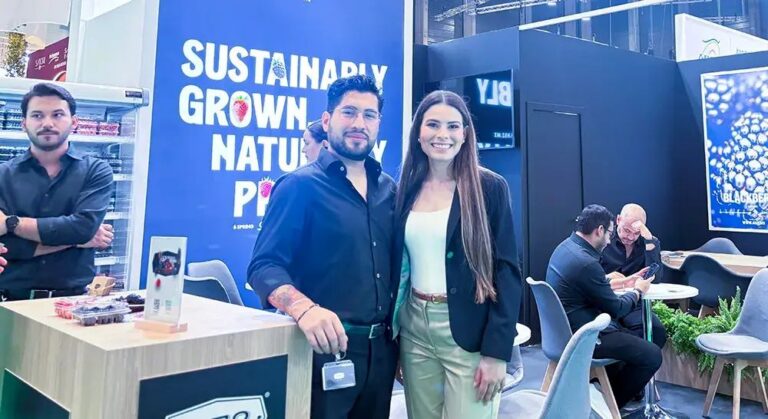
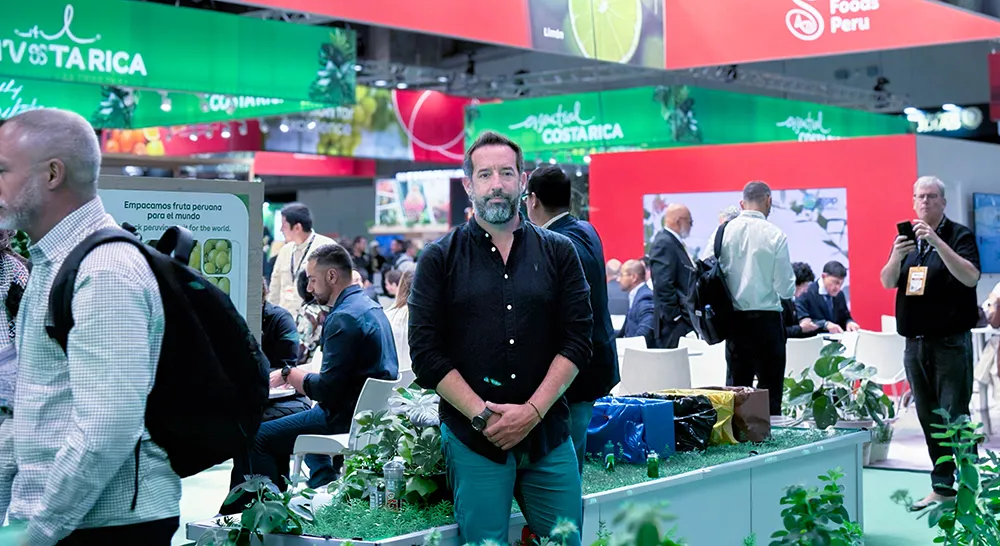
Esli Recinos, representative of H52, with Grecia Navas, project manager of Blueberries Consulting, during Fruit Attraction 2026 in Madrid. © Blueberries Consulting

Differentiation begins in the field
But segmentation doesn't begin in the supermarket. It starts earlier, with production decisions and the fruit obtained in the field.
From an industry perspective, Flores identifies varieties, presentation, and quality as some of the changes that are altering the competitive landscape. When referring to a new variety, he highlights productivity, tolerance to pests and diseases, post-harvest suitability for long journeys, and consumer appeal.
Recinos takes that discussion even further back, to the harvest. For him, differentiation begins even in the way the fruit is handled from the source: poor handling during harvest can compromise its condition and reduce the proportion of fruit suitable for higher-value segments.
From that point on, the logic shifts away from treating the entire production as a homogeneous product. “We are already seeing processes, even in small-scale production, of separating blueberries according to their different sizes and sweetness levels,” Recinos explains.
This opens up the possibility of recognizing differences within the same harvest and directing each fruit category towards the commercial segment where it can obtain the best return.
Size provides a good example. Flores points out that some markets are demanding larger fruits, even larger than what was traditionally considered jumbo.
Recinos introduces the nuance: bigger doesn't necessarily mean better for all markets. A characteristic that might command a premium in one destination may be less relevant in another. That's why understanding the consumer becomes crucial when sorting and marketing the fruit.

The condition must be maintained until destination
Producing the right fruit is not enough. Its condition must also be maintained throughout its journey.
Flores identifies three key points: good agronomic management, attention to crop nutrition and health, and a cold chain capable of preserving the fruit until it reaches the consumer. He also emphasizes the importance of technologies that allow for better management of conditions during transport.
His recommendation to Mexican producers is clear: pay special attention to the quality of the fruit entering the cooler or cold storage. From there, the distributor and other actors in the supply chain must maintain that quality until it reaches its final destination.
The final condition therefore depends on the entire chain, from field management to storage, transport and delivery to the market.
Flores identifies opportunities in Europe, North America, and Southeast Asia, and also mentions markets such as Japan and South Korea. Opening up these markets means competing with different consumers while simultaneously ensuring that the fruit arrives in the condition required by each market.
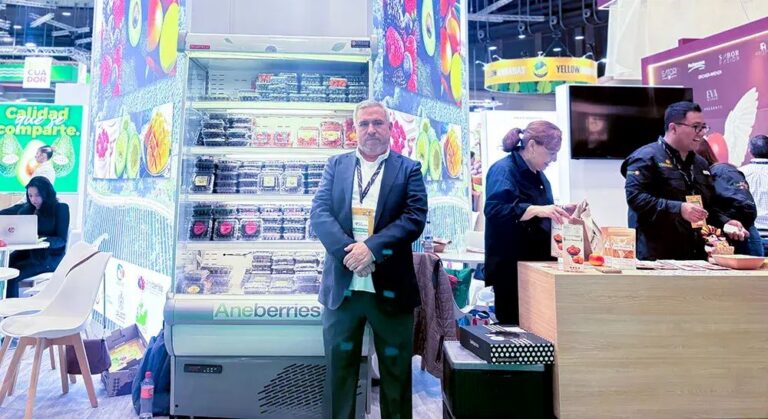
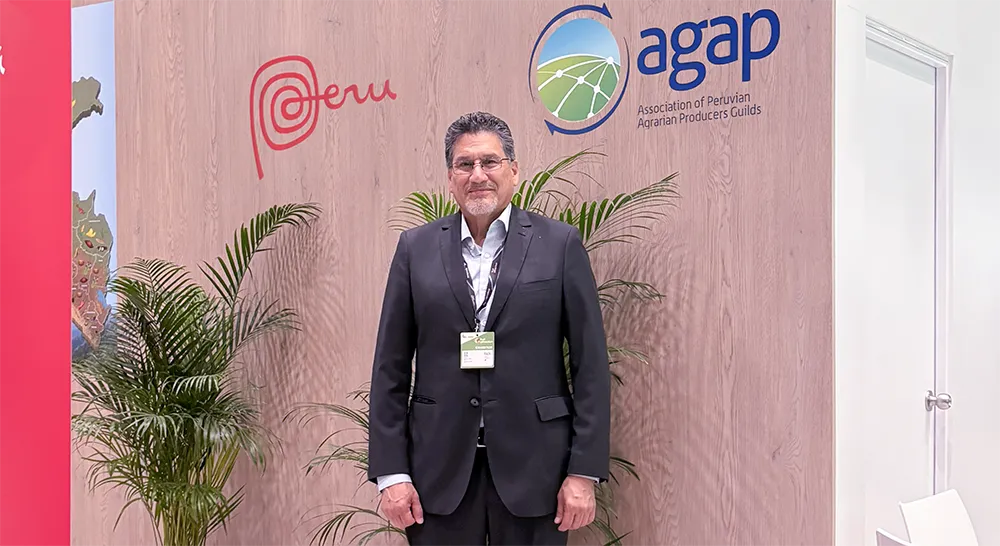
Juan José Flores García, general manager of the National Association of Berry Exporters (Aneberries), during Fruit Attraction 2026 in Madrid. © Blueberries Consulting
The information has to go back to the producer
Market diversification brings back to the table the problem that Recinos raised from the beginning: information does not always return to its origin.
Today, there are more tools available to show producers where their fruit ends up, how it is received, and what attributes consumers value. For Recinos, this flow also includes aspects related to quality, origin, respect for the environment, and working conditions.
This information can also guide the producer's decisions. Knowing how their fruit is received and what attributes each market values allows for a better understanding of what to produce and how to segment the supply.
That's where the two interviews converge. Flores emphasizes variety, quality, condition, and markets; Recinos adds the need for better segmentation and for consumer information to flow back to the fields.
For Mexico, competing on value begins with ceasing to think of blueberries as a single product. The question is what fruit each market wants, how to maintain its status, and how to bring that information back to the farmers.
Blueberries Consulting at Fruit Attraction 2026
Blueberries Consulting will continue its presence at Fruit Attraction 2026, from October 6th to 8th in Madrid, meeting with companies and industry leaders to gain firsthand knowledge of the sector's production, technological, and commercial challenges and to advance the development of its 2027 international agenda. Companies interested in exploring opportunities for participation, positioning, and business development at upcoming events can schedule a meeting with the team during the trade fair.
Contact: contacto@blueberriesconsulting.com
WhatsApp: + 56 9 3469 3871
Read also:
- Blueberries Consulting kicks off its 2027 business agenda at Fruit Attraction
- Blueberry varieties in Mexico: choosing well will be key to competing better
- Mexico grows 15% and moderates its expectations with a focus on quality and new varieties
- Blueberries Mexico 2026 concluded with a roadmap for the next stage of Mexican blueberries
- Fruit Attraction 2026: Chilean blueberries redefine their competitiveness through genetics, condition, and new markets
- Miguel Bentín at Fruit Attraction 2026: “The peak of the Peruvian blueberry will be equal to or less than predicted”
- Gabriel Amaro (AGAP) at Fruit Attraction 2026: “Year after year there is greater competition in the blueberry sector”
Previous article
Miguel Bentín at Fruit Attraction 2026: “The peak of the Peruvian blueberry will be equal to or less than predicted”next article
ARTÍCULOS RELACIONADOS