Mexican berry exporters ask that certifications not become a bureaucratic burden

The implementation of labor certifications for berry agro-exports by the federal Ministry of Labor could become an administrative burden for small producers in the country, warned Juan Pablo Molina Baranzini, vice president of Producers of the National Association of Berry Exporters (Aneberries).
In an interview, he states that the sector shares the objectives of strengthening labor rights, improving traceability, and raising standards, although he considers it essential that the new obligations do not become a bureaucratic burden that limits the competitiveness of the industry.
The USMCA, Mexico's main trade agreement with the United States and Canada, is in its review stage and one of the main focuses is that trade policy aligns with international commitments on labor matters.
Under the administration of President Claudia Sheinbaum, labor certifications for agricultural exports were implemented to verify compliance with social security obligations throughout the production chain, but producers warn of risks.
“We must avoid disproportionate burdens on small and medium-sized producers. It's important to remember that the agricultural sector operates in regions where there is often no internet or even electricity. All these factors must be taken into account,” he adds.
Since the end of 2025, Aneberries has participated in meetings with the Ministry of Labor to learn about and analyze the new Labor Certificate for Agro-exports. “We have discussed it as companies and as an industry to understand how it can contribute to higher levels of compliance,” he says.
Molina Baranzini believes that certification can strengthen Mexico's position regarding the labor and environmental provisions contained in chapters 23 and 24 of the USMCA.
However, he warns that implementation must be built with clear rules and functional processes.
"Anything that leads to higher levels of compliance, formality, and sustainability is positive for the industry. The important thing is to ensure that implementation is viable and that we can build it gradually, with clear rules and functional mechanisms," says the representative of the main organization representing the production chain of this sector in Mexico.

Juan Pablo Molina Baranzini, Vice President of Aneberries Producers © Aneberries

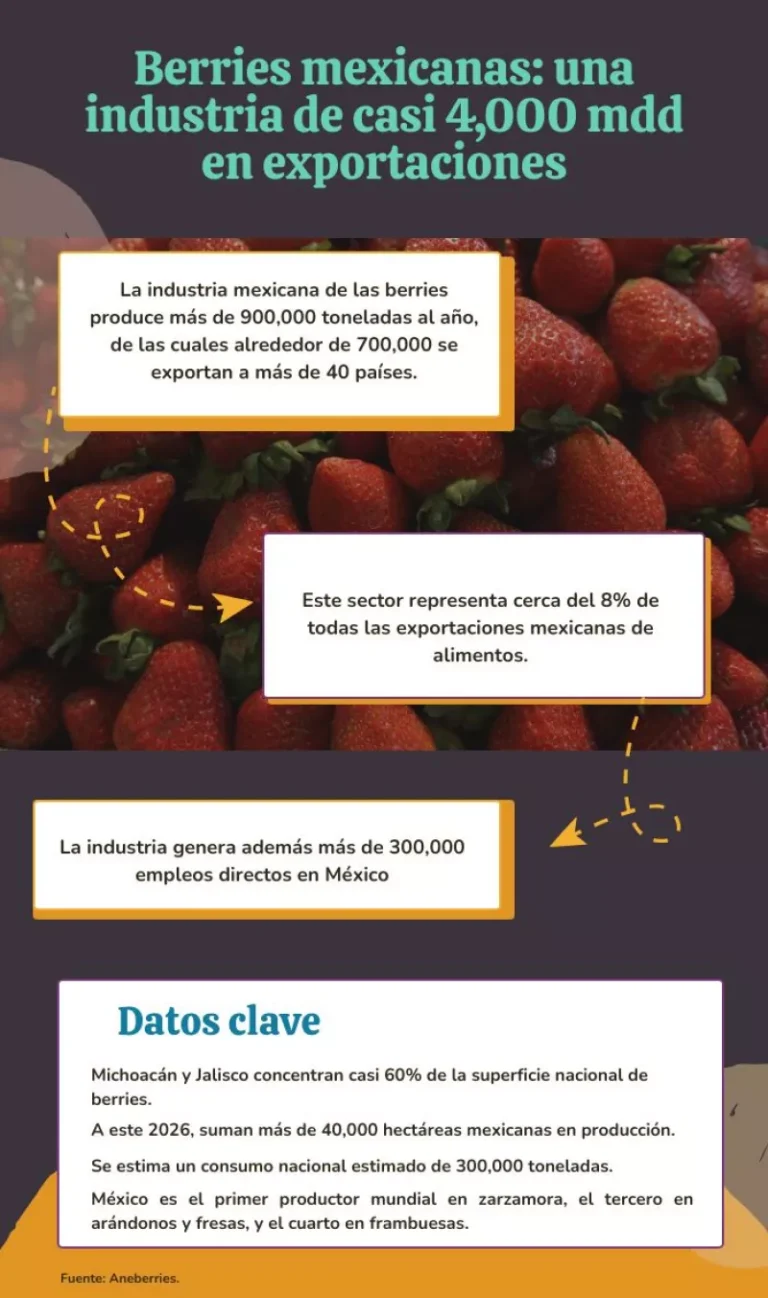
The Mexican berry industry is one of the most dynamic drivers of Mexican agricultural exports, with sales abroad reaching almost $4,000 billion annually, mainly to the United States, and generating thousands of direct and indirect jobs in states such as Jalisco, Michoacán, Baja California, Guanajuato and Sinaloa.
Founded in 2010, Aneberries brings together berry producers, exporters and marketers, and works on issues of training, research, food safety, sustainability, certifications and access to international markets.
Furthermore, he is one of the main interlocutors between the industry and the Mexican authorities on issues related to foreign trade, labor and environmental regulations, as well as in the promotion of better agricultural practices that allow maintaining the competitiveness of one of the most successful sectors of the Mexican countryside.
Certifications: an evolution, not an imposition
The six-year review of the USMCA coincides with the push for new labor and environmental certifications promoted by the federal government for agricultural exports.
In early May, legislative changes were announced that incorporate labor and environmental verification mechanisms in agricultural production destined for export, thus empowering the Ministry of Labor and Social Welfare (STPS) to issue a Labor Certificate for Agro-export, which accredits compliance with social security obligations throughout the production chain.
Its objective is for agri-food trade to develop "under verifiable standards of labor compliance and free from deforestation," aligning trade policy with international commitments such as the USMCA itself, whose labor and environmental chapters require guaranteeing labor rights and protection of natural resources.
Molina says that these issues are not new to the berry industry, since Aneberries has been working on programs for food safety, traceability and international certifications for more than 15 years since its inception.
He explains that the association developed the Berry GAP program, a system of good practices adapted to small and medium-sized producers to facilitate their incorporation into international standards.
“The berry sector is made up of many small producers. What we have sought is to transfer those levels of compliance and good agricultural practices to systems accessible to them,” he says.
In the last season alone, the association conducted more than 6,000 training sessions aimed at producers and workers in the sector.
© Aneberries

A sector that is committed to formality
According to the vice president of Aneberries, one of the main challenges for Mexican agriculture continues to be formalizing employment.
Berry production uses a large amount of labor at different times during the production cycle, which creates challenges in terms of recruitment, labor mobility and access to social security.
However, Molina argues that municipalities with an agro-export focus show significantly better results than the national average.
It cites a study conducted by the Wilson Center Mexico Institute and Jornamex, which contrasts that while formal employment in the national agricultural sector ranges between 23% and 25%, in agro-exporting regions it can exceed 70%.
“San Quintín is a very clear example. The level of formality is above 70%, well above the national average,” he points out.
The study also identified that agro-exporting municipalities registered greater progress in poverty reduction and social mobility than the national average.
However, he acknowledges that structural obstacles still exist. One of them is the difficulty temporary workers face in obtaining basic documentation such as the Federal Taxpayer Registry (RFC), an essential requirement for their inclusion in formal employment schemes.
“There are workers who live hours away from a SAT office. These are structural challenges that we have to solve in order to keep moving forward,” he says.

“A very complex season”
The Mexican berry industry closes 2026 having one of the most complex seasons in recent years.
According to Molina Baranzini, factors such as exchange rate volatility, the international geopolitical environment, and the increase in production costs—especially of agricultural inputs and chemical products—have put pressure on producers and exporters in the sector.
Added to this is the unique dynamic of the market, since Mexican production is complementary to that of the United States. While domestic berries primarily supply the market during autumn, winter, and spring, the US supply becomes more significant during the summer months, forcing Mexican producers to constantly adapt to international market conditions.
"Challenges are turning into opportunities, and I think berries have stood out for seizing those opportunities."
U.S. purchases of Mexican agricultural products registered their first annual decline in nearly 30 years in 2025. The value of imports from Mexico reached $43,849 billion, compared to $48,629 billion the previous year, a reduction of approximately 10%.
For Molina, the future of the industry will depend on maintaining the adaptability that has characterized the sector in recent years.
“We need to maintain that constant evolution. Markets change, demands change, and we have to keep transforming ourselves to remain competitive,” he adds.
With the USMCA renegotiation underway, stricter environmental and labor requirements, and an increasingly complex international environment, the Mexican berry industry faces new challenges. But for Aneberries, the path forward lies in the same formula that has fueled its growth over the past two decades: innovation, training, and compliance.
ARTÍCULOS RELACIONADOS