Blueberries: emerging markets will reshape the export map in 2025/26

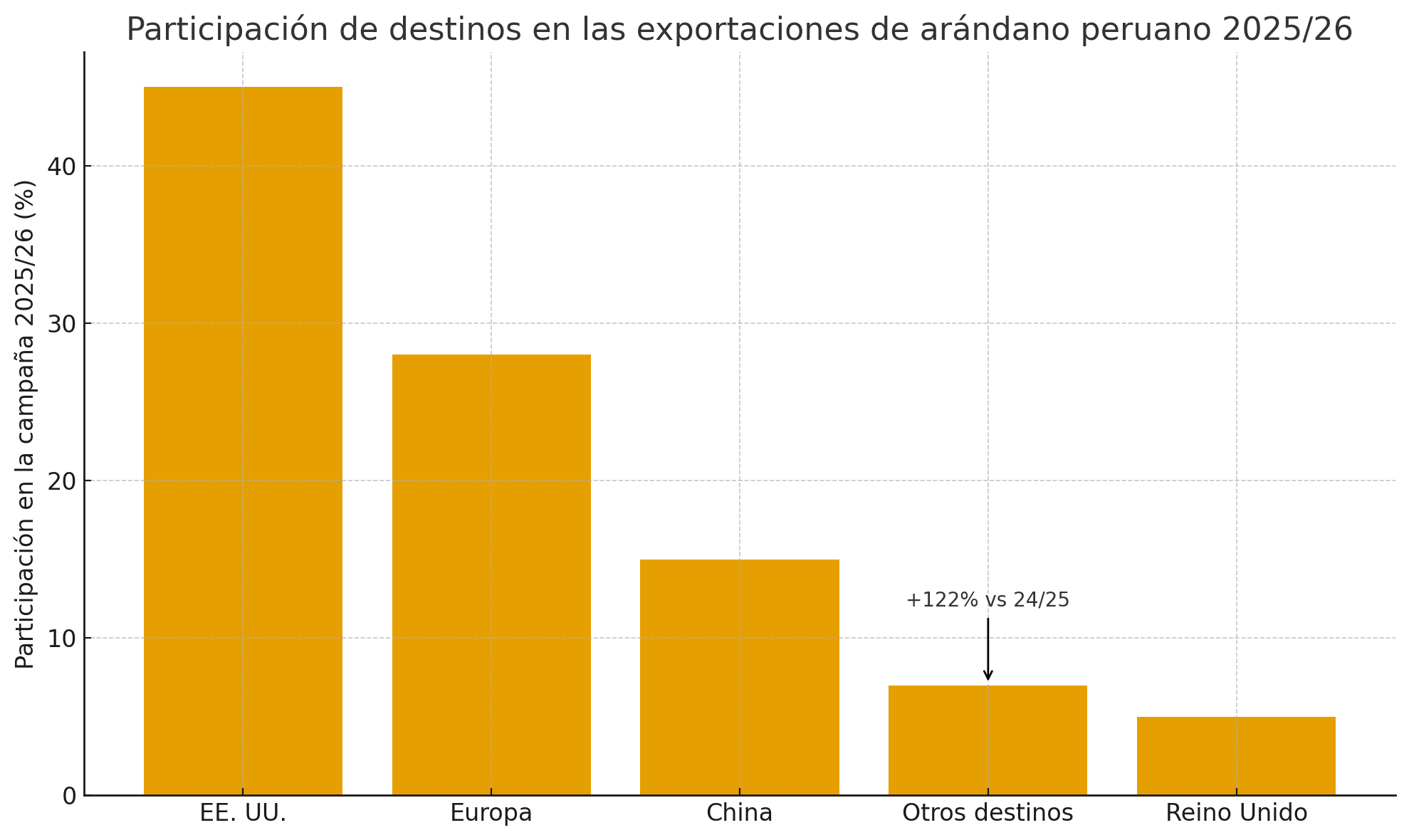
In the 2025/26 season, Peruvian blueberry exports not only grew in volume, but the distribution of the fruit also changed. The "other destinations" category now represents a significant portion of total exports and is experiencing much faster growth than traditional markets. Behind this label are countries that barely registered in the statistics just a few years ago, but which now maintain stable programs with recurring weekly purchases, not just one-off transactions.
For the Southern Hemisphere, this shift opens up a new landscape. The United States, Europe, and China remain the cornerstones, but the "other destinations" category is beginning to rebalance the scales: it allows for better distribution of commercial risk, taking advantage of specific opportunities, and exporting fruit with attributes tailored to the demands of each market. In practice, exporters no longer focus solely on "three major markets" but are incorporating a fourth key decision-making factor into their annual business plan.
© Blueberries Consulting

New destinations, new rules of the game
The rise of the "other destinations" segment is also changing the strategic conversation within companies. The question is no longer limited to how much is sold to the United States or Europe, but rather to what role emerging markets like Canada, Taiwan, India, or Saudi Arabia play in the use of seasonal tails, the sale of certain varieties, and the capture of better returns for fruit with specific attributes. Each of these destinations has its own consumption patterns, formats, channels, and price sensitivity.
This diversity necessitates the design of more sophisticated market portfolios. Some destinations are ideal for large, premium-quality fruit; others work better for medium sizes or for varieties with good flavor but less suitable for extremely long journeys. The "other destinations" label ceases to be a catch-all category and becomes a set of markets with a name, a specific focus, and a defined strategy within the overall marketing mix.

Impact on weekly shipping planning
The growth of these secondary markets isn't solely measured in annual figures, but also in how the shipping curve is structured throughout the season. The "other destinations" window shows specific weeks with a high concentration of containers, both at the beginning and in the middle of the season, when supply pressure to the United States or Europe is highest. This provides a safety valve to manage production peaks and avoid saturation in the primary markets.
At the same time, this increased complexity demands closer coordination between the field, logistics, and sales departments. The decision of which fruit goes to each market is no longer based solely on the spot price, but also considers the fruit's condition, its estimated post-harvest life, and the actual window of arrival at its destination. In this context, the "other destinations" category acts as a strategic buffer, helping to sustain returns and reduce the risk of oversupply in a few key markets.

From secondary bloc to strategic blueberry hub
The expansion of Canada, Taiwan, India, and Saudi Arabia indicates that the concept of “other destinations” is becoming obsolete. What was seen a few years ago as a marginal group now functions as a true demand hub that complements and, at times, competes with traditional markets. For exporting countries, this means more options, but also greater demands for segmentation and consistency.
In this new landscape, success depends not only on opening new markets, but also on maintaining long-term business relationships, understanding consumer behavior, and adapting varietal and logistical offerings to the specific conditions of each market. Those who manage this fourth hub effectively will have greater flexibility to navigate an increasingly competitive global blueberry industry, where smart diversification of markets is as important as productivity in the field.
ARTÍCULOS RELACIONADOS