Peruvian blueberries in the UK: moderate but consistent growth

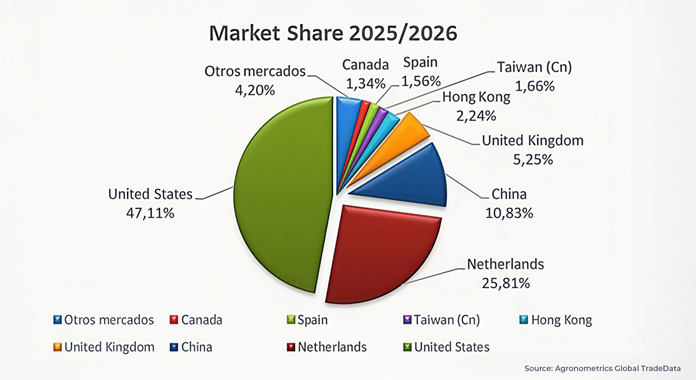
Peruvian blueberries are seeing an increase in exports to the United Kingdom. In the latest available data, the British market accounts for 5,25% of exports, reinforcing its importance as a European destination during a season characterized by increased competition for export windows and consistent availability.
This performance is best understood within the context of the restructuring of the Peruvian blueberry market in Europe. As Europe consolidates its role as the second largest trading hub, the United Kingdom emerges as a market capable of sustaining programs and absorbing volume, especially when fruit condition, logistical compliance, and consistent sizes align.

A market with clear windows
UK participation is typically linked to retail programs and well-defined consumption windows. When its share increases during a specific season, it signals active demand and greater stability in purchases during the observed period.
For Peru, this represents an operational advantage. A destination with structured programs allows for more precise planning and helps to balance the portfolio, especially when other markets adjust their purchasing pace or concentrate demand in specific weeks.

Europe is organized through platforms
The growth of the British market occurs within a context where the Netherlands maintains a dominant role as a European hub, with a significant share of the destination mix. This logistical architecture facilitates more efficient redistribution within the continent and ensures the continuous supply of markets such as the United Kingdom.
In practical terms, the combination of a strong hub and a destination with stable demand strengthens the ability to sustain volume with less logistical friction. This is especially important in an industry where speed of arrival and schedule adherence directly influence turnover, pricing, and commercial reputation.
Signal for export strategy
The UK's performance confirms that Europe is gaining traction as a component of the Peruvian blueberry market, beyond the Netherlands' role as a distribution hub. Expansion within the continent opens up opportunities, but also raises the bar for consistency, as European markets tend to quickly penalize any gaps in quality or continuity.
In summary, the United Kingdom is consolidating its position as a destination that brings balance and depth to the export portfolio. If this trend continues, its participation could become a key driver within a more robust European strategy for Peruvian blueberries.
ARTÍCULOS RELACIONADOS