Economic and social expectations for the imminent inauguration of the Port of Chancay in Peru

The Chancay port, which will be officially inaugurated on Thursday, November 14 in the city of Lima remotely by the President of China, Xi Jinping, has caused excitement in the region as well as in the US and it is expected that the port operations will begin while international concern grows with the recently re-elected Donald Trump as President. On the other hand, the project has brought a new wave of activity to the city, such as the arrival of Cosco employees, which has caused an increase in the demand for services and products. Chancay, which was once a quiet city, is now hosting great changes and the construction of hotels, universities and hospitals is already being considered. Likewise, property prices have skyrocketed; before the construction of the mega port, land in the region cost an average of US$2 per square meter, the current average is US$35. However, in the face of this rapid growth, the inhabitants of Chancay have mixed feelings, reports SCMP.
The potential of Puerto Chancay
Ruben Tang, former legal advisor to the Ministry of Commerce of Peru, said that although the port will take several years to reach its full capacity, it has the potential to develop the region and also to change the way foreign trade works in Peru. “The port is an incentive to modernize the cabotage law, for example,” Tang suggested.


Rubén Tang-Advisor Vice-Rector for Research Project for the Pontifical Catholic University of Peru (PUCP)-Asia Relations
“It has also sparked debates in the Peruvian Congress to turn the entire southern region of Chancay into a free trade zone, similar to Shenzhen in China,” he added.
Chancay has a depth of more than 18 meters, allowing even the largest vessels to unload at the port. And in addition to being strategically located on the Pan-American Highway, which connects several South American countries, the city would also serve as a connection between other regional ports in Chile, Ecuador and China, as well as other important markets in the Indo-Pacific.
It should be recalled that as part of President Xi Jinping’s Belt and Road Initiative (BRI), a consortium led by the Bank of China agreed in 2019 to lend up to US$3.500 billion for the construction and development of the port, which would mainly connect South America to Chinese hubs. The negotiations, which also involved other smaller Chinese banks such as China Minsheng Bank, Shanghai Rural Commercial Bank and Bank of Communications Co, lasted three years; construction began in 2019.

Other effects: Human Factor
Chancay residents have mixed feelings about the rapid growth. Some are optimistic about job creation – the Peruvian government estimates the port will create 8.550 direct jobs over the next decade – but others fear gentrification, inadequate public services and the project’s environmental impact will force them out.
For its part, Cosco has built a gymnasium, renovated the local police station and donated funds to create a boulevard in the city centre. It has also launched a scholarship programme that finances the tuition fees of city residents who wish to study at partner universities in Lima.
Still, there have been repeated protests since construction began. In July, a group of residents calling themselves the Front for the Dignity and Freedom of Chancay traveled to Lima to demonstrate in front of the Peruvian Congress.

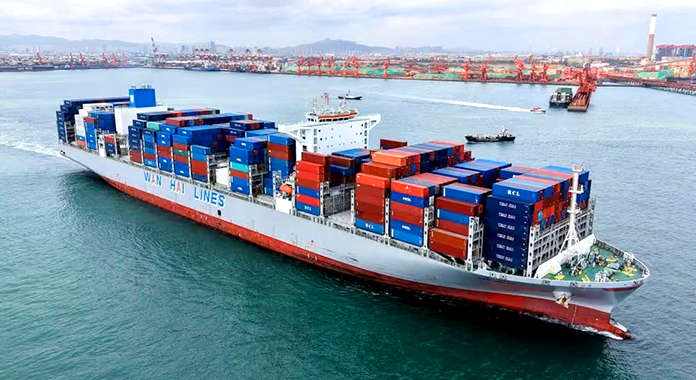
A cargo ship at a Chinese-funded port in Chancay, Peru. Tuesday, Nov 12, 2024. Photo: whec.com/ ASSOCIATED PRESS / Silvia Izquierdo
They claimed that the constant dynamite explosions needed to clear the works were affecting the mental health of port residents and damaging the structure of their homes.
The group also sent a letter to the Peruvian Council of Ministers requesting the creation of a committee to engage with the population and address “the consequences of the problematic construction of the megaport in the areas of health, public safety, food and water.”
They also want a law to be passed requiring the transfer of at least 2% of all government revenue from trade tariffs to communities affected by the port.
Activists have accused Cosco of failing to conduct studies covering the full environmental impact caused by the port, in particular focusing on construction work in the Santa Rosa wetlands, known for their numerous species of birds, reptiles and plants.
Previous article
Agrovision and its efforts to increase global demand for blueberriesARTÍCULOS RELACIONADOS