IBO predicts continued growth in the blueberry industry in the coming years
The International Blueberry Organization (IBO) conducted a comprehensive analysis of the global blueberry industry in its 2025 Report. It forecasts growth in the industry and marketing, but also poses challenges that must be addressed by the various stakeholders in this industry. “There are very significant changes in one area: business risks, and a greater need to address environmental and labor challenges.”, highlights Mario Steta, president of the IBO.
The key change this year is driven by the policies, regulations, actions, and messages of the U.S. government, and other governments in response, that are challenging the way global trade is conducted. “The implementation of tariffs is affecting many economic sectors, including food chains and food production. While blueberries are a very small component in the context of global trade, we are probably the best example of an agricultural product with a global reach, with all that this entails. Therefore, given the recent uncertainty that is likely to persist in the coming months, it is important that, as an industry organization, we analyze not only how we respond to potential problems and consequences, but also how we find ways to use these changes to our benefit and that of our consumers.“,” Steta notes.

Continuous growth
The IBO report forecasts that global blueberry production will continue its growth trajectory, “with combined production of fresh and processed blueberries expected to exceed 3,18 million metric tons by 2028. The steady growth seen since 2005 is expected to accelerate further, driven by expanding acreage and improving yields in several regions.”, Señala.
In this regard, it states that America will continue to maintain its dominant position, with volumes expected to exceed 1,48 million metric tons by 2028. The industry in the region will be led by the US, Peru and emerging suppliers from Latin America, "which consolidates the region's position as the backbone of global supply", he reaffirms.
Meanwhile, the Asia-Pacific region continues to show strong expansion, reaching over 1,19 million metric tons by 2028, with China being the main driver, with sustained investment in acreage and production infrastructure driving steady growth.
In the case of EMEA (Europe, Middle East and Africa), “Although lower in absolute terms, production is projected to nearly double 2020 levels, surpassing 528,000 metric tons by 2028. Growth in Morocco, Spain, and Eastern Europe supports this trajectory.”He says.

America leads the Top 10
The Americas continue to lead the world in blueberry production. By 2028, production across the region is expected to exceed 1,48 million tons.
Based on data presented by the IBO for the 2024 campaign on the top 10 fresh blueberry exporting countries, Peru leads the ranking with 329 tons, followed by the Netherlands, Chile, and Mexico.
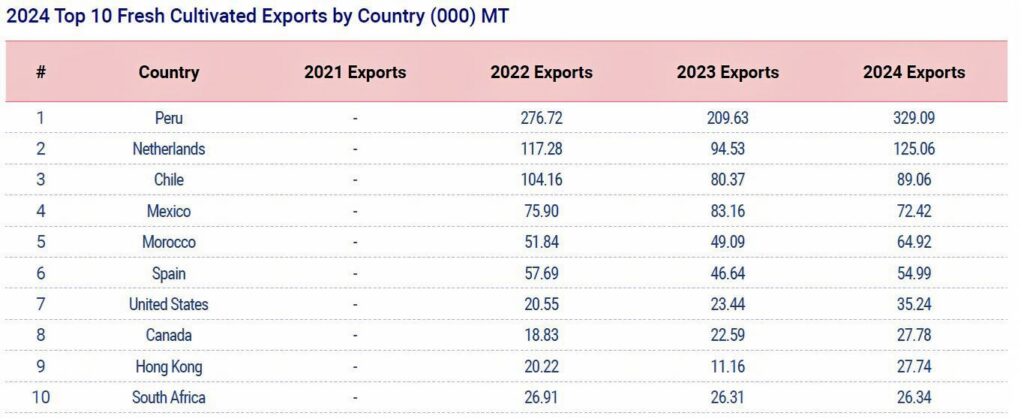
The IBO highlights Peru as the main driver of growth, with steady increases in both planted area and yield. It projects production to exceed 658,000 tons by 2028, supplying all global markets, while Chile is expected to significantly increase its production as new plantations mature.
In North America, production is expected to exceed 485,000 tonnes by 2028, led by the western United States and supported by continued stability in Canada.
Mexico and Central America, although on a smaller scale, are showing slower expansion. Together, the Americas are projected to produce nearly 1,5 million tons of blueberries by 2028, underscoring the region's central role in sustaining long-term global supply growth.

The Asia-Pacific region
In the Asia-Pacific region, China is seen as the absolute leader and the main driver of growth. Production is expected to exceed 1,19 million tons by 2028, accounting for the vast majority of the region's output. "China's growth has been driven by the rapid increase in cultivated area, and this expansion is expected to continue steadily over the coming years."
He also warns that "our model could be overestimating Asian volumes, as China is struggling to expand due to land-use restrictions and other barriers to sustained growth."
Main markets
In the analysis of countries importing fresh blueberries, the United States leads the list with 305 tons imported, followed by the Netherlands, Germany, the United Kingdom, Canada, Spain, and China.
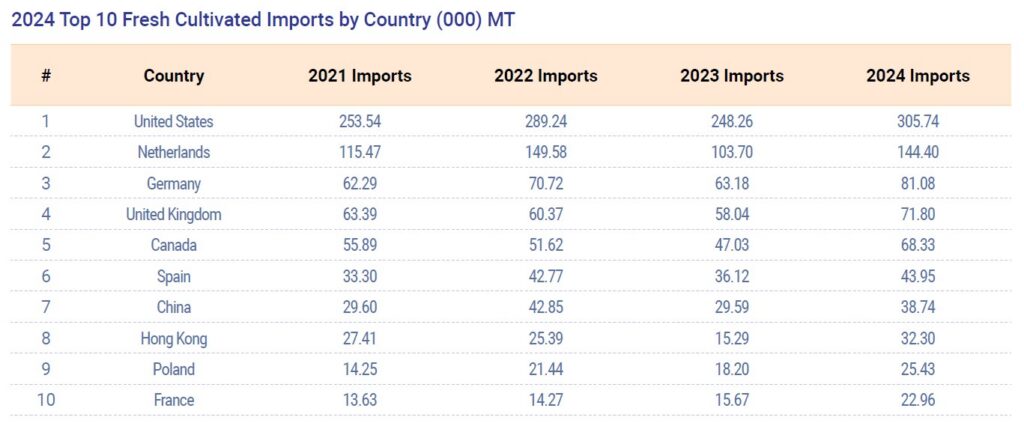 Given that the United States led the import of blueberries in 2024 and President Trump's announcement of import tariffs, there is real concern within the industry, and IBO President Mario Steta is calling for attention.
However, opening new markets and developing producer strategies to mitigate the impact of tariffs will be vital in the coming months.
Previous article
The great challenge of the economic gap in the USMCA countriesARTÍCULOS RELACIONADOS