Sea-shipped cherries take over the market as blueberry prices rise
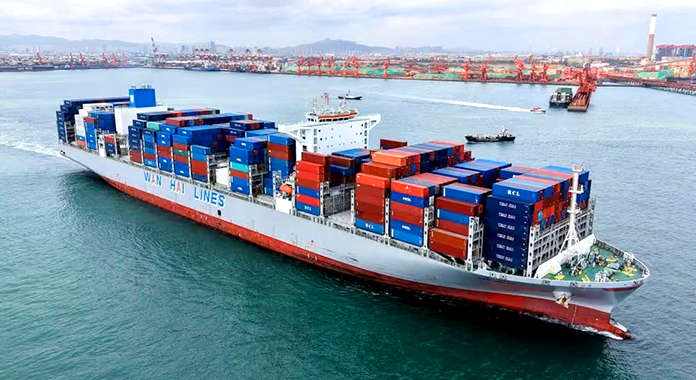
During week 50, the market shifted towards Chilean cherries transported by sea. Market operators indicate that, given the limited volume of fruit arriving by air and the significant price advantage of maritime transport, most opted to sell cherries arriving by ship. The majority of these shipments were of the Santina variety.
Sea cherries showed a wide range of prices. For Santina, the 2,5 kg x 2 (two-in-one) format ranged from just over 300 to just over 400 yen per box (US$41,70–55,60), with premium shipments in the 450–470 yen range (US$62,50–65,30). Some batches, however, traded for as little as 330–360 yen (US$45,80–50,00).
In individual 2,5 kg boxes, 3J cherries were priced at around 220–230 yen per box (US$30,60–31,90) and 2J cherries at around 190–195 yen (US$26,40–27,10). According to traders, sea cherry prices started the week high and eased toward the end as arrivals increased. For the two-in-one format, the price difference reached 10–40 yen per box (US$1,40–5,60). Some traders added that certain lots were offered at lower prices due to lower-than-expected firmness and flavor.

Peruvian blueberries on the rise due to lower supply
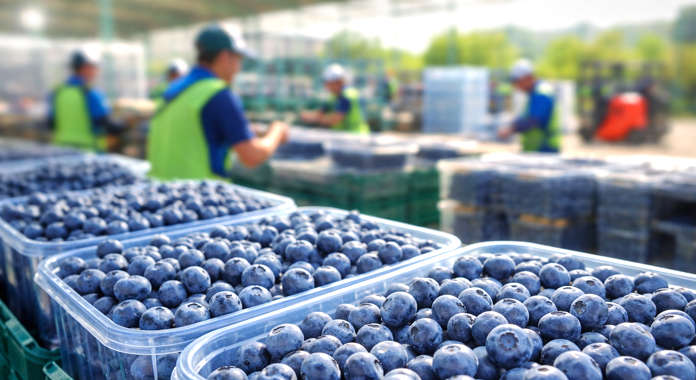
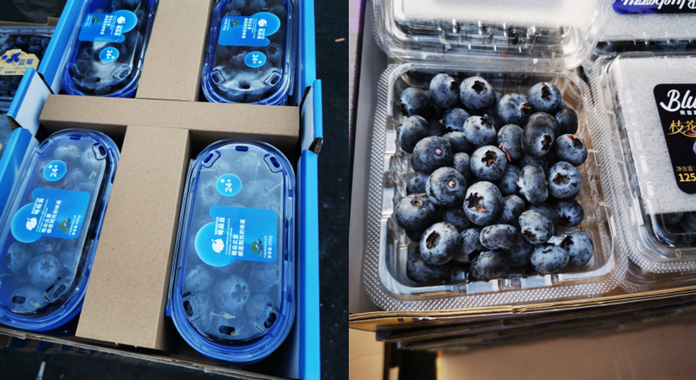
Meanwhile, Peruvian blueberry arrivals continued to decline during week 50, while prices continued to rise. Blueberries of 14 mm or larger were priced at around ¥100 per box (US$13,90), and those of 18 mm or larger ranged from ¥120 to ¥130 (US$16,70–18,10), approximately 10% higher than the previous week.
Several operators attribute this increase mainly to the reduction in incoming volumes, the tighter supply of certain high-quality brands, and the high prices of Yunnan blueberries, which acted as a benchmark and support for the market.

Yunnan consolidates premium blueberry segment and faces growing competition from other fruits
For Yunnan blueberries, prices for 15 mm and 18 mm sizes remained relatively stable. However, the premium format with extra-large fruit—24 mm or larger—saw an increase of around 10–15%, driven by supply constraints. Compared to the previous week, week 50 saw small volumes of 20 mm and larger sizes arrive, but overall supply remained limited.
Meanwhile, other imported fruits faced a less favorable scenario. Durian arrivals increased during week 50, but weak sales downstream led buyers to reduce both the frequency and volume of their purchases, putting downward pressure on prices. Vietnamese Kanyao durian (size A3) settled at around 230–250 yen per box (US$31,90–34,70), a marked drop from the more than 300 yen (US$41,70) recorded in the second half of the previous week.
Peruvian avocado shipments also increased, with prices for cardboard box packaging around ¥85 per box (US$11,80).
As for domestically produced fruit, the market offered a wide variety: high volumes of citrus fruits and gift boxes of apples, in addition to strawberries, Crisp Honey kumquats, Yunnan cherimoyas, and other specialties. A small shipment of Golden Diamond pineapples from Hainan was also available, priced at approximately 90–95 yen per box (US$12,50–13,20). Traders consulted indicated that, despite the diverse offerings, sales remained slow during week 50, though they expect the buying environment to improve in the following weeks.
ARTÍCULOS RELACIONADOS