Nutrition, salinity and monitoring: practical keys left by María del Carmen Salas at Lima 2026
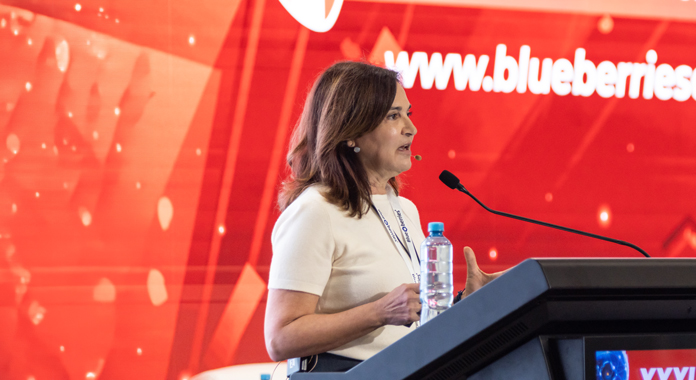
During the second day of the International Blueberries Peru 2026 Seminar held in Lima, Dr. María del Carmen Salas, a doctoral professor at the University of Almería, focused her presentation on precision management, specifically "Tools for controlling nutrition and salinity in potted blueberry production." Going beyond conventional methods, her approach centered on providing growers with tools and technical criteria that enable them to maintain consistent production levels while minimizing the risks associated with environmental variability.
Salas made it clear that nutrition is not an isolated factor, but rather the result of rigorous control of the interaction between water, substrate, and the plant. The stability of the system depends on the technical team's ability to interpret what is happening within the plant and react with sound judgment to any deviation.

Control and monitoring as a basis for stability
For Salas, the key to success in intensive production lies in continuous monitoring. It's not about following a rigid set of guidelines, but about understanding dynamic variables such as electrical conductivity (EC) and pH in the root zone. Frequent monitoring allows for the identification of trends before they become problems that affect yield.
The adjustment of the nutrient solution should be a direct response to the data obtained in the field. Factors such as drainage percentage and its chemical composition are vital indicators that dictate whether the fertigation strategy is efficient or if it is accumulating salts that unnecessarily stress the crop. In this regard, he recommended:
- Consider the sensitivity of the varieties to salinity.
- Control of nutrient solution and drainage: concentration of the main macronutrients (NO3, K, Ca, Na).
- Fertigation management by adjusting water needs in real time.
- Water above the plant's water needs (washing fraction) for salts in the root zone.
- Use of quality substrates with suitable physical properties and good aging.
- Choose fertilizers with a low salinity index.
- Consider the use of biostimulants/growth regulators, etc.
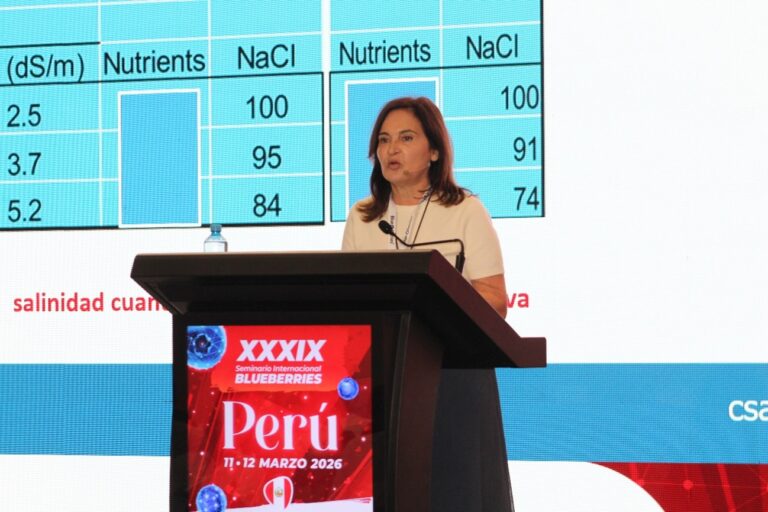
Dr. María del Carmen Salas, University of Almería, Spain. @Blueberries Consulting

Connection with the Peruvian productive reality
The specialist's points directly resonate with the challenges observed during the recent Technical Tour. In a context where Peruvian agricultural exports are moving towards intensification and the large-scale use of potted plants, technical decisions regarding substrate management and salinity control become critical for maintaining competitiveness.
In high-density systems, the margin of error is drastically reduced. The challenges of scale in Peru demand that the transition from soil to pots be supported by impeccable water resource management, where monitoring technology is efficient for daily decision-making.
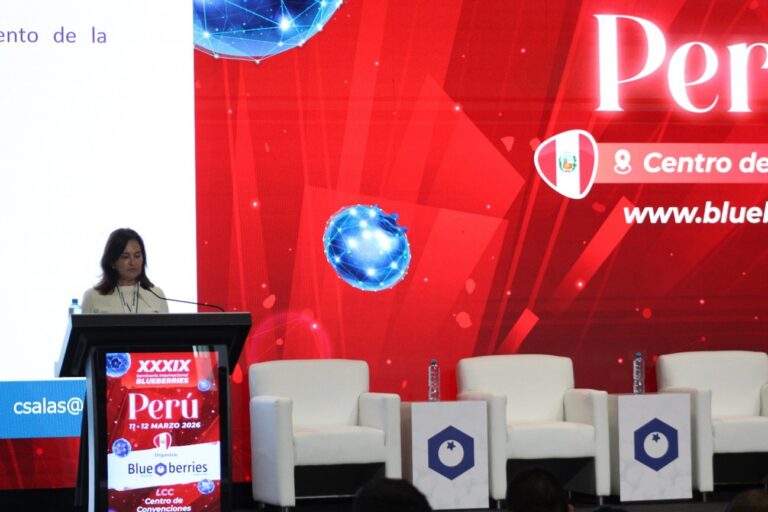
Dr. María del Carmen Salas, University of Almería, Spain. @Blueberries Consulting

Training and transfer: the value of the diploma
The depth of these concepts and their practical application form the core of the Diploma in Soilless Cultivation, developed by Blueberries Consulting in partnership with the University of Almería. This program is the natural next step for professionals seeking to specialize in the leading methodologies of modern agriculture worldwide.
This training milestone allows Peruvian technicians and producers to access top-tier knowledge transfer, connecting Almería's academic expertise with the real needs of local fields. Continuity in training is ultimately the guarantee of a resilient and technologically advanced agricultural industry.
ARTÍCULOS RELACIONADOS