Foliar pathogens and quantification of losses: Walter Apaza Tapia established criteria to prioritize decisions in blueberries
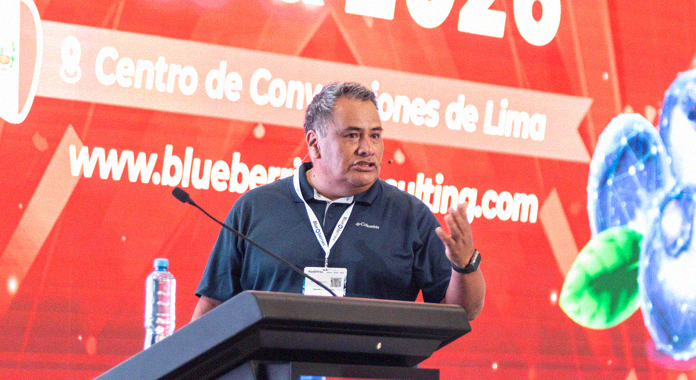
Plant health becomes crucial when linked to scale, costs, and production consequences. On the second day of the International Blueberries Seminar Lima 2026, Walter Apaza Tapia addressed foliar pathogens from an applied perspective, focusing on quantifying pressure and impact to move from perception to evidence-based management.
The presentation reinforced a cross-cutting principle for the industry: measurement changes how decisions are made. When data is quantified, scenarios can be compared, resources can be allocated more precisely, and decision-making focused on consistency is strengthened, especially in campaigns where the fruit faces long transit times and more demanding markets in terms of condition.

Practical indicators for measuring pressure and risk
Apaza explained that the assessment of plant health is strengthened when field indicators are used, allowing for the anticipation of high-risk scenarios. Regarding Botrytis, he highlighted petal retention as a relevant sign and emphasized the usefulness of observing flower drop as an indicator of disease pressure. “Every time I enter a field and see many fallen flowers with Botrytis, the pressure is high,” he noted.
The approach incorporated the need to differentiate between infections that are visibly expressed and those that remain latent or quiescent, which are often more difficult to manage and manifest themselves more strongly as the fruit moves through the supply chain. In this regard, quantification through field assessments and camera readings provided reference thresholds for interpreting the level of pressure and adjusting decisions before the problem escalates to its final destination.

Prioritize data-driven strategies and timely prevention
One of the key contributions was establishing criteria for prioritizing health strategies when time, resources, and budget must be allocated efficiently. The talk emphasized that decision-making improves when intervention occurs before a problem manifests, because the effectiveness of control depends on the timing of application. “Prevention is thousands of times better than cure,” he stated, explaining that the response to different pathogens changes drastically when action is taken after symptoms appear.
This framework connects quantification with technical return. Measuring pressure, identifying critical periods, and evaluating results allows for more precise program adjustments, avoiding reactive applications and improving the consistency of control throughout the season.
Resistance, harvest, and residues as variables that amplify losses
Apaza addressed resistance as a structural risk, especially in Botrytis, and argued that the strategy requires rotations and complementary tools, including multi-site-of-action products and biological agents that must be validated under real-world conditions. He also warned that disease control is unsustainable if the supply chain is disrupted by operational factors.
At that point, he connected plant health with harvest management, explaining that fruit arriving soft or overripe increases the risk of problems at its destination and favors the appearance of opportunistic fungi. “Currently, one of the most critical problems facing the industry is how to properly manage the harvest,” he noted, describing the challenges of labor, peak production, and supervision in large-scale operations.
The discussion also incorporated the commercial component associated with waste. In increasingly demanding markets, healthcare planning must consider restrictions and maximum limits, because program decisions directly impact access and competitiveness.
A health management framework focused on consistency and condition
In summary, the presentation established a management approach that links health and safety with measurement, prioritization, and consistency of results. Quantification allowed for a structured discussion, moving from indicators and thresholds to timely decisions, with strategies that integrate prevention, evaluation, and continuous adjustment. In a business where quality is protected throughout the entire supply chain, measuring pressure and impact becomes a key tool for reducing losses and maintaining quality at the destination.
In addition to his presentation, Walter Apaza Tapia will participate in the panel discussion “Loss Reduction and Quality Maximization with a Systemic Approach: From the Supply Chain to the End Consumer,” scheduled for Thursday, March 12, from 12:25 to 13:20 p.m. Along with Apaza, the panel will include Bruno Defilippi Bruzzone, José Monasterio Muñoz, Haydee Quevedo, Ignacio Santibáñez Abraham, and César Guzmán, with the aim of connecting cross-cutting decisions from production and harvesting to post-harvest, logistics, and the buyer's experience.
ARTÍCULOS RELACIONADOS