Luis Miguel Vegas: Peru doubles blueberry production, but El Niño forces cautious projections
By: Natalia Rubio Iversen
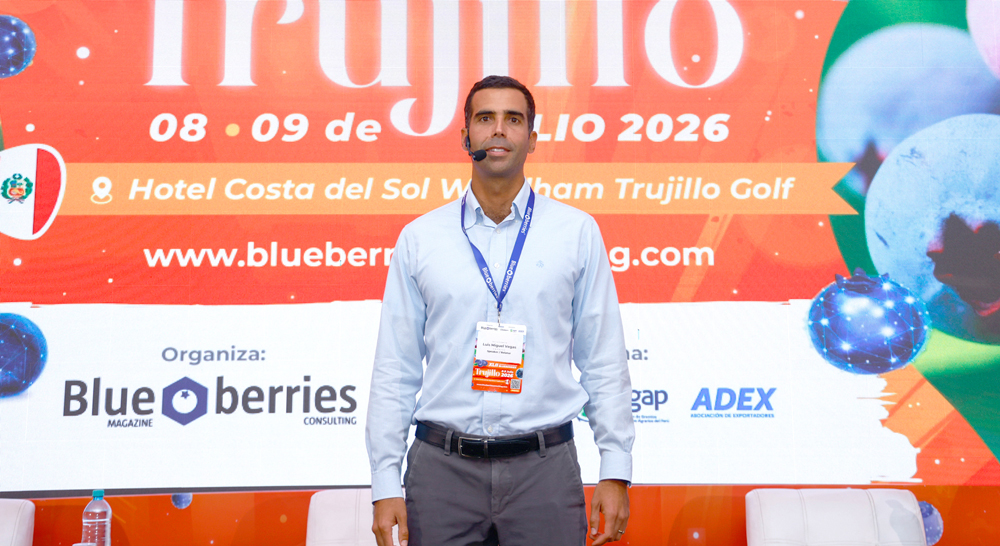
Peru began the 2026–2027 season with higher volume than last year, but this initial surge is not enough to meet annual projections. This was the assessment presented by Luis Miguel Vegas, general manager of Proarándanos, during the XLII International Blueberries Seminar Trujillo 2026.
“Since the beginning of May to date, Peru has exported double the volume of the previous season,” he noted.
The Proarándanos weekly report, updated to week 26, specifies that progress: 11.126 tons exported, 114% more than in the same period of the 2025–2026 campaign.
A higher start, but not the final one
For Vegas, the early growth shouldn't be interpreted solely as a sign of higher volume. It also shows that Peru is beginning to extend its production season, a necessary condition for an industry that will continue to increase its supply and cannot concentrate all its fruit during the peak weeks.
“If Peru is going to continue growing, we have to extend the harvest, bring it forward, and spread out the fruit harvest from September, October, and November,” he stated.
May and June, which previously had less weight in the Peruvian production curve, are beginning to gain importance. This change is due to pruning practices, improved nutrition, new production areas, and varieties with a greater capacity for earlier harvests.
At the outset, Vegas highlighted the importance of Sekoya Pop, which accounts for nearly a third of early shipments. The weekly report from Proarándanos also confirms its strong presence in the United States, where it represents half of the volume shipped through week 26.
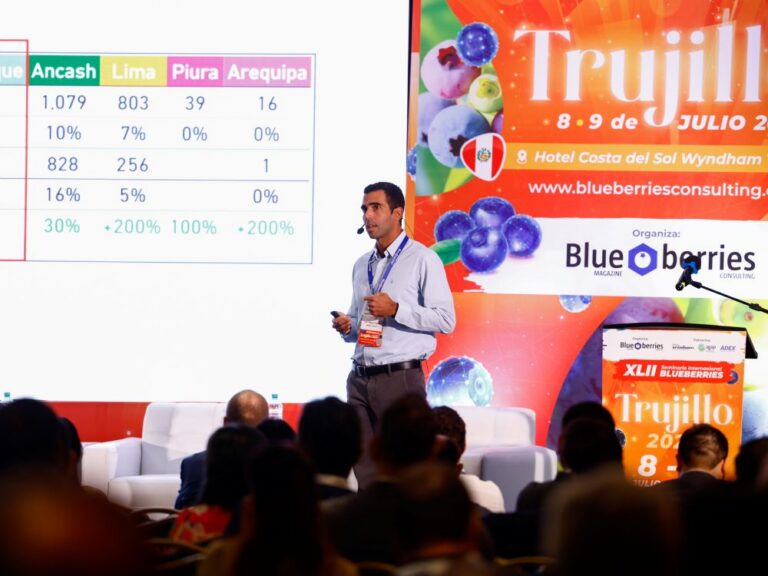
The regional analysis also reveals differences. Ica's share of shipments has risen from approximately 3% in the same period last year to nearly a quarter of current shipments, while Lambayeque's volume is lower than in the same period last year. For the industry, this difference confirms that the campaign cannot be analyzed solely from a national perspective: it will be necessary to examine regions, varieties, and specific distribution windows.
Luis Miguel Vegas International Seminar Blueberries Trujillo 2026 © Blueberries Consulting

The Child changes the way of projecting
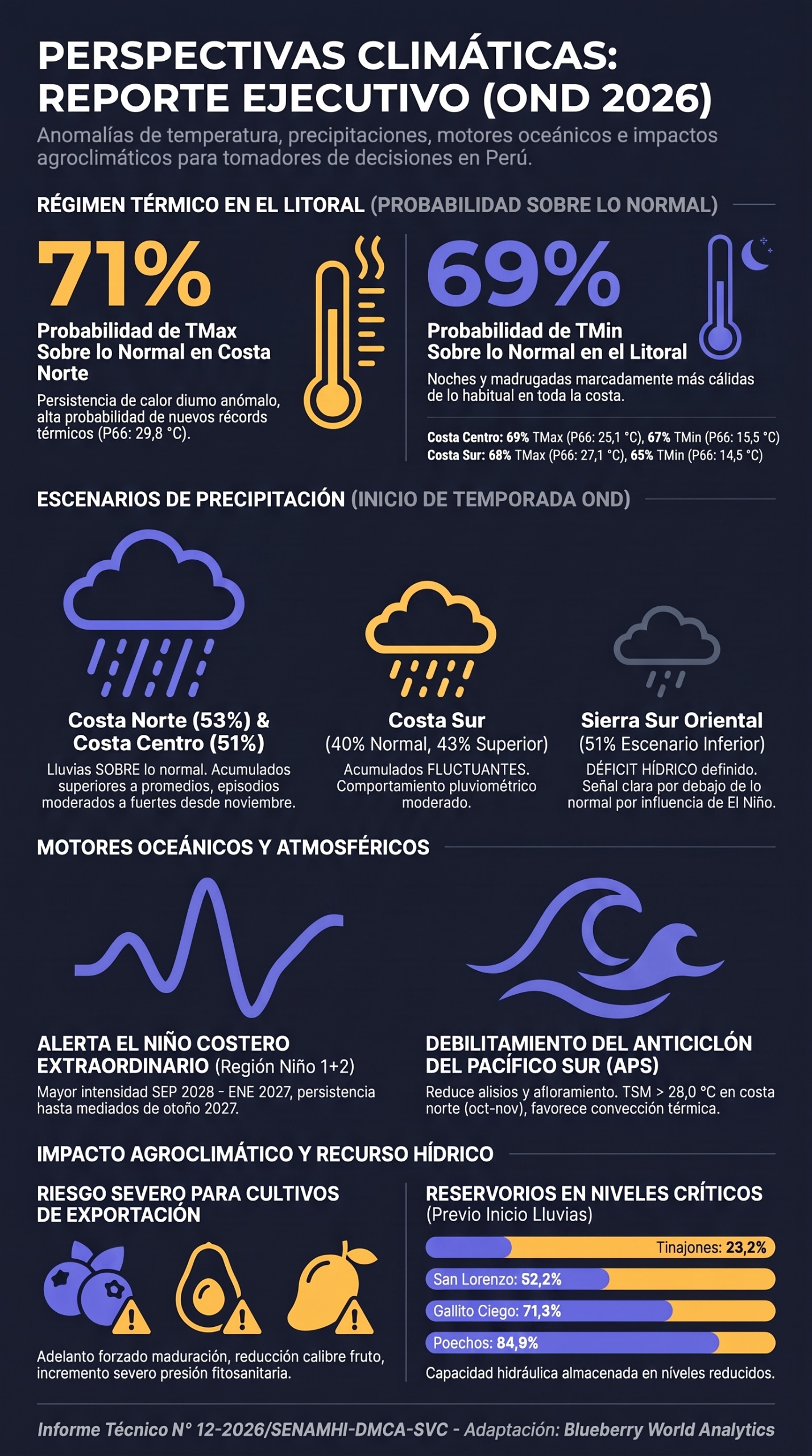
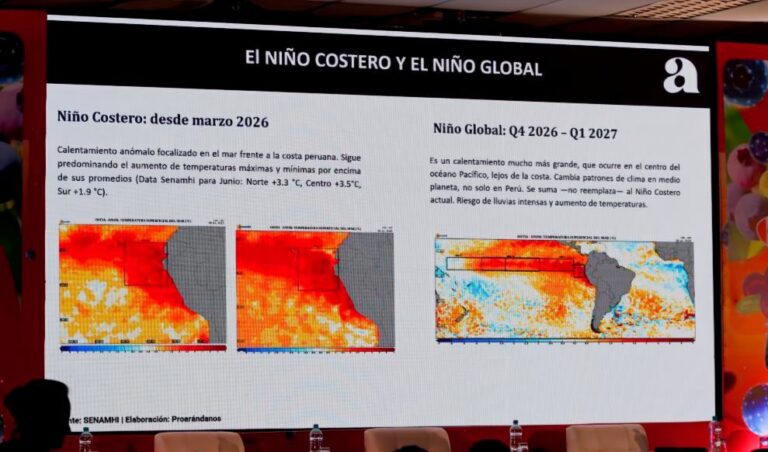
Vegas's main concern is the climate. He explained that the coastal El Niño effect, which began in March with the warming of the sea off the Peruvian coast, is compounded by the development of a global El Niño, which could prolong above-average temperatures.
According to Vegas, the initial phase doesn't yet fully reflect that impact, because it's due to pruning and management practices implemented months earlier. The greatest uncertainty lies in what's to come.
The general manager of Proarándanos indicated that the most noticeable impact could appear starting in September, when intermediate varieties or those with higher chilling requirements become more prevalent. Therefore, the association will not yet provide a full campaign projection.
“We haven’t yet released a full campaign projection because there is still uncertainty about the impact the weather will have towards the end of the campaign,” he said.
Instead of issuing a full annual estimate through April, Proarándanos will work with shorter timeframes. Vegas explained that the next forecast will cover the following 10 weeks, until the first week of September, and that monthly updates will follow.
For producers and exporters, the message is that a good start doesn't guarantee that the entire potential volume will translate into exportable fruit of sufficient size, health, and condition. The season must be monitored with up-to-date information, not just a general projection.
International Blueberries Seminar Trujillo 2026 © Blueberries Consulting

Size, condition, and varieties under pressure
One of the most sensitive points of the discussion was the effect that the weather can have on the upcoming fruit harvest. Vegas mentioned risks associated with insufficient chilling, inhibited flowering, delays in certain varieties, reduced fruit size, disease pressure, and a lower exportable percentage.
One of the examples mentioned by Vegas was Ventura, a variety sensitive to lack of chilling temperatures and still significant in Peruvian cultivation. The Proarándanos acreage report, compiled using SENASA data, records 5.437 hectares of Ventura, representing approximately 19% of the country's total cultivated area.
This data is important because El Niño will not affect all varieties equally. Some may experience delayed growth; others may face size or condition issues; and in some cases, the effect could be felt in the exportable percentage.
Vegas also warned that higher temperatures can accelerate plant growth and lead to fruit being harvested before reaching the size required for certain commercial programs. It's not just about producing more kilos, but about maintaining the attributes that allow the fruit to command a higher price at its destination.

Luis Miguel Vegas International Seminar Blueberries Trujillo 2026 © Blueberries Consulting
The United States leads, and growth will demand more destinations
Another significant change is in the markets. In previous years, the first months of the Peruvian campaign saw a higher participation from China. This year, however, the United States took the lead at the start.
According to Proarándanos' weekly report, as of week 26, the United States accounted for 3.993 tons, equivalent to 36% of the total exported volume. China, on the other hand, reached 1.426 tons, with a 13% share and virtually unchanged growth compared to the same period last year.
Vegas explained that the United States has shown strong performance, supported by increased consumption and the arrival of high-quality fruit. However, he cautioned against viewing this growth with caution, because the Peruvian market is still based on a small volume and coincides with local US production.
In China, the situation is different. The market remains important, but it faces a structural shift: its local production is growing and accelerating its production schedule. This doesn't eliminate opportunities for Peru, but it does raise the bar.
“There is always a place for Peru, but only for good quality fruit, fruit with the highest standards,” he stated.
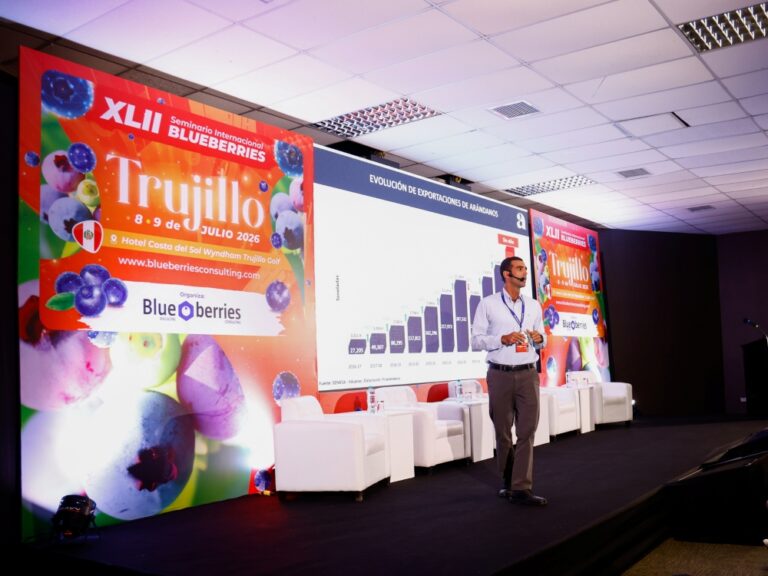
Luis Miguel Vegas International Seminar Blueberries Trujillo 2026 © Blueberries Consulting
Before concluding, Vegas outlined Peru's potential. He explained that, in a scenario without El Niño, the harvest could have reached close to 490.000 tons, equivalent to a 25% increase in volume. However, he clarified that this will not be the expected scenario for this season, precisely because of climate uncertainty.
The production base explains why this potential exists. Proarándanos' acreage report indicates 29.127 hectares cultivated for the 2026–2027 season, concentrated mainly in La Libertad, Lambayeque, and Ica.
Therefore, Vegas also emphasized the need to develop more destinations. If Peru continues to expand its offerings, it cannot rely solely on the United States, Europe, and China. In this context, he highlighted Latin America's potential due to its proximity and mentioned ongoing developments or openings in markets such as Egypt, New Zealand, and Japan.
For producers and exporters, the underlying message is that growth is no longer solely about acreage or tonnage. The 2026–2027 season will have to be analyzed in terms of different phases, varieties, regions, and destinations. In a year marked by El Niño, the outcome will depend on how well the industry manages to transform its production potential into exportable fruit with the necessary size, health, condition, and market opportunity.

Luis Miguel Vegas International Seminar Blueberries Trujillo 2026 © Blueberries Consulting
ARTÍCULOS RELACIONADOS