Overview of the global blueberry market
The global market of blueberry It is experiencing a period of reduced availability and high prices in several European markets, coinciding with the transition from production in the Northern Hemisphere to supply from countries in the Southern Hemisphere. Limited availability and high prices are being recorded in the Netherlands and Germany, while Austria and Croatia show more stable market conditions. In Italy, consumption of blueberries It continues to grow, driven by varietal development and expanding demand in large-scale distribution.
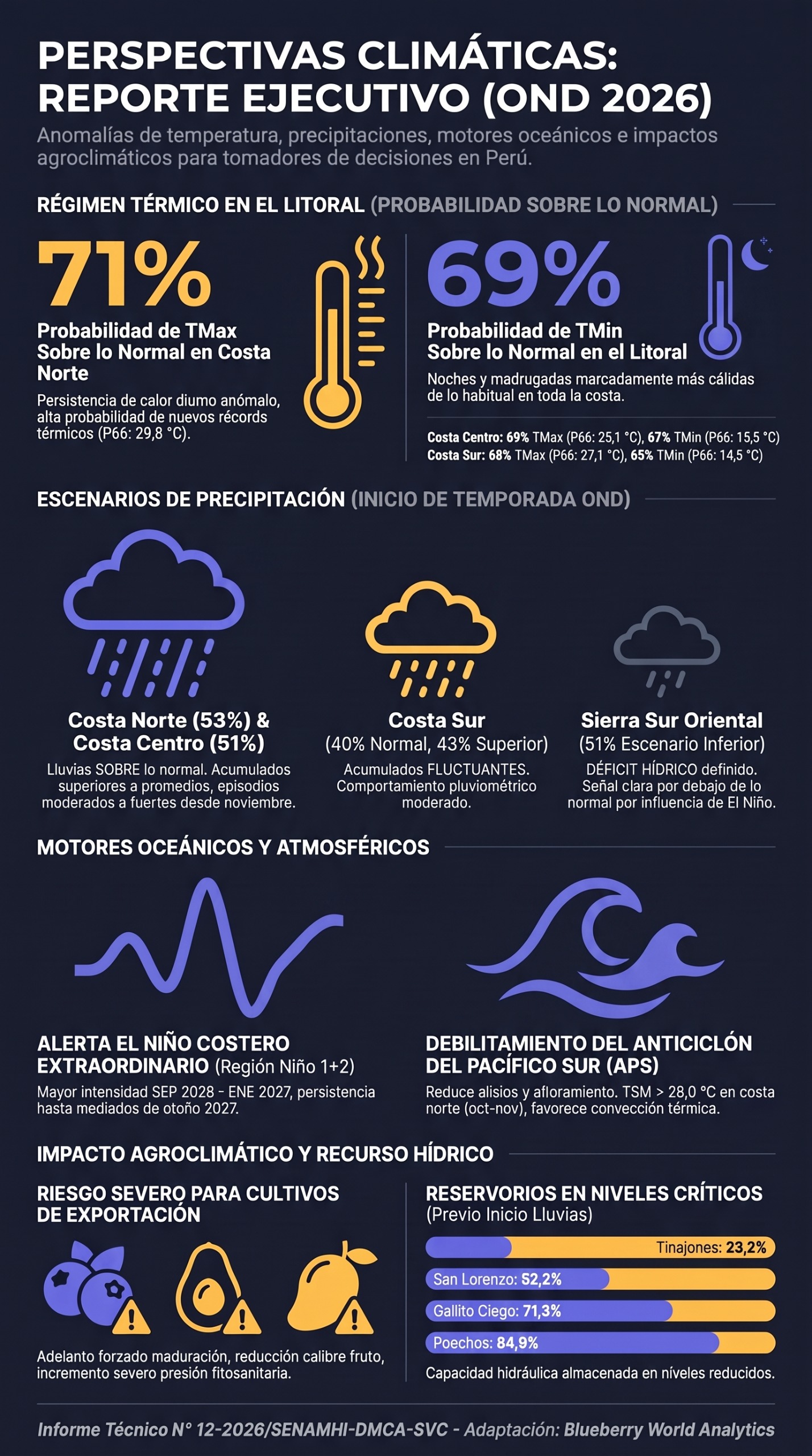
Meanwhile, Peru has revised its export forecasts downward due to the effects of El Niño, with a decrease in shipments expected in the coming weeks. South Africa has had a favorable start to its season and hopes to benefit from reduced Peruvian supply to support prices. In Mexico, Peru, and Morocco, rising production and labor costs, along with difficulties related to water availability, continue to put pressure on producers.
The Netherlands: lower supply and persistently high prices
“Since the start of the overseas season, supply has been limited. Prices have remained high, although we haven't seen the peaks recorded in previous years,” notes a Dutch importer.
“On the contrary, prices have remained high for several consecutive weeks, resulting in an unusually high average price. Fortunately, supermarkets are beginning to understand that they must pay market prices to ensure supply. We don't expect significant changes until the Chilean fruit arrives. The last weeks of November and the first two weeks of December are already shaping up to be more challenging than the current situation. We hope that Chilean exporters will be able to ship within the planned timeframes, so that sufficient volumes reach retailers before Christmas.”
Quality has also presented a challenge.
“El Niño has affected the fruit. Firmness and post-harvest life have been particularly difficult aspects to manage in the blueberries “These products come from South America, South Africa, and Zimbabwe. Customers should be informed weekly that the product may behave differently, and even then, unexpected inventory management issues may arise. Quality can vary considerably from batch to batch,” the importer adds.
“Generally speaking, it’s a demanding market that requires close and constant monitoring, but that’s also what makes the product interesting. blueberry It's a natural product, and if its marketing were simpler, many more companies would participate in the business. That's where experienced operators can make the difference.”
“With less fruit available, marketing companies have smaller volumes to offer. In the current tight market, we are seeing a growing number of producers opting to sell directly rather than through marketing companies. Is this decision driven solely by price, or are they assessing relationships with a view to the coming years, when volumes are expected to increase again? Nobody knows for sure, but it will be interesting to see how the market evolves.”

Italy: consumption and market development are growing
The market of blueberry It is experiencing strong growth, with consumption estimated to increase between 50% and 150% in just two years, both in Italy and globally. In more mature markets, such as the United Kingdom and the United States, individual consumption already exceeds one kilogram per year, while in Canada it is approaching three kilograms per capita.
According to the source, this growth is driven by the qualitative leap of new varietal selections with good organoleptic characteristics and by the convenience of a ready-to-eat fruit with no waste.
Genetic programs such as Sekoya, the Eureka family and the Australian varieties IQ Berries offer large sizes, marked aromatic profiles and a preservation capacity that, according to the original note, can extend between 45 and 60 days, reducing deterioration during the logistics chain.
To ensure a continuous supply to large retailers for 52 weeks a year, production from the Italian regions of Piedmont, Veneto and Sicily is complemented by partner fields located in Bulgaria, Romania, Serbia, Turkey, Egypt and Georgia.
Good post-harvest preservation allows for exports to continental Europe, Russia, and the Middle East by sea, through the ports of Genoa and Venice, as well as to high-demand markets such as India and the United Arab Emirates by air. China, however, remains temporarily excluded from these programs due to the absence of bilateral phytosanitary agreements.
Packaging is done directly in the countries of origin or at the platform located in Piedmont, using different formats of sealed containers up to 500 grams, with emphasis on premium lines that reach higher prices and sustain a total turnover of close to 20 million euros annually.
According to YouGov data for the year ending in August 2026, the blueberries They are purchased by 38% of Italian households, almost 10 percentage points more than two years ago.
The frequency of purchases is approximately eight times per year per household, while the average expenditure per purchase exceeds €3,70 and the volume purchased per purchase surpasses 300 grams. Supermarkets are the main distribution channel, while the organic segment continues to have a limited market share.
Spain: Lower availability keeps prices high
The Spanish season of blueberries It has finished in Huelva, the country's main producing area, and is practically finished in the northern growing areas as well.
Spanish operators are currently importing blueberries primarily from Peru, with smaller volumes coming from South Africa and Zimbabwe. The reduced availability from Peru is cited as the main factor behind the sharp increase in market prices.
The season had started with expectations of a more abundant harvest, but forecasts were revised downwards week after week due to the effects of El Niño.
“We are talking about practically half of the Peruvian production available compared to the initial forecasts,” says a Spanish importer.
In approximately 15 days, a major operator in the sector will begin harvesting blueberries Ultra-early crops in Huelva, although initial volumes will be limited and would gradually increase during December.
Spanish supply is not expected to reach significant volumes before the end of January. Meanwhile, Peru will continue to be the main supplier to the Spanish market, although with volumes considerably lower than usual.
Chilean imports are expected to begin in mid-December. Until then, prices should remain relatively stable, with limited availability continuing to characterize the market.

Germany: lower supply and rising prices
The German market of blueberry It is going through the usual seasonal transition. The Northern Hemisphere campaign is nearing its end, with the last arrivals from Poland and Romania, while the blueberries Overseas goods from South Africa, Namibia, and Peru are now being packed in larger volumes.
According to an importer, the market is currently characterized by lower availability and consequently higher prices.
For now, no aggressive promotional campaigns based on large formats and low prices are expected. Instead of 500-gram packages, retailers are primarily offering 250-gram and even 125-gram sizes.
Prices gradually increased during the third quarter and, according to the importer, further increases cannot be ruled out in the coming weeks.
Austria: sufficient supply and good quality
In Austria, the blueberries They remain available in sufficient quantities and of good quality, according to the latest market report from the Vienna Wholesale Market.
The blueberries Polish fruit is still being sold on the wholesale market for 9,98 euros per kilogram, while specialist shops and retailers offer fruit from Chile, Morocco, Peru, Spain and Tunisia, among other origins, in addition to occasional volumes of local production.
Croatia: stable supply and prices
Peru is one of the main suppliers of blueberries from the Croatian market, accompanied by smaller volumes of local production and from Kosovo.
Availability remains generally stable, although the market continues to rely primarily on imports. Prices of blueberry Imported prices have remained relatively stable compared to last year, generally between 15 and 17 euros per box.
North America: Peru revises its export forecasts downwards
Peru is the main supplier of blueberries from the United States and Canada at this time of year. Export forecasts were revised downward due to a stronger-than-expected El Niño impact.
The outlook for the Peruvian 2026/27 season has weakened considerably, despite shipments during the first few weeks being well above the levels of the previous year.
The blueberry growers' association Proarándanos has lowered its forecast for the entire season from the 382.000 tons estimated in September to around 366.000 tons in October, a further decrease of 4,2%. This would put exports 4,4% below the previous season, despite having a cultivated area approximately 15% larger.
The campaign began earlier than usual, with higher temperatures accelerating crop development. Initial shipments to the United States were particularly strong, reaching approximately 70.000 tons by week 39, a 26% year-on-year increase. However, these initial volumes did not reflect the expected performance for the remainder of the season.
During the next eight weeks, exports would reach approximately 108.000 tons, compared to 156.000 tons last season, representing a drop of 31,2%.
Instead of registering a pronounced seasonal peak, weekly shipments would stabilize at around 13.500 tons. By week 39, exports had already reached only 12.400 tons, 39% below the previous year's level.
Organic supply would also remain particularly restricted, with exports for the entire season estimated at around 24.900 tons.
Mexico: varietal replacement and export diversification
The Mexican sector of blueberry Aneberries projects a production of close to 90.000 tons in 2026, of which around 75.000 tons would be destined for export.
The United States remains the primary destination, favored by its geographic proximity and Mexico's spring supply window. Michoacán, Jalisco, Baja California, Guanajuato, and Sinaloa are the main producing regions.
The sector is making progress in varietal replacement, with greater attention to fruit firmness, flavor, post-harvest life and post-harvest quality.
Exporters are also looking to expand their sales into Europe and Asia, while rising production costs continue to be a concern for the industry.
Morocco: High temperatures affect blueberry cultivation
Morocco exported around 89.000 tons of blueberries fresh produce during the 2025/26 season, 6% more than the previous year.
The expansion of the cultivated area made it possible to compensate for the yield losses associated with adverse production conditions.
Recent heat waves affected crops in Agadir, where temperatures under tunnels reached 46°C, causing heat stress and foliar damage.
Production conditions in Kenitra and Larache were more favorable, although some fields in those areas also registered heat damage.
Water availability, varietal choice, and crop nutrition continue to be among the top aspects of focus for growers as they prepare for the next phases of the production cycle.
South Africa: Favorable start to the season
Season blueberries In South Africa, the season got off to a favorable start. Last year, frost reduced the harvest in the northern producing regions by approximately 2.000 tons, while this year the start has been positive, with volumes in line with expectations in all regions.
Total production destined for export is estimated at 27.000 tons.
News from Peru regarding the impact of El Niño on the volumes of blueberries These figures are considered “very positive” for the South African sector, according to an industry representative. The expectation is that producer prices could benefit from a less supplied market in Europe and the UK.
“We are very optimistic about the upcoming season, and as the new plantings mature and the right varieties become established, we improve year after year. We just hope we won't be negatively impacted by the Port of Cape Town again. Port inefficiencies cost producers…” blueberries billions of rands every year.”
In the domestic wholesale market, the blueberries They are being sold at 2,70 euros per kilogram, with prices expected to decrease until November, when the South African harvest reaches its peak.
Previous article
Chilean blueberries: volume would grow 2%, but replacement varieties would increase 39%.next article
ARTÍCULOS RELACIONADOS