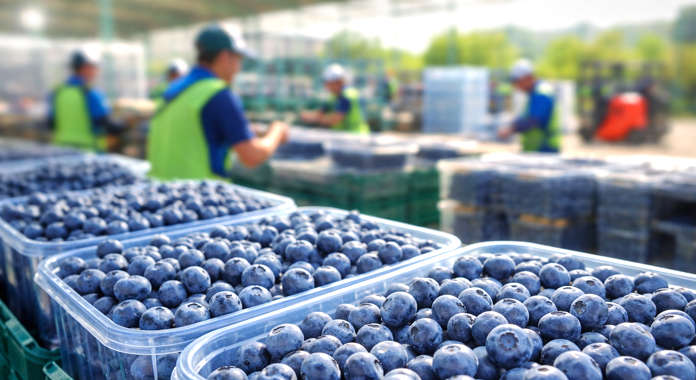
Raimundo Ortúzar, from CarSol Group: "Today the business cannot be conceived without participating the 52 weeks of the year as a retail supplier"

CarSol Group is a company founded in 1986, which distributes blueberries in North America, Europe and Asia, produced on its own farms and from associated farmers. The company is headquartered in the Netherlands, with commercial offices in the US (East and West Coast), Europe (Rotterdam) and Asia (Singapore) and access to production capacities in Chile, Peru and Portugal.
By having the capacity to offer blueberries throughout the year, the company has aroused the interest of large wholesalers to form strategic alliances, distribution networks and a large presence in the most relevant markets.
We consulted Raimundo Ortúzar, CarSol executive, about how the pandemic has affected them and he tells us that the effects have been noted mainly in the availability of people for harvesting and packingDue to the fear of contracting the disease and "because people are well covered in their needs by state aid and bonds, they do not have much interest in participating in tasks such as agriculture," he says.

What does the Chilean blueberry season look like?
- In general, we see the season optimistically although with some uncertainty due to the COVID situation, but we are convinced that by having our own commercial offices, where there is a solid commercial alliance with Guimarra Berries in the USA, we have our own marketer in Rotterdam CarSol Europe and commercial partnerships with Turners and Growers, which allows us to very well cover Asia with great strength in secondary markets outside of China, so we are in a very good footing to face any eventuality.
Today Peru drastically lowered its volumes and left the markets free of pressure that as an industry we must capitalize, correctly distributing our offer, added to a small decrease in volume that we are seeing, we should face a season without major shocks.
Today the business cannot be conceived without participating 52 weeks of the year as a supplier of the retailIn that sense, as CarSol, we have also expanded our production to Peru and the northern hemisphere in Portugal, which allows us to be present in our clients throughout the year and to analyze the business in a more comprehensive way.

What prospects and challenges do you envision for the blueberry industry in the future?
- With blueberries being a commoditized product today, within a very competitive industry, I think there are challenges that we cannot miss, such as having a focus on the quality of the fruit. A product of good quality and condition will always be better defended in complex markets, where there is no longer room for poor fruit, which is practically no longer for sale. We also have great production challenges that allow us to produce more kg / ha and of better quality, where in the equation we see that Q becomes more important every day, since P is practically constant. For this, it is also important to keep in mind the automation and control of different production and logistical processes where also as an industry we leave a lot of money on the table

Has a varietal change been noticed in Chilean production, in production or in quality?
- In general, from Chile we have not yet noticed a drastic change in varieties, we continue to work old varieties such as O'Neal and others, which are not very productive, expensive to harvest and little appreciated in the markets. Today there are groups of very good varieties in terms of production and quality, but they are still closed and difficult to access. These varieties, along with other genetic programs that are not so complex in their commercial structure, are a great tool that allows obtaining greater productions per hectare and of better quality, thus helping to make the business more profitable from the field.
The executive says that the organic market is the one that grows the most each season. "I am convinced that the industry is going in that direction, to deliver a more 'green' product to the final consumer". He comments that the demand for organic blueberries is constantly growing in the US market and higher values are achieved compared to conventional fruit, “and lately in Europe, where it was difficult to achieve a significant price difference, we already see commercial programs that are valuing the product more. organic delivering a price differential ”, he affirms.
Previous article
Agricultural Platform is created to determine the irrigation needs of crops in real timenext article
Berries ZA joins Fruit South AfricaARTÍCULOS RELACIONADOS