Xinjiang consolidates its position as a key player in China's winter blueberry market
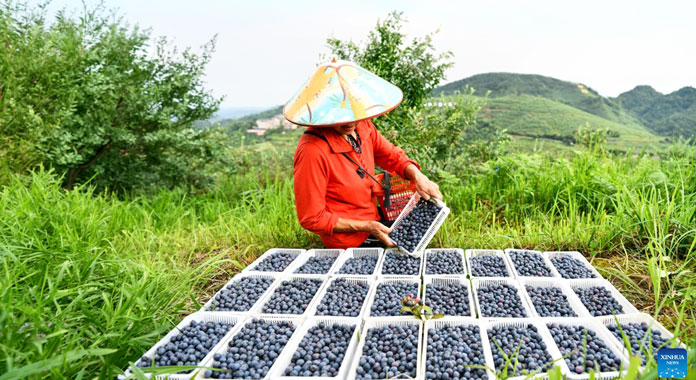
In March, the largest planting base officially began operations in blueberries of Xinjiang, developed by Xinjiang Agriculture and Animal Husbandry Investment (Group) Co. Ltd. The project is located in the Modern Agricultural Industrial Park of Moyu County, Hetian (southwest Xinjiang), and aims to position the region as one of the main winter production hubs of the blueberry in China.
With a total investment of 660 million yuan (US$95,5 million), the initiative includes 300 high-standard greenhouses. This is complemented by supporting infrastructure, such as seven water and energy supply projects, road access, and three professional cold chain and sorting centers. Together, these elements form an integrated industrial chain covering planting, handling, harvesting, storage, and transportation.
The project began in August 2025. Currently, 126 greenhouses have already completed planting, and the entire project is expected to be finished by the end of March. The first large-scale harvest is planned for November. Once all 300 greenhouses are fully operational, the Moyu complex will become one of the largest production bases of [unspecified product/product/etc.]. blueberries China's winter crop, with an estimated annual production of over 1.500 tons and an annual value of up to 120 million yuan (US$ 17,4 million).

Off-season window: a competitive advantage
Large-scale development lays the foundation for the growth of the industry. blueberry in Xinjiang, while its off-season schedule gives it a commercial advantage. blueberries Xinjiang products are mainly traded from late December to mid- or late April, with a supply window that can extend up to five months.
In comparison, other producing regions in China operate with different window periods. Yunnan supplies from November to May, although its peak season is concentrated in the beginning and middle of that period, and quality tends to decline after March. Sichuan and Guizhou supply between May and June, when competition from other fruits is high and margins are tight. Meanwhile, Northeast and East China market large volumes between June and August, usually at more affordable prices.

Climate and quality: sun, temperature range and premium attributes
Xinjiang's climatic conditions are described as a differentiating factor in quality. The region receives an average of 2.965 hours of sunshine per year, which favors photosynthesis and nutrient accumulation. Furthermore, the temperature difference between day and night—15 to 20 °C—contributes to sugar accumulation, with an estimated content of 14–16%, higher than that of most other regions. blueberries from other producing areas of the country.
The text also notes that irrigation with meltwater from the Tianshan Mountains and low levels of industrial pollution contribute to larger fruit with firmer flesh and greater juiciness. Regarding anthocyanins, it indicates a content approximately 20% higher than in other varieties. blueberries Grown in China, Xinjiang positions itself as an attractive origin for the premium segment. While other regions are gradually reducing their market presence, Xinjiang is entering its peak season and capturing a significant share of the winter market.
Prices and demand: high values with still limited supply
The combination of quality and supply window translates into solid commercial performance. Wholesale prices remain around 80–120 yuan/kg (US$11,57–17,36), while retail prices range from 160 to 240 yuan/kg (US$23,15–34,72), approximately two to three times the price of blueberries common in China. Even so, the report indicates that demand continues to outpace supply.
Sales have boosted profitability for producers. In Shache County (southwest Xinjiang), net income per mu (traditional unit of land area) is expected to exceed 50.000 yuan, and during the peak growing season, yields per mu could reach 10 times that of cotton and 15 times that of corn, attracting more producers to the crop. blueberries.
next article
ARTÍCULOS RELACIONADOS