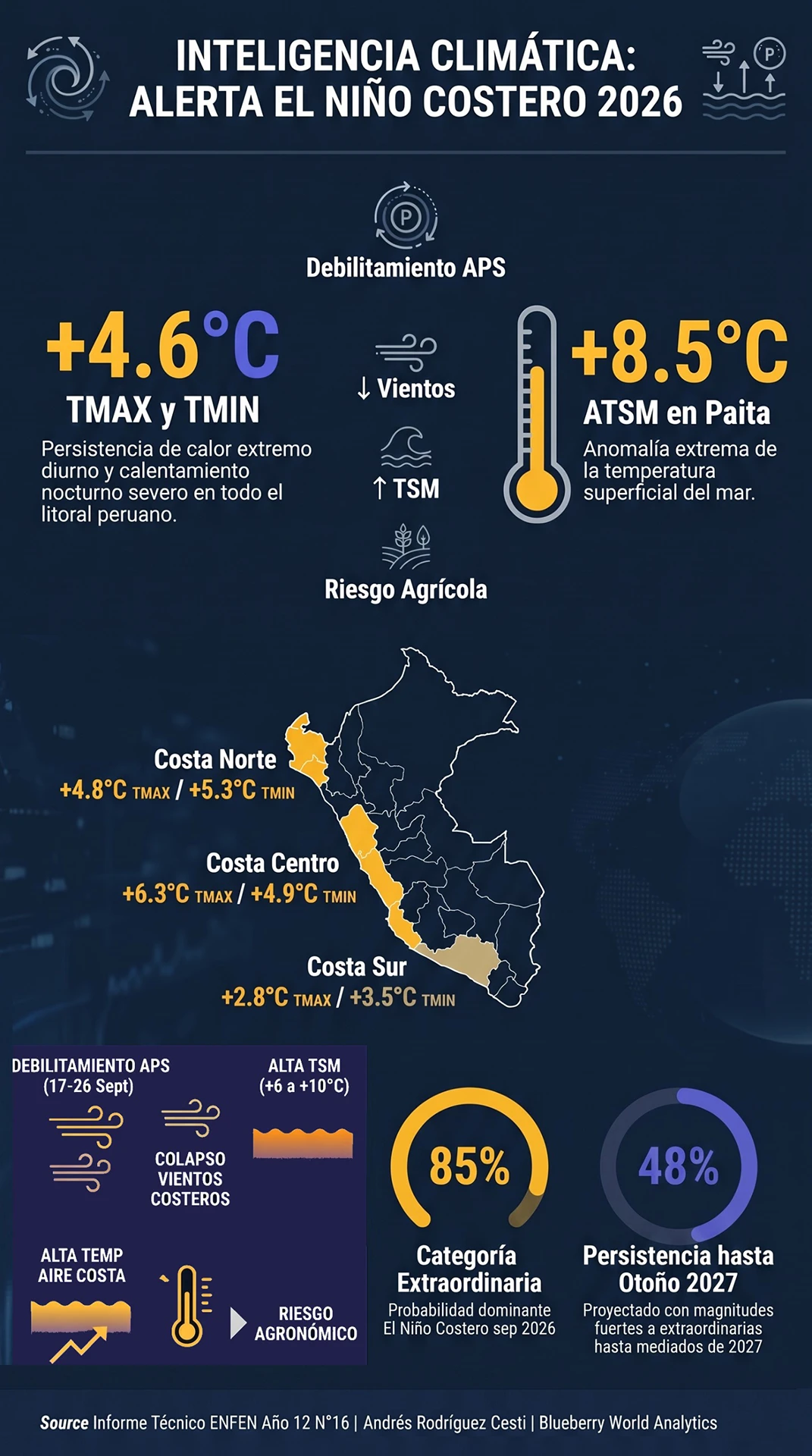
The potential development of El Niño in 2026 is once again putting pressure on the blueberry industry in South America.
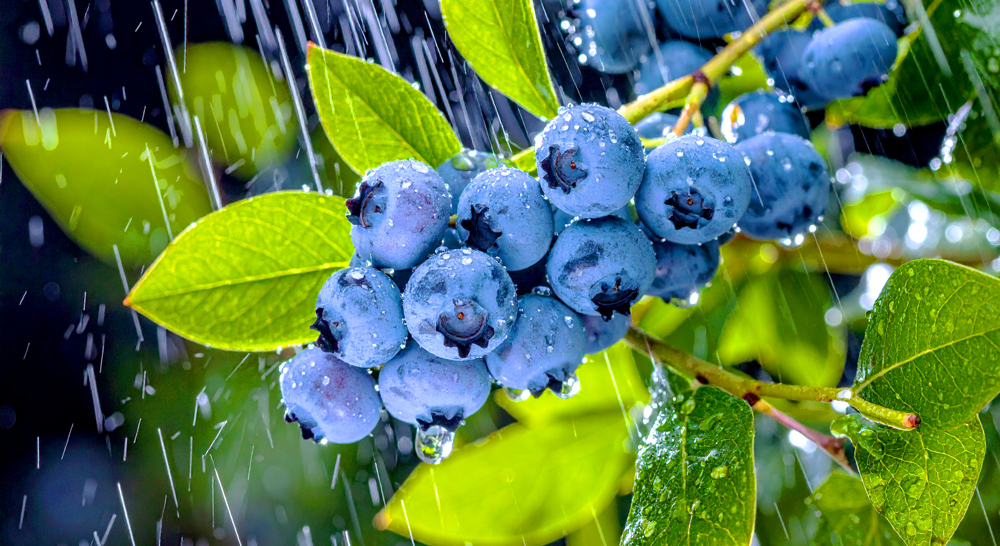
The potential development of an intense El Niño event has once again raised concerns about the risk to export-oriented agriculture on the South American Pacific coast. After years—and even decades in some areas—marked by water scarcity, the problem would no longer be solely the lack of water, but also the potential impact of heavy rainfall and extreme weather events on production systems that have adapted precisely to manage this limitation.
Official monitoring is already underway. NOAA, through its Climate Prediction Center, estimated in April that El Niño is likely to emerge between May and July 2026, with a 61% probability, and that the phenomenon could persist through the end of the year. In Peru, SENAMHI and ENFEN also warned of a likely transition to warmer conditions in the central Pacific starting in June, while in Chile, MeteoChile indicated that the phenomenon “is beginning to take shape.”
In the industry blueberryThis risk is not limited to visible damage in the field. Often, the consequences appear later: fruit with less firmness, condition problems, and a shorter post-harvest life, with commercial losses that are not always immediately apparent in the field.

At first glance, a rainier season might seem like good news in regions accustomed to water scarcity. But the problem isn't just the amount of water, but its intensity. Rainfall concentrated in short periods can saturate soils, damage infrastructure, and create complex conditions for production systems designed to manage scarcity, not abundance.
En blueberriesThis can translate into root stress, reduced nutrient absorption, increased disease pressure, and physiological alterations that ultimately affect fruit quality. And in an industry where much of the value is determined far from the field, at the destination, any deterioration in condition can significantly alter the commercial equation.
The risk is also in the market
The most sensitive issue lies not only in the field, but also in competitiveness. Today, the industry of blueberry It operates in a scenario where consistency is no longer a desirable attribute, but a requirement. Any significant alteration in quality or logistical continuity can quickly translate into a loss of competitiveness compared to other, more stable players.

In this context, Chile and Peru do not face exactly the same type of vulnerability. While Chile could be more severely affected by intense rainfall during critical periods of its season, Peru has continued to consolidate a different production model, supported by more stable conditions in several of its regions and by an operation designed to maintain commercial continuity. This difference becomes even more relevant in a context where both countries are already monitoring the evolution of the phenomenon through their official agencies.
Different vulnerabilities
El Niño has also historically affected Peru, particularly in severe events that impact infrastructure, temperatures, and logistics. However, the two countries' exposures differ. Chile concentrates a significant portion of its export production in areas sensitive to heavy rainfall, with logistical infrastructure that could be compromised by extreme episodes. Peru, on the other hand, faces other risks, such as thermal anomalies and potential disruptions to coastal logistics, although it has demonstrated a significant capacity for adaptation and expansion.
While Chile is observing the potential impact of a rainier winter, Peru continues to solidify its position as a global leader in the industry. This difference makes any climate disruption affecting quality, fulfillment, or continuity of supply in the region all the more significant.

Anticipating is not enough
The advantage is that a phenomenon of this nature doesn't appear without warning. Today, climate monitoring allows us to anticipate scenarios further in advance than we could a few decades ago. NOAA has already estimated a significant probability of El Niño developing during 2026, while in Peru and Chile, official agencies are also monitoring its potential regional effects. But anticipation is not the same as being prepared.
In that context, the industry of blueberry It should carefully review drainage, soil management, preventative phytosanitary strategies, logistical protocols, and response capacity to potential operational disruptions. In a market where the margin for error is increasingly smaller, resilience is also becoming a competitive advantage.
A test of resilience
An intense El Niño event could end up being much more than just a weather phenomenon. For Chile and Peru, it could also become a test of productive and commercial resilience. The blueberry business is no longer solely about genetics, productivity, or costs: it also depends on the ability to respond more effectively to uncertainty.
Read also:
The 2026 Coastal El Niño: a test of maturity for the Peruvian blueberry
From growth to resilience: the global blueberry industry facing climate change
Previous article
New blueberry operation in Peru aims to supply global marketsARTÍCULOS RELACIONADOS