Agricultural association calls on Chile to "react" on irrigation: "We visited Peru and were amazed by what they have achieved"
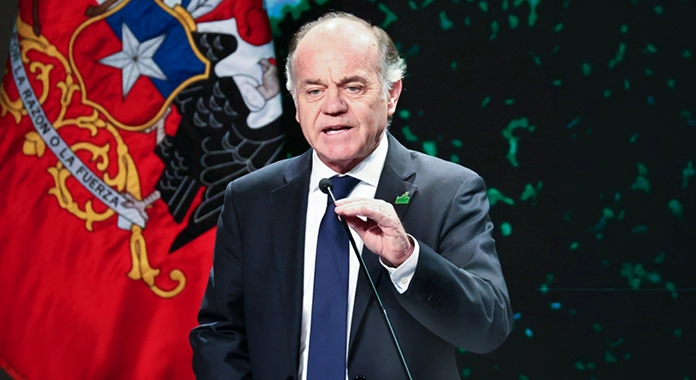
During the National Agricultural Meeting (Enagro 2026), the president of the National Agricultural Society (SNA), Antonio Walker, called for accelerating investments in irrigation infrastructure and promoting a water policy that allows for expanding the country's agricultural area, taking Peru's progress as a reference.
Before more than a thousand attendees gathered at the Metropolitan Santiago, in Vitacura, and with the presence of President José Antonio Kast and the Ministers of Finance, Jorge Quiroz; Agriculture, Jaime Campos, and the General Secretariat of the Presidency, José García Ruminot, the union leader warned about the challenges facing the sector and the need to make decisions to take advantage of Chile's productive potential.
"During 2024 and 2025, agriculture grew faster than the national economy. However, this year the signs of a loss of momentum are evident and we must look at them carefully," Walker said.
The president of the SNA noted that the sector's performance is mixed. While nuts maintain reasonable prices, meat prices have recovered, and the dairy sector remains stable, other sectors continue to face difficulties, including wine, traditional crops, sugar beets, the forestry sector, and some fruits.

He added that this scenario is compounded by international uncertainty and the rising cost of essential inputs and services for production, such as energy, fertilizers, agrochemicals, and logistics.
"Not all of these factors are within our control. But there are many others that we can influence," he stated.
Peru's progress
One of the main focuses of the speech was water availability and the need to expand irrigated land in Chile. In this regard, Walker cited Peru as an example, following a visit he made last week with the Minister of Economy and Mining, Daniel Mas.
"Last week we visited Peru together with the Minister of Economy and Mining, Daniel Mas, and we were amazed at what they have achieved thanks to a tremendous public-private partnership with an investment of US$24 billion. They plan to irrigate 2,6 million hectares, while Chile will continue irrigating the same 900.000 hectares if we don't react," he stated.
According to the leader, the Peruvian experience demonstrates the importance of coordinating the public and private sectors to develop large-scale water infrastructure projects. Therefore, he insisted that Chile needs a water policy and to move forward with initiatives that will allow it to expand its agricultural frontier.
In that context, Walker thanked the Minister of Agriculture, Jaime Campos, for his work in promoting irrigation projects. "He teaches us about agriculture and also about politics very often because of the tremendous effort he has made to advance this agenda of growth for large irrigation projects," he said.

The president of the SNA also highlighted the "Irrigating the Desert" project, an initiative that seeks to develop a 200-hectare pilot project in Copiapó using desalinated water, with the goal of converting desert lands into productive areas.
"We have the potential, the technology, and the capacity. What we need is the decision and the will to move forward," he said.
The proposal, he added, seeks to demonstrate that mining and agriculture can complement each other in the north of the country and contribute to safeguarding water intended for human consumption.
"Without water there is no agriculture. And without agriculture there are fewer jobs and little regional development. And most importantly: there is no food," he emphasized.
The end of his time at the head of the SNA
The speech also had a personal component, as Walker noted that this was the last edition of Enagro that he would be leading as president of the National Agricultural Society.
"Friends: this Enagro has a very special meaning for me. It is the last one that I will be leading as president of the National Agricultural Society," he said.
In his assessment, he recalled his career in the sector, both as a farmer and union leader, as well as during his time at the Ministry of Agriculture and his current role at the SNA. He also highlighted his contact with producers of varying sizes throughout the country.
"I have had the privilege of traveling throughout Chile and experiencing its agriculture from many perspectives: as a farmer, as a union leader, as Minister of Agriculture, and now as president of this historic institution," he stated.
Walker recalled the difficulties the industry faces, from frosts and droughts to fires and crime, but also praised the producers' ability to innovate and compete internationally.
"I've seen them face frost, drought, fires, and crime. But also innovate, start businesses, and compete with the best in the world," he said.
He concluded by highlighting the country's agricultural potential: "And every time I travel back to Chile I end up thinking the same thing: what enormous potential our country has!"
Source: Emol.com
Read also
- “There’s no way to compete with them”: Peru’s boom dethrones Chilean agriculture and attracts national entrepreneurs
- How Peru managed to turn one of the driest deserts in the world into a major food production center
- Rodrigo Ferreyra: In substrate, water management requires more control
- Ica is growing and demands more precision: the technical contribution of Paracas 2026 to the blueberry producer
- The new commercial phase for blueberries in Ica demands greater precision and better coordination.
Previous article
Blueberries to the UK: FPC warns of possible cost increases and border requirementsnext article
ARTÍCULOS RELACIONADOS