Mohamed Alamouri: "Larache has exceptional water quality for growing berries."
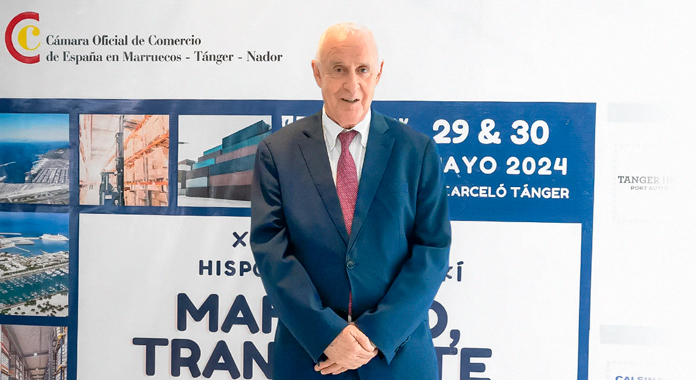
The country has become one of the world's leading exporters of these products, with a potential market of more than 300 million consumers. Mohamed Alamouri, President of the Moroccan Interprofessional Federation of Red Fruits Interproberries Maroc, explains how this sector has developed.
The cultivation of strawberries, raspberries, and blueberries has become one of the main agricultural attractions of northern Morocco. Its privileged climate, with more hours of sunshine per year than in Europe; the extraordinary quality of the waters in the Larache region; and a key geostrategic location, at the gateway between Africa and Europe, with a series of logistical infrastructures that accelerate the export process, are the factors that have led the country to become a global powerhouse in the sector.
Currently, Morocco dedicates more than 12.300 hectares to berry cultivation, of which only 2.500 are strawberries, which were the first of its kind to arrive in the country. In recent years, raspberries, first, and more recently blueberries, have captured the largest market share. Furthermore, the country has become one of the world's leading exporters of berries to numerous European countries.

To learn more about the implementation of this sector in the agricultural region of Larache, Atalayar spoke with Mohamed Alamouri, a man with extensive experience and knowledge of this sector, who currently chairs the Moroccan Interprofessional Federation of Red Fruits, Interproberries Maroc.
The berry sector has a long history in Morocco and is known for its excellent quality. What were its origins?
Red fruit production in Morocco is not a new development: it began to be cultivated in our country in the 80s in Agadir. The first crop to be cultivated was strawberries. Then, starting in 2005, raspberry cultivation was introduced. And more recently, since 2008, blueberries have been introduced, which currently command a larger market share. It should be noted that the northern region of Morocco, where this sector began to develop, is an area with abundant, high-quality water and impressively good soil.
Its Mediterranean climate, its proximity to Europe and other markets, as well as the logistical facilities available in the Tangier-Tetouan-Al Hoceima region, with the port of Tangier Med and its connectivity with that of Algeciras, are key factors that have enabled the development of this sector.
What role did the Spanish play in the arrival of this crop to Morocco?
A very important role. Several factors came together: on the one hand, Moroccan farmers, who were open to improving their standard of living and opening up to new crops; and on the other, Spanish investors, who had plans to expand berry production to northern Morocco. This is how the first pioneers arrived in our country, such as Miguel de Alconeras and then Pepe Portolés, of the company Fergar.

At the time, I was CEO of Lupus, in 1989, a position I held for about 20 years. We began developing the product, and a few years later, the Arozamena family arrived and founded the company. Natberry. Then other more or less medium and small companies began to arrive, such as Sun of the South o Albagri, and a bigger monster that is Pepe Gandía, with Royal AGRIAnd finally it arrived Driscoll's, who bought Alconeras and began growing strawberries, raspberries and blueberries in the American style, with his genetics and methods.
From there, how did the berry sector in Morocco begin to organize itself?
We organized ourselves as a profession because we wanted the sector to be sustainable, safe, and high-quality from a food perspective. Therefore, over the years, a number of cooperatives, some of them Moroccan, have been established, which has allowed berry production to increase considerably, making it necessary to find a number of markets to sell them.
For a few years now, European supermarkets, especially English ones (when England was still part of the European Union), have begun to take an interest in our production. They inquired about quality, food safety, labor standards, and so on. We took great care to obtain all the necessary social quality certifications to comply with the surprise audits they sent us. And so we established a level of quality and stability in the market, which allowed our berry production to be accepted in countries like England, Germany, Belgium, the Netherlands, Luxembourg, and even Spain—but in this case, not for consumption, but for redistribution.

What are your relations like with your Spanish counterparts?
We've always maintained a good relationship with them. We've been present at the forums held in Huelva with our friends. We've purchased from them and managed to establish a relationship of trust and reliable interaction with them. But at a certain point, political relations between Spain and Morocco began to change, and obstacles began to arise for products of Moroccan origin. We're in a market open to more than 300 million consumers, and we don't harm anyone. We have a very high-quality product, and we don't create unfair competition for anyone. It's true that labor is cheap, but that doesn't affect the cost per kilo of the product, which is determined by a series of inputs such as fertilizer, plastics, drippers, cardboard, tubs... All of this isn't manufactured in Morocco; it's imported from abroad, and that means customs and transportation costs have to be paid, and all of these costs are passed on per kilo. And labor isn't as cheap as it used to be: keep in mind that in countries like Egypt, workers are being paid much less.
Ultimately, the producer has to recover all those costs to pay their suppliers and continue their business. In any case, it's true that we continue to collaborate with Spain in many areas: handling services, refrigeration, know-how, machinery... Many of our machines are maintained by Spanish technicians, engineers who come to Larache to teach us how to do things.
What is the quality of Larache's water?
Excellent: our water is groundwater at a depth of about 80 meters, with a very low pH and excellent quality for both irrigation and electricity production. The water in our dam is abundant and sufficient even during droughts. We can boast that, in the Larache region, we are the most favored in Morocco in terms of groundwater and surface water quality.
Participate in the International Blueberry Seminars most important, and be part of the World Blueberry Tour!
To participate and learn more details about the XXXVIII Morocco Seminar 2025 enter the following link: XXXVIII International Seminar on Red Fruits
To purchase tickets click HERE
Check out the available sponsorships HERE
Previous article
Blue as part of Peru's sustainable agricultureARTÍCULOS RELACIONADOS