Potential and challenges of the fruit market in Africa

In recent years, fruit trade in Africa has experienced significant expansion. While most production is destined for the domestic market, the sector has significant potential as a source of income for agricultural producers.
Given the high economic profitability per hectare associated with various fruit crops, developing this sector sustainably presents an opportunity to optimize the use of the continent's limited resources and contribute to reducing Africa's trade deficit in essential food items.

The most important fruits produced, both in quantity and value, are plantains and cooking bananas, which serve primarily as a staple food due to their starchy qualities. The most important fruit-producing countries in Africa, based on production value, include Algeria, South Africa, Egypt, Morocco, and Nigeria.
Fruits inside and outside Africa
Fruits traded within Africa vary substantially from those traded with external partners. Among African nations, the most commonly traded fruits by value are apples, unspecified fruit juices, and bananas.
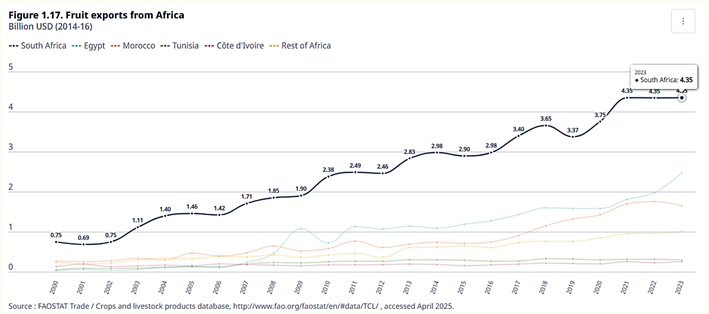
In contrast, exports to non-African destinations are largely composed of citrus fruits, blueberries, and grapes, reflecting their higher unit values in export markets. This trend is driven almost entirely by an expansion in exports from South Africa, Egypt, and Morocco, which have seen considerable growth over the past two decades (Figure 1.17).

Fruit production by 2034
According to projections for banana and tropical fruit production (detailed in Chapter 10 of the OECD-FAO Agricultural Outlook 2025-2034), the outlook for increased fruit production in Africa through 2034 is expected to be influenced by a moderate expansion of the cultivated area, coupled with persistently low productivity levels. Growth in consumption is expected to be only gradual due to limited income growth, environmental challenges, and geopolitical developments that restrict access and availability for consumers.
Therefore, the prospect of improved nutritional outcomes appears uncertain. Intra-African trade growth is expected to be facilitated by the African Continental Free Trade Area (AfCFTA) and the continued urbanization trend, which supports the development of formal fruit value chains.
Trade beyond Africa
In terms of market potential beyond the continent, South Africa is expected to continue to benefit from growing demand from the Near East, particularly from Saudi Arabia and the United Arab Emirates (UAE), and increasingly from markets in the Far East. Meanwhile, Morocco and Egypt are strategically positioned to meet the growing import demand from European markets.
Growth in fruit exports from Kenya, particularly avocados, is also expected in response to rising demand from global markets and investments in production expansion.
However, work will be necessary in key development areas for further growth in the fruit sector across Africa, including transportation infrastructure and maintaining cold chains. The challenges are particularly pronounced in landlocked countries, which face considerably greater difficulties in reaching international markets. Furthermore, limited harvest windows expose the sector to adverse weather risks that further complicate production and marketing.
SOURCE: OECD-FAO Agricultural Outlook 2025-2034
ARTÍCULOS RELACIONADOS