Peruvian blueberry production defeats seasonality with the help of genetics
The blueberry has ceased to be an agricultural commodity and has become the undisputed face of Peru's agricultural export powerhouse, a symbol of agricultural engineering and entrepreneurial vision that has rewritten the rules of global fresh fruit trade.
Exports surpassed $2,270 billion in value last season, a figure never before achieved for any agricultural product, which is not just a statistical record. It is the tangible manifestation of a bold, strategic commitment to ongoing innovation.
Peru remains the world's leading exporter, boasting the highest overall yield of 19 tons per hectare, according to an article published in the Economic Supplement of the El Peruano newspaper.
Seasonality
However, the most novel and least discussed perspective of this leadership lies not in the maximum quantity produced, but in the strategic management of seasonality through genetic conversion, a highly sophisticated internal tactic known as the plan to raise the production valleys.
The traditional narrative of agricultural exports has always focused on the magnitude of its sales peaks, the peak moments of the harvest.
For Peruvian blueberries, the bulk of exports has historically been concentrated between August and December. This temporal compression generated a twin vulnerability that threatens long-term stability.
On the one hand, the massive concentration of volume during this period inevitably produces saturation in global markets (primarily the United States, the European Union, and China). This oversupply forces producers to aggressively compete downward, putting pressure on unit prices and eroding profit margins across the entire industry.
On the other hand, this short-term dependence exposes the sector to intolerable logistical and climatic risks, as any shock (a transport stoppage, a port blockage, or a climatic event) can decimate the year's most valuable harvest. The maturity of the sector therefore demands a shift in strategic focus.
The true measure of the economic strength of the Peruvian blueberry crop is not how high its annual peak reaches, but how stable and robust its production base is during the peak periods—the months of lower activity, specifically June-July and January-April.
Strategic objective
This is where the concept of "valley elevation" takes on critical importance. This strategic objective, supported by analysis from the Ministry of Agrarian Development and Irrigation (Midagri), explicitly seeks to "reduce peaks and expand exports throughout the remaining months of a campaign."
Achieving this continuity is not merely a technical factor; it is the operational foundation that ensures systemic resilience and long-term financial sustainability. The central instrument for achieving this deseasonalization and, consequently, price stability, is the industry-driven varietal revolution.
The evolution of the genetic portfolio of Peruvian blueberries is one of the most rapid agricultural transformations ever seen in the world.
Less than a decade ago, the Biloxi variety was the backbone of production, accounting for more than 58% of certified hectares in 2016. This variety, while productive, had a very marked seasonality, tying the sector to the peak period.

Varieties
Currently, Biloxi has been strategically relegated to a secondary role (approximately 16% of the surface area), being replaced by a mix of more sophisticated and versatile genetics.
The Ventura variety has taken the lead (around 26% of the surface area), but the most profound change is evident in the rise of licensed club varieties, such as Sekoya Pop (which already exceeds 14% of the surface area).
The proliferation of more than 60 different varieties in the Peruvian countryside, an unparalleled genetic stock, is not a botanical coincidence. It is the result of a conscious business decision to diversify phenological cycles and spread production risk.
Peruvian producers invest millions of dollars annually in acquiring licenses for these new genetics.
The value of these club varieties lies precisely in their phenological plasticity: their capacity for adaptation. Through sophisticated agronomic management (pruning, irrigation, and nutrition adjustments) and the exploitation of the diverse microclimates along the Peruvian coast, growers can intentionally induce or extend flowering and fruiting periods.
This control over the plant's biology allowed Peru to extend its supply window to 52 weeks a year.
The continuity award
This unique capacity for continuous supply is what gives Peru its main structural commercial advantage over hemispheric competitors such as Chile, Argentina, and South Africa.
Large supermarkets and international retail chains, which operate under a just-in-time logistics model, don't look for seasonal suppliers; they look for permanent business partners.
Peru's ability to guarantee deliveries of high-quality fresh blueberries year-round allows the sector to sign annual supply contracts and negotiate premium prices during periods of low global supply (January to April and June to July), thus offsetting the pressure on prices during peak months.
Furthermore, the elevation of valleys has a direct and positive effect on logistics optimization. Shipping companies and air freight forwarders require stable and predictable volumes to justify frequent and efficient routes. By smoothing the export curve and avoiding the logistical shock of peak season, the sector ensures a more regular, and therefore safer and more economical, flow of cargo. This reduces delays, lowers the risk of fruit loss, and maintains shelf quality, strengthening Peru's image as a quality supplier. This represents a paradigm shift: moving from being a "mass harvest supplier" to a "continuous solution provider."

Climate resilience and structural challenges
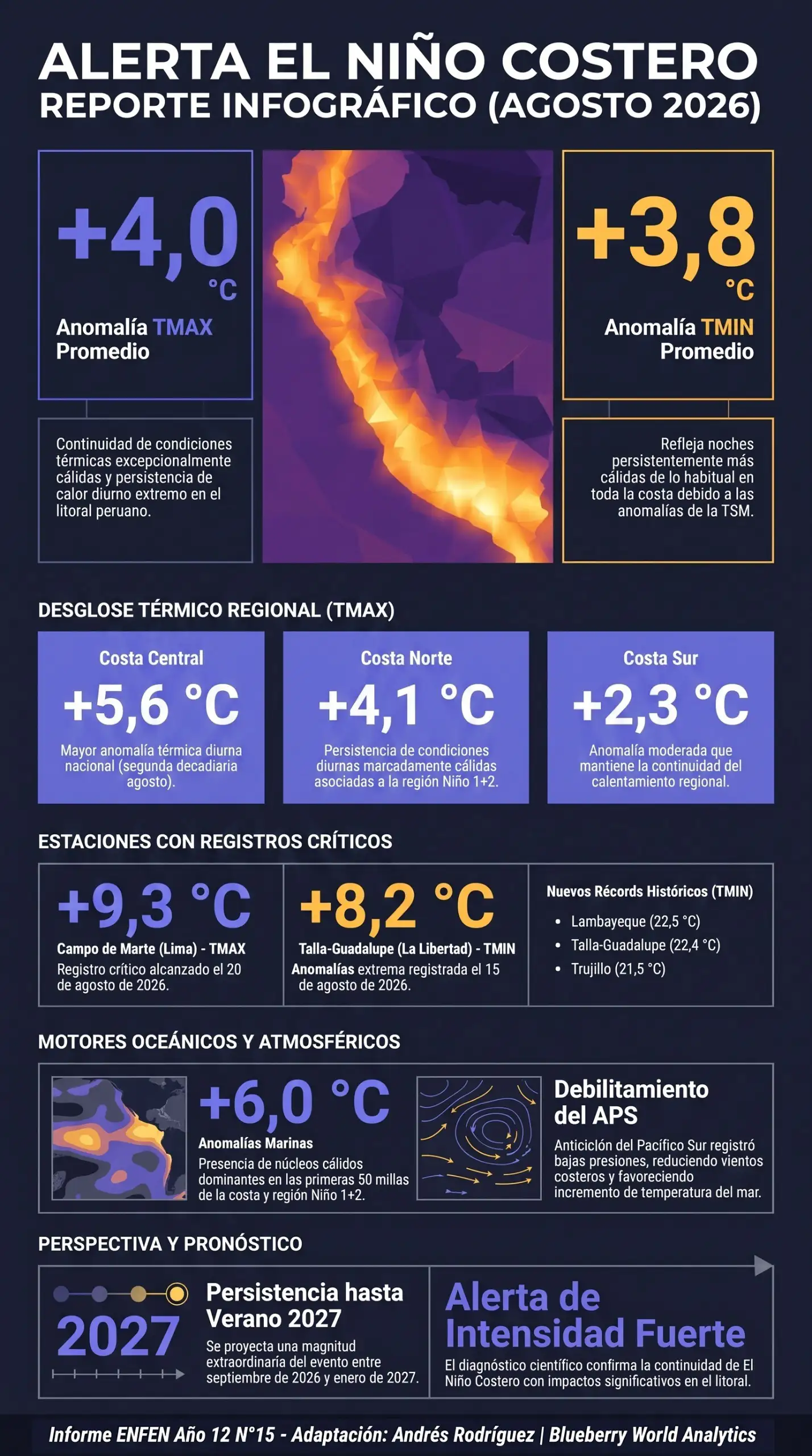
This genetic diversification not only stabilizes prices, but also acts as the most effective biological insurance against the sector's main threat: climate change and phenomena such as El Niño and La Niña.
Old, uniform varieties were extremely susceptible to extreme weather conditions.
Today, with a portfolio of more than 60 varieties with different resistance thresholds and production spread across different latitudes and altitudes, the impact on one area or specific variety can be offset by the resilience of others.
The rapid capacity to replenish volumes and project a strong recovery for the 2024/2025 season, following the severe El Niño crisis in 2023, is the acid test of this vertical stability strategy. This investment in genetics is, in essence, an investment in climate adaptation.
To sustain this complex 52-week operation, the sector also needs institutional and infrastructure support commensurate with its leadership.
Infrastructure
The productive expansion promoted by the IBO Report 2024, which positions Peru to lead global production expansion by 2025, requires continuous improvement of supporting infrastructure: from port efficiency and facilitation of customs procedures to public investment in research and development (R&D) that guarantees access to the latest water and genetic management technologies.
The State's task is to ensure that the sophistication achieved in the field is reflected in the fluidity of the export chain.
The future outlook for Peruvian blueberries, therefore, goes beyond the $2,270 billion mark. It lies in the unparalleled ability to guarantee a stable supply of the berry throughout the year, transforming an inherently seasonal product into a constant source of value.
This verticalization of supply is the model that defines the new era of national agriculture, one where resilience and ultimate profitability are built on the elevation of the valleys, ensuring that Peru's leadership in blueberries remains immutable.

Professionalization of the field
The export figures are great, but the most significant impact of the blueberry boom is being felt by people and their communities.
This high-tech agroindustry has completely transformed the role of agricultural workers. Seasonal labor is no longer enough; the real demand is for technical specialists.
Managing sophisticated drip irrigation systems, using optical sorting technology to grade fruit, and complying with international certifications are tasks that require new skills.
This is forcing our young people to seek technical and specialized training. By doing so, their market value increases dramatically, improving their quality of life and economic stability.
This qualitative leap combats rural migration, as career opportunities and decent wages now exist right where they live.
In the end, the blueberry industry isn't just selling fruit; it's cultivating skilled human capital. What we're really building is a new rural middle class, anchored in agricultural knowledge, technology, and innovation.
Facts & figures
– Despite being the world leader in volume and yield, the blueberry industry must overcome the challenge of sales concentration.
– The fact that the United States, the European Union, and China account for the majority of exports is the sector's main geopolitical vulnerability.
– Maturity now demands a focused effort on opening and consolidating secondary markets.
– Growth in destinations such as Japan, Russia, and Argentina, although incipient, is a measure of global appetite beyond traditional partners and should become the focus of investment to ensure less dependence.
ARTÍCULOS RELACIONADOS