Week 1 opens the year with a better price tone for Peruvian blueberries
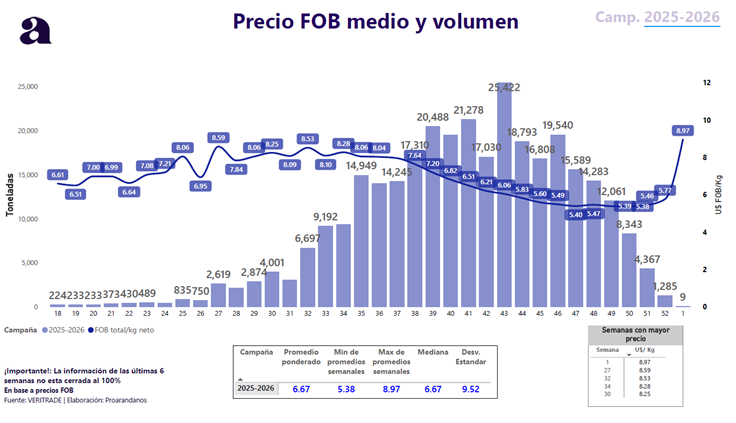
Week 1 delivers a positive sign for the blueberryWith an average FOB price that has improved compared to the start of the previous season. However, this improved performance is mainly driven by exports to "other destinations," which are registering the highest price with a very low volume of only 9 tons. Therefore, this result is not representative of the overall performance of the week or of the larger volume markets. Going forward, monitoring in the coming weeks will be key to confirming whether the market can sustain this level or if the price adjusts as the flow of fruit increases.
The report also adds a relevant element for interpreting this data with perspective. It cautions that the information for the last six weeks is not yet finalized, so adjustments to averages, minimums, and maximums may occur. This methodological precision helps to interpret week 1 with caution and maintain consistent comparisons between campaigns.

Comparison of campaigns and weekly volatility
In the historical comparison, the 2025/26 season is slightly above the weighted average of 2024/25, while 2023/24 shows higher overall levels. Beyond the average, the report's value lies in the weekly dispersion, as it reveals how wide the price range can be depending on the time of year and the intensity of the volume.
In this context, week 1 typically serves as a starting point rather than a conclusion. If the price holds, trading activity intensifies, and better conditions for programs become available. If it corrects, the focus shifts to more selective execution, where target, turnover, and condition become crucial for capturing spreads.

The gap by destination defines the outcome
The report confirms that the FOB price of blueberries varies significantly by market. The United States remains key due to its scale, Europe and the United Kingdom have their own trends, and China tends to see higher prices in specific weeks. Other destinations, meanwhile, exhibit competitive behavior and price spikes that may be relevant for diversification strategies.
For exporters, this gap by destination has direct implications. It affects the selection of export windows, the development of export programs, quality requirements, and the logistical coordination necessary to ensure the fruit arrives in optimal condition. During transition weeks, these differences tend to become more pronounced, rewarding consistency and penalizing delays or fruit that does not meet specifications.
Organic and opportunities in smaller-scale markets
The organic segment maintains a unique dynamic within the report, with a higher average price and variability that typically demands greater precision in planning and execution. For those operating in this segment, the value differential is present, but it is sustained by consistency of supply, condition, and traceability, especially when recent data can still be adjusted.
The report also identifies markets that, during this period, are registering attractive FOB prices within smaller-scale destinations. These opportunities can open up niche markets, provided they are evaluated in conjunction with logistical costs, condition risk, and business requirements. In short, week 1 starts off on a positive note and reinforces a key idea: value is built by combining destination, timing, and execution.
ARTÍCULOS RELACIONADOS