Week 1 would mark the change of pace in the Peruvian blueberry campaign 2025/2026
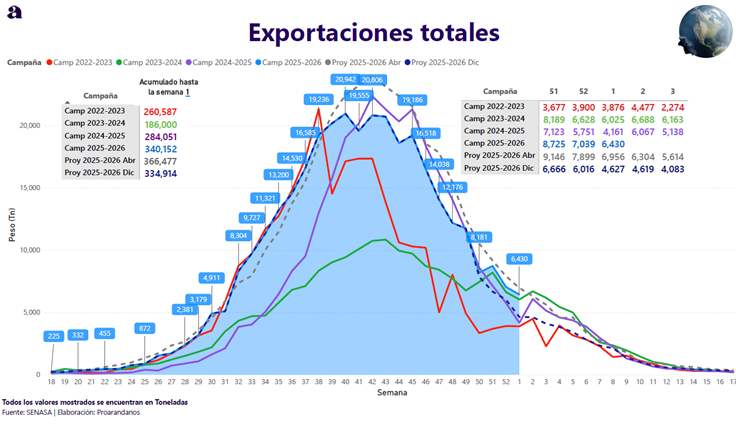
The 2025/26 campaign of Peruvian blueberry It reaches 340.152 tons accumulated by week 1, consolidating a volume that continues to have a significant impact on the market and the commercial outlook for the season. In operational terms, the accumulated figure confirms a sustained supply, which necessitates close monitoring of performance by destination and the rate of shipments.
More than just an isolated data point, week 1 becomes relevant because it helps to understand how the curve readjusts after the last few weeks of the year. At this point, the industry begins to measure in more detail the regularity of shipments and the ability to maintain schedules without compromising condition in transit.

The weekly curve enters transition
In the weekly table of the report, the 2025/26 campaign shows a progressive decline between week 51 (5.066 t), week 52 (4.224 t), and week 1 (3.932 t). This behavior is consistent with an adjustment phase, where output is leaving behind the most intense levels of the peak and beginning to stabilize.
To blueberry producers and exportersThis transition translates into a change in priorities. With a more moderate weekly flow, precision in harvesting and packing, shipment planning, and cold chain coordination become increasingly important, especially when transit times and inventory turnover at the destination become more critical.

Destinations that dictate placement
United States It continues to concentrate the majority of the accumulated total and remains the market that defines a large part of the program of Peruvian blueberryEurope maintains a leading role in the mix and remains a destination that drives placement, with high demands in consistency and compliance.
In parallel, the block of other destinations reinforces the diversification of blueberry export programexpanding the base of markets receiving fruit. In a transition phase like week 1, this point is often crucial because it requires more precise execution for each destination, both in terms of format and rotation and outbound logistics.
Operational readings for producers and exporters
With the weekly flow readjusting, the technical challenge of blueberry The focus is on maintaining condition and continuity without sacrificing efficiency. During transition weeks, performance hinges on operational details that directly impact the bottom line, such as cold chain management, processing speed, and dispatch timeliness.
The report also confirms that maritime transport remains the primary driver of exports, while air freight maintains a smaller share, sensitive to specific shipping windows and schedule adjustments. In this segment, consistency and coordination between different links in the chain tend to be more important than price spikes, as the market generally rewards regularity and on-time delivery.
ARTÍCULOS RELACIONADOS