South Africa intensifies efforts to open Japan to its blueberries
By: Natalia Rubio Iversen
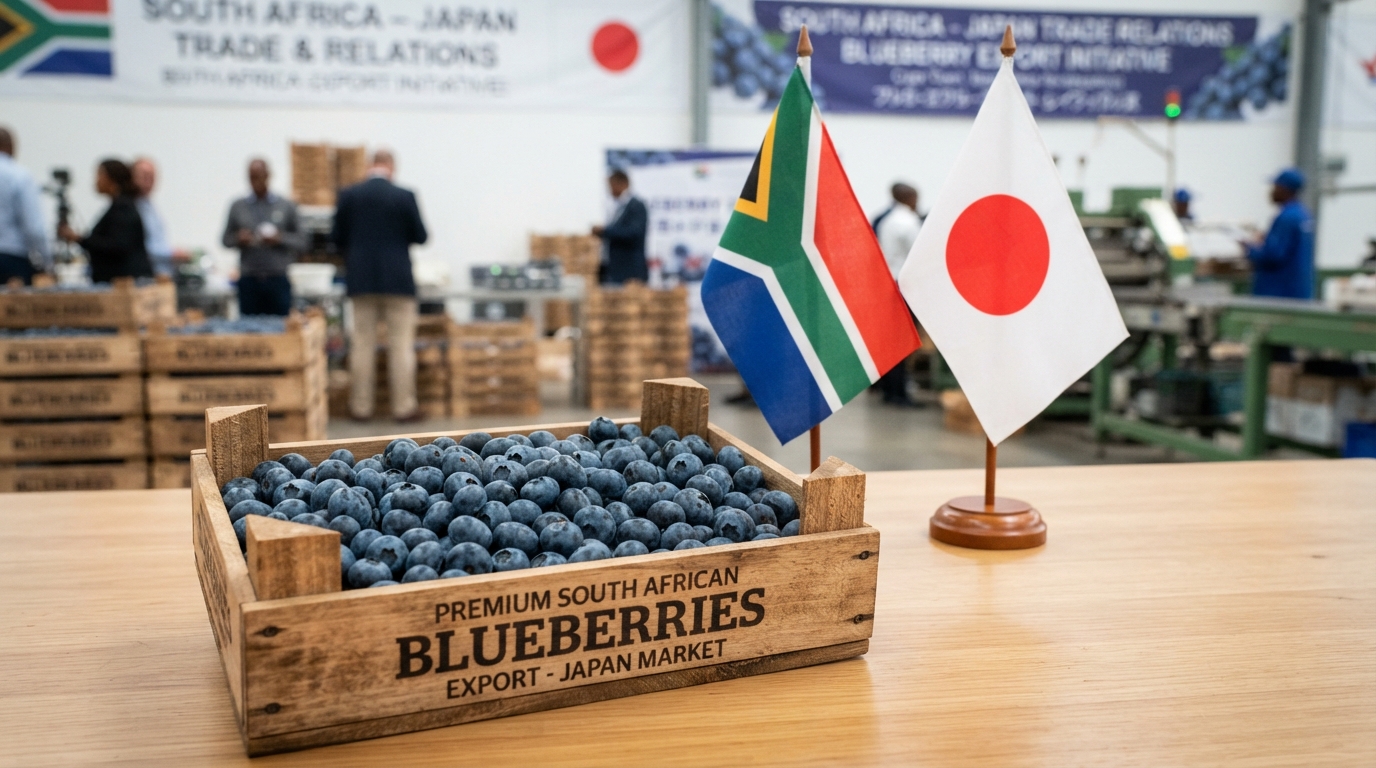
South Africa returned to Japan to try to open a market its fresh blueberries are currently barred from. The new mission brought together agricultural authorities, Berries ZA, importers, and representatives from the Japanese industry, as the market access process, formally initiated in 2022, continues.
Brent Walsh, CEO of Berries ZA, participated in the delegation led by Kelibogile Brand of the South African Department of Agriculture. The agenda included meetings with stakeholders involved in food security and plant protection, importers, and the Japan Blueberry Association, as well as a seminar held at the South African Embassy.
The process isn't starting from scratch. In 2024, Berries ZA had already participated in a mission to Tokyo that included meetings with agricultural and phytosanitary authorities and a presentation to 25 importers and retailers. Two years later, South Africa is once again targeting the Japanese market.

Access pending since 2022
Before competing for buyers, South Africa needs to resolve phytosanitary access issues.
The Japanese Ministry of Agriculture, Forestry and Fisheries (MAFF) records that the application to authorize the entry of blueberries South African fresh produce was received on June 13, 2022. Among the quarantine pests relevant to the process is the Mediterranean fruit fly (Ceratitis capitata).
MAFF's public file does not yet show that the subsequent stages of phytosanitary risk assessment and management have been completed. This process must determine what measures would reduce the quarantine risk to a level acceptable to Japan before authorizing the entry of the fruit.
The new mission confirms that negotiations are ongoing, but not that Japan has approved market access or that the application has formally advanced to a new stage. Until that happens, the Japanese market will remain a potential market, not an approved destination, for South African blueberries.

Japan: low volume, high value, and few suppliers
The persistence is better understood when looking at the market. In 2025, Japan recorded approximately 2.047 tons of imports worth US$26,1 million under HS code 081040, which covers blueberries and other fresh fruits of the genus Vaccinium. A year earlier, imports had been around 1.895 tons worth US$25 million.
Japan is small in volume compared to the major world markets, but it registers high unit import values and a highly concentrated external supply.
Mexico contributed approximately 1.321 tons in 2025; the United States, about 518 tons; and Chile, around 137 tons. Together, these three countries accounted for approximately 96% of the volume recorded under that heading.
Therefore, a potential opening would not leave South Africa with an empty market. Its exporters would have to compete in a space where the main suppliers are already established and have consolidated trade programs.
The concentration also puts the size of the opportunity into perspective. Japan can contribute value within a diversification strategy, but it doesn't have the volume to single-handedly transform South Africa's export structure.
More destinations, but also more demands
In 2025, South Africa recorded approximately 29.400 tons exported under the same trade classification. The Netherlands received around 11.000 tons and the United Kingdom around 10.000, with a significant portion of shipments remaining concentrated in Europe.
Although those markets remain central, the South African industry already sells fruit in Asian destinations such as Hong Kong and Singapore and is working to expand its presence in the region.
Japan fits into this search for alternatives. For an exporter, having more open markets expands the options for placing fruit according to week, quality, condition, and demand.
But obtaining the protocol would only be the first step.
Competitiveness will then depend on logistics, costs, and, above all, the ability to maintain condition during transit. blueberriesThat means arriving with firmness, bloom, sufficient shelf life and uniformity of quality, in addition to meeting the buyer's specifications.
Genetics also plays a role. Not all varieties respond the same way to distant markets, nor do they maintain their post-harvest condition equally. Commercial viability will depend on which varieties coincide with the weeks of supply and their ability to maintain quality during transport.
Therefore, it is still premature to speak of a clear window of opportunity for South Africa. To determine this, its harvest and shipping schedule would have to be compared with the monthly flows from Mexico, the United States, Chile, and other suppliers that provide Japan.
Only then would it be possible to know in which weeks real commercial space might exist.
South Africa has revived negotiations that began more than four years ago. Now it needs to transform those efforts into a protocol that will allow its fruit to enter the market. Only then will the second challenge arise: arriving with the necessary conditions, genetics, and competitiveness to compete in a small, demanding market already dominated by established suppliers.
Read also:
- AgroBerries aims to expand its blueberry exports in Asia
- China expands tariff-free access to African exports
- Zimbabwe accelerates its blueberry growth and marks a new export frontier in Africa
- South Africa begins blueberry season with improved export prospects
- Shanghai and Ningbo ports face delays of up to two weeks: How does this affect Peruvian trade?
- Wan Hai strengthens its operations in Peru and aims to transport blueberries to Asia
Previous article
Production Practices, Grower Concerns, and Plant Biostimulant Use: A Survey of Georgia Blueberry Growers and Implications for the US Blueberry Industrynext article
ARTÍCULOS RELACIONADOS