Thomas Fichet: “In blueberries, hormones play a key role in the plant's adaptation”
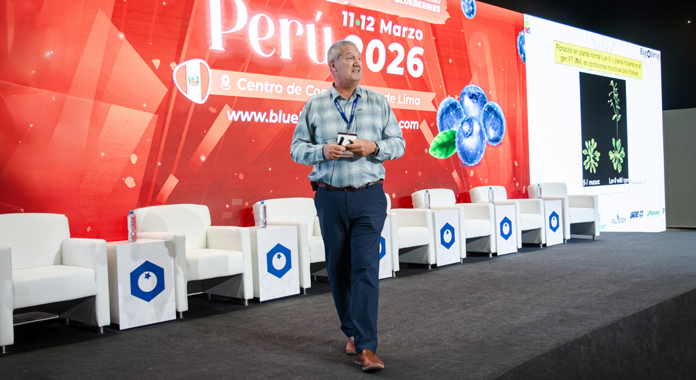
In the current scenario of the industry of blueberryIn a world where productivity and quality increasingly depend on agronomic precision, plant physiology is beginning to occupy a more prominent place in technical discussions. This is the view of the researcher. Thomas Fichet, who during his participation in the International Blueberries Seminar Lima 2026, addressed the role of plant hormones and their relationship with the crop's ability to adapt to adverse conditions.
In her talk “Mechanisms of floral induction and differentiation in blueberriesThe presentation, given during the first day of the meeting, focused on physiological processes that help to better understand how the plant responds to the environment. In that context, it highlighted the importance of continuing to deepen this type of knowledge within a blueberry industry that faces increasing changes in climate and production.

The scientist explained that plant hormones are compounds produced by plants that play a crucial role in maintaining their balance, among other functions. They operate at very low concentrations, are very small molecules, and are present throughout the plant, in all its cells. Unlike animal hormones, he clarified, they do not depend on a specific organ for their production. “Every cell in the tissue, the root, the leaf, can produce all the plant hormones of the plant. Therefore, their regulation is completely decentralized,” he explained.
Unlike humans, plants cannot move when the climate is unfavorable. They must remain in one place and face radiation, high temperatures during the day, or low temperatures at night. In this scenario, these mechanisms allow them to adapt much better. As an example, he mentions the case of Chernobyl: “If you go to Chernobyl today, all the trees and vegetation are green. That is, they are able to adapt to those adverse conditions and, ultimately, grow and multiply,” he explains.

Thomas Fichet at the XXXIX International Blueberries Seminar Lima 2026 © Blueberries Consulting

What role do hormones play in blueberry cultivation?
Hormones are essential because they help regulate various plant processes and play a vital role in its balance and adaptation. Faced with conditions such as climate change, excessive temperature, or radiation, the plant activates physiological responses that allow it to better cope with that environment.
What factors influence these hormonal responses?
Primarily the environment. Factors such as temperature, radiation, or low relative humidity can trigger the synthesis of plant hormones as a signal of adaptation. As a result, the plant can reduce water loss, produce thicker leaves, or generate antioxidant compounds.
Is the industry taking this level of complexity into account?
This is an issue that still requires further exploration. That's why it's important to continue creating opportunities such as seminars, courses, and conferences, which allow technical teams to specialize, stay up-to-date, and better prepare for the changes to come, especially those related to climate.
What does this mean for agronomic management?
This involves continuing to strengthen technical knowledge and the ability to observe how the plant responds to the environment. In a crop like the blueberryIn situations where conditions change and competition increases, a better understanding of these processes can become an important support for management.
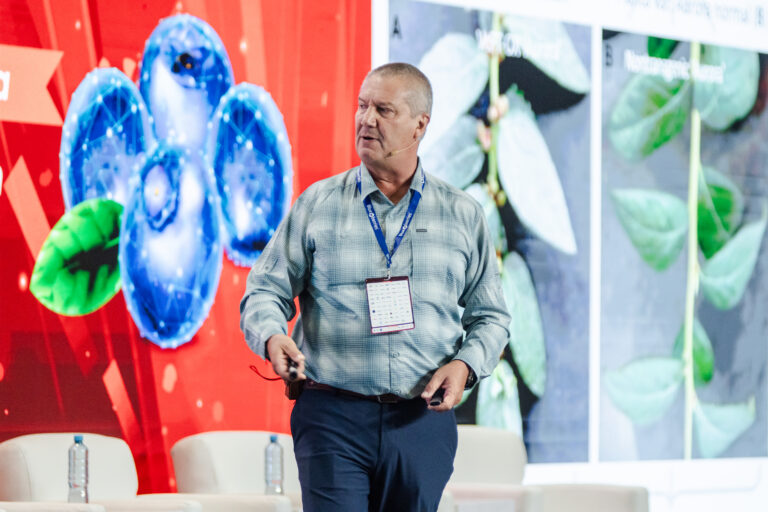
Thomas Fichet at the XXXIX International Blueberries Seminar Lima 2026 © Blueberries Consulting
A physiological perspective
Fichet's approach sparks a fundamental discussion within the industry. blueberry Regarding the importance of a deeper understanding of the crop's physiological response, hormones appear as part of a signaling system that allows the plant to adapt to the environment and continue developing under often adverse conditions.
In a context where climate change, increased production, and international competition demand ever greater precision, advancing this type of knowledge can become a significant support for decision-making. It's not just about intervening in the crop, but about doing so with a better understanding of its biology.
Thus, physiology ceases to be seen solely as a specialized field and begins to be more strongly integrated into productive conversation. In a blueberry Increasingly demanded by quality, condition and adaptation, a better understanding of the plant's response is also becoming part of the technical challenges facing the industry.

Thomas Fichet at the XXXIX International Blueberries Seminar Lima 2026 © Blueberries Consulting
Read also:
Applied research in blueberries: new studies now available for download at Blueberries Consulting
Check out the full interview on our channel. Youtube Blueberries TV
next article
ARTÍCULOS RELACIONADOS