Academic research creates tool to measure the global competitiveness of blueberries

For decades, agriculture was seen as a profession steeped in tradition, hard work, and the land. Today, however, simply planting crops is no longer enough to guarantee profitability. Globalization, new quality standards, and technological disruption have transformed the agricultural sector into a highly competitive environment, where only those producers capable of innovating, learning, and managing intelligently survive.
In the words of Héctor Luján, CEO of Hortifrut, “The future of the farmer is not in producing more, but in producing better; those who do not measure and those who do not manage, do not compete.”. From Michoacan, Mexico, territory where the blueberry As the fruit has become established as a high-value export, a pioneering effort has emerged to understand the factors that determine agricultural competitiveness in a globalized environment. This study seeks construct the Agricultural Competitiveness Indicator (ICA), a tool that combines business management, statistical analysis and artificial intelligence to measure, compare and predict the competitive performance of production units.
The development of the ICA is based on international research that unites the field experience with data analysisSemi-structured interviews were conducted in five producing countries: Mexico, Peru, Chile, the United States, and Canada., with industry leaders such as Héctor Luján (Hortifrut), Miguel Bentín (ProArándanos Perú), Andrés Armstrong (Chilean Blueberry Committee), Miguel Ángel Curiel (Aneberries México), and representatives from companies such as Mission Produce, Sun Berries, Berries Paradise y Naturipe Farms, among others.

Based on these testimonies, more than 80 factors of competitivenessgrouped into six key dimensions: production, economic environment, education, environment, security and governance. This information was encoded and transformed into a statistical analysis matrix which allowed us to estimate the relative weight of each dimension within the overall model.
Currently, the project is progressing towards the phase of quantitative validationwhere factor analysis, logistic regressions, and artificial intelligence models are applied (Random Forest) to consolidate the definitive ICA. In its final phase, the model will be integrated into a interactive digital board which will allow Compare agricultural competitiveness between regions and countriesproviding a practical tool for producers, associations and decision-makers in the sector.
Although the contexts are different, the results converge. In MexicoThe opportunity lies in taking advantage of its geographical proximity with the world's largest market, although it faces challenges in infrastructure, technology, and institutional coordination. Peru, Competitiveness has become established as a state policy based on varietal planning and innovation. In ChileThe debate focuses on the varietal renewal and sustainability; Meanwhile in United States y to Canada, the emphasis is on the automation, genetic research and logistical efficiencyEach country shows a different path, but they all agree on the same conclusion: success no longer depends on the size of the farm, but on the level of management and the intelligence with which decisions are made..
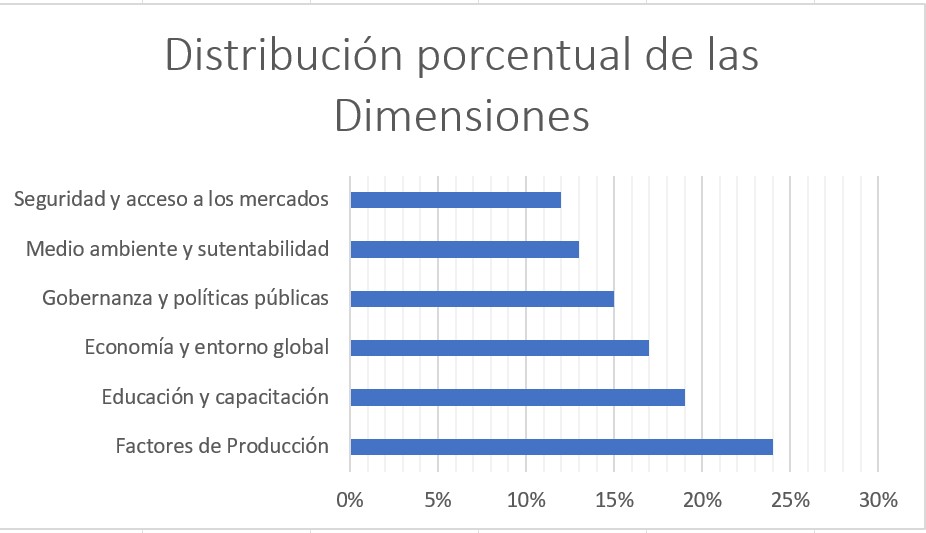
Figure 1. Percentage distribution of the dimensions that define agricultural competitiveness. The results show the predominance of internal factors—technology, training, and management—over external market or political conditions, confirming that innovation and learning are the true sources of competitive advantage in the blueberry sector.

Quantitative findings reinforce this trend
The dimensions with the greatest relative weight were the factors of production (24 %) and education and training (19 %), followed by the global economic environment (17%) and institutional governance (15 %). One of the surprises of the analysis was the low weighting given to security and market access (12 %), This issue, despite its media relevance in countries like Mexico, is not among the main determinants of perceived competitiveness for producers. This suggests that farmers and agricultural entrepreneurs have learned to operate in uncertain contexts, prioritizing... efficiency and innovation about external factors that they cannot control.
Taken together, this evidence confirms that new agricultural competitiveness is not won with land or climate, but with strategy, knowledge and resilience. Today's competitive producer is an information manager, a global decision-maker, and above all, a constant learner.
The agricultural world is undergoing a silent revolution. What was once based on experience and intuition is now defined by data, information and adaptability. In this new scenario, productivity no longer depends solely on physical effort or inherited knowledge, but on the ability to interpret trends, anticipate risks, and make informed decisions in real time.
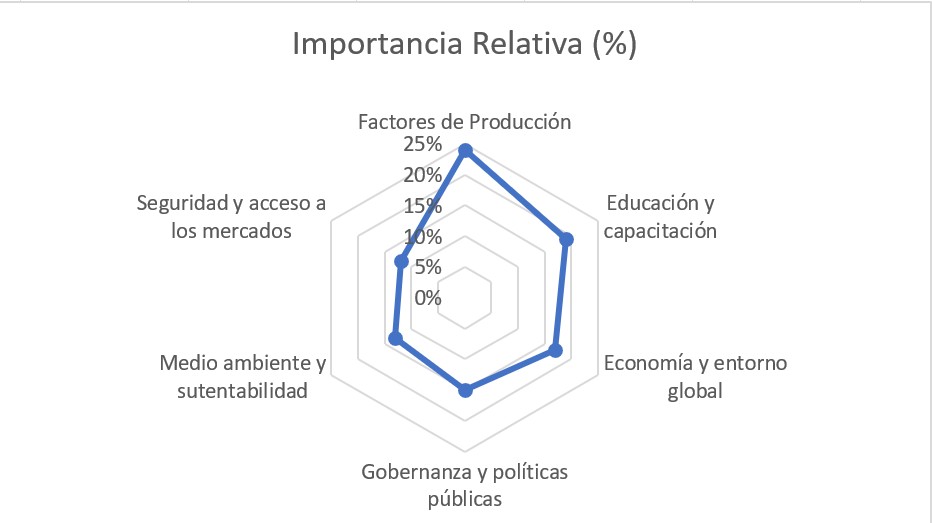
Figure 2. Radar of relative weights of the dimensions of competitiveness
agricultural. Source: Prepared by the author (2025), based on interviews and a matrix of
agricultural competitiveness

Data management has become the new fertile ground for the modern producer
Every weather record, every soil analysis, every market variable constitutes a seed of knowledge that, if well managed, can make the difference between profitability and loss. insights has ceased to be a complementary resource and has become a strategic asset: Whoever controls the data controls the future of the field.
But no technological system can replace the farmer's mindset. Today's competitive landscape demands producers capable of learning, unlearning, and relearning; leaders who understand that training is not a one-off event, but an ongoing process. The farmer who resists change falls behind, not because their land is worth less, but because their management model no longer speaks the language of the global market.
In a world saturated with technology, traditional agriculture—that which produces without records, sells without planning, and competes without information—no longer has a place. The new agriculture is built upon analytics platforms, knowledge networks, and collaborative decision-makingThe challenge is not to produce more, but to produce better, with a strategic vision and with an eye beyond national borders.
Because future competitiveness will not be defined by who grows the best blueberries, but by who best understands the global environment that surrounds them..
ARTÍCULOS RELACIONADOS