The current state of the blueberry industry: Luis Miguel Vegas will present the sector's figures and projections in Trujillo.
By: Martin Carrillo
As general manager of Proarándanos, Vegas has established himself as one of the most authoritative voices analyzing the evolution of the world's leading blueberry exporter. His presentations have become a must-attend event for producers, exporters, genetics companies, marketers, investors, and market analysts, not only because of the magnitude of the figures he presents, but also because he brings together firsthand information on the production, commercial, and varietal realities of Peru.
In an industry where changes occur rapidly and investment decisions must be anticipated several years in advance, having up-to-date data on planted area, varietal replacement, exports, logistics, and target markets represents a strategic advantage. Therefore, Luis Miguel Vegas's participation in the 2026 Trujillo International Blueberry Seminar, to be held on July 8th and 9th, is generating considerable excitement.
Peru changed the industry
It may seem repetitive, but it is worth remembering that the recent history of the Peruvian blueberry is probably one of the most surprising phenomena in modern agriculture, and it is not a fortuitous or fleeting event, but a reality that is maintained, consolidated, and projected to continue growing.
"The average growth rate of the last decade has been 30% per year," the executive explained, adding that this is not only due to the planting of new hectares (3000 per year), but also to an intense process of genetic renewal that is redefining the country's productive profile, with more productive varieties and better quality fruit.
The most recent data from Proarándanos shows that Peru currently has more than 29.000 hectares under cultivation, with La Libertad consolidating itself as the main producing region, followed by Lambayeque. Both represent two-thirds of Peru's total production, hence the importance of Trujillo as a meeting point for the industry, as it is located in the heart of the region.

Varietal revolution
One of the central themes of Vegas' presentation will undoubtedly be the evolution of varieties. It's no secret that genetics has become one of the main drivers of competitiveness for the Peruvian industry. New varieties aim to improve productivity, fruit quality, firmness, flavor, post-harvest life, and adaptation to different markets, as well as providing better defense against threats, both pathogens and water scarcity.
Currently, varieties such as Sekoya Pop concentrate a significant part of the national surface area, reaching 20% in some areas, reflecting the profound change that the industry is experiencing with respect to the genetic materials that dominated the first years of expansion.
The information presented by the leader of Proarándanos will provide firsthand knowledge of the behavior of the new genetics and which varieties are growing, which are consolidating, and which could lead the next stage of development for the sector.
For producers and genetic companies, this information is a fundamental reference for defining new investments.
Market and new opportunities
Another major attraction of the Vegas exhibition will be the ongoing updates to the export campaign, both in terms of production projections and the diversification of its markets.
The most recent reports from Proarándanos show that the 2026-2027 campaign is progressing with strong dynamism, registering significant growth compared to previous seasons, even exceeding 30% in weekly or partial shipments, thereby consolidating Peru's position in the main international markets.

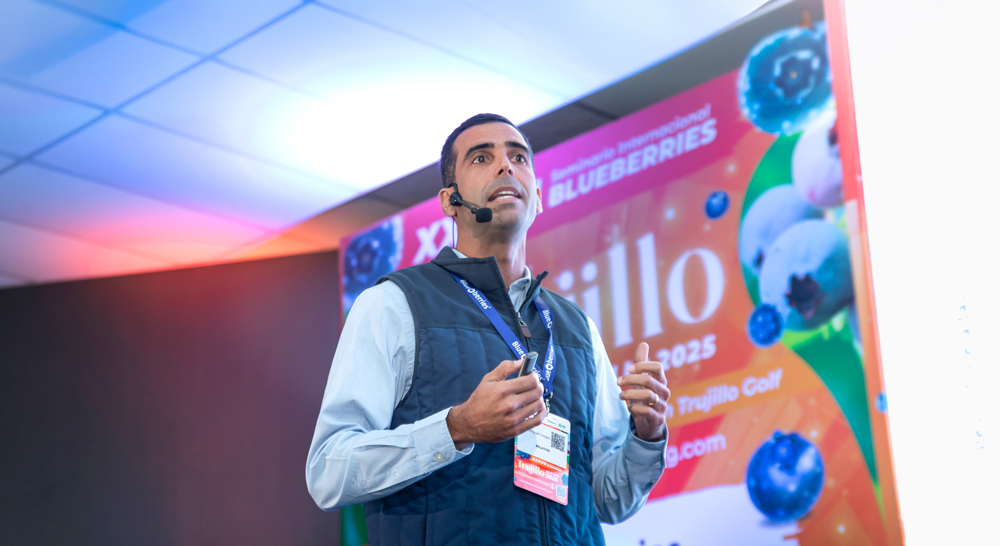
Luis Miguel Vegas at the XXXVII International Blueberries Seminar Trujillo 2025 © Blueberries Consulting

The United States remains the main destination, although Europe, Asia and various emerging markets are becoming increasingly important within the Peruvian export strategy.
"Peruvian blueberries have positioned themselves globally as high-quality blueberries. Peru has established itself as a reliable supplier in different markets around the world, and what we have to do is take care of it," he maintains.
For the executive, the challenge lies not only in increasing volume, but also in maintaining the standards that have allowed the Peruvian product to build its international reputation. "While we will continue to grow in volume, we must not compromise on quality in any way, but rather continue to enhance it," he emphasizes.
From this perspective, it will be interesting to also learn from the specialist the reasons for the notable drop in the organic production of Peruvian blueberries and, above all, the surprising drop in shipments to commercial destinations in China, which until now had been steadily increasing.
The logistical challenge
Peruvian growth also brings new challenges, and Vegas has warned that one of the main issues facing the industry is logistics.
"We must be aware of the challenge that this increase in volume will represent in terms of the logistics of the campaign," he has repeatedly pointed out, and from this perspective he is one of those who values the entry into operation of the port of Chancay, one of the great transformations for Peruvian foreign trade.
"The port of Chancay definitely represents an advantage, especially with regard to the Asian market. It allows us to have shorter services to China, shorter transit times, and that helps us reach the market in a better way," he explains, and values the possibility of arriving in China with better fruit condition, improving commercial opportunities in one of the markets with the greatest growth potential for Peruvian blueberries.

Luis Miguel Vegas: Leadership in numbers: Evolution of Peru's production and trade matrix in the last season. © Blueberries Consulting

More than a statistical presentation
The importance of Luis Miguel Vegas's participation in the 2026 Trujillo International Blueberry Seminar goes beyond the numbers. His presentation has become an analytical tool for understanding the future direction of the global blueberry industry.
The evolution of varieties, the expansion of cultivated land, logistical challenges, the opening of new markets, and export projections are all factors that influence the decisions of producers and companies worldwide. That's why, each year, when Vegas presents its update on the Peruvian campaign, the focus isn't solely on Peru. What the industry is really observing is a signal of where the global market is headed.
Check out the summary of the XXXVII International Blueberries Seminar Trujillo 2025 on our Blueberries TV Youtube channel
Read also:
Peruvian blueberries look to Trujillo to analyze climate, health, genetics and quality
Trujillo hosted the most important event in the blueberry industry in Northern Peru.
ARTÍCULOS RELACIONADOS