Luis Miguel Vegas: “Peru is a strategic ally for the US”

During the 39th International Blueberry Seminar held in Lima, one of the most discussed topics among industry leaders was how the global competitive landscape for blueberries is changing. In this context, Luis Miguel Vegas, general manager of Proarándanos, addressed the challenges facing the sector at a stage where simply expanding production is no longer enough to guarantee commercial success.
According to the executive, the industry has entered a phase where competition between countries is being redefined under new parameters.
“Today, countries no longer compete solely on volume, but on overall efficiency,” Vegas noted during his participation in the meeting.
Increasingly strategic business
The rapid growth of global blueberry production has raised the bar for exporters. For Vegas, the current challenge is not only to produce more fruit, but also to develop the strategic capacity to manage an increasingly complex and uncertain environment.
“The blueberry industry has grown exponentially in recent years. It is no longer enough to produce and harvest at the best time; you have to be strategic to reach the market at the right time,” he explained.
This strategic approach also involves preparing for external factors that producers cannot control, but which directly impact the business.
Among them he mentioned climatic phenomena such as El Niño, which can significantly alter production conditions, as well as geopolitical factors that affect logistics and input costs.
“The crisis we are seeing in the Middle East could have a direct impact on freight costs and the supplies needed for operations. That's why the industry needs to be very disciplined and strategic,” he said.

Luis Miguel Vegas: Leadership in numbers: Evolution of Peru's production and trade matrix in the last season. © Blueberries Consulting

Un Partner for the USA
Another factor that worries the industry is the international trade scenario, especially the tariff measures of the Trump administration in the US, which may affect the competitiveness of exporters.
“This is a direct blow to companies’ results, which we hope can be reversed in the short term. We are expecting this measure adopted by the American government to end around July so we can return to the conditions we had previously, with zero tariffs,” he stated.
However, the executive emphasized that the relationship between Peru and the United States in the blueberry market should be understood more as a strategic alliance.
“The US market doesn’t have enough production to meet all the consumption demands of its population,” the executive explains, arguing that it’s also about increasing healthy eating habits, so if that consumption is to increase, a Partner As Peru, it confirms and emphasizes that the development of Peruvian industry not only benefits local exporters, but also the entire US logistics and trade chain.
Furthermore, he states that “around 30% of the blueberries produced in Peru have American capital. These are investors from the United States who have committed to developing the crop in the country,” he indicates.
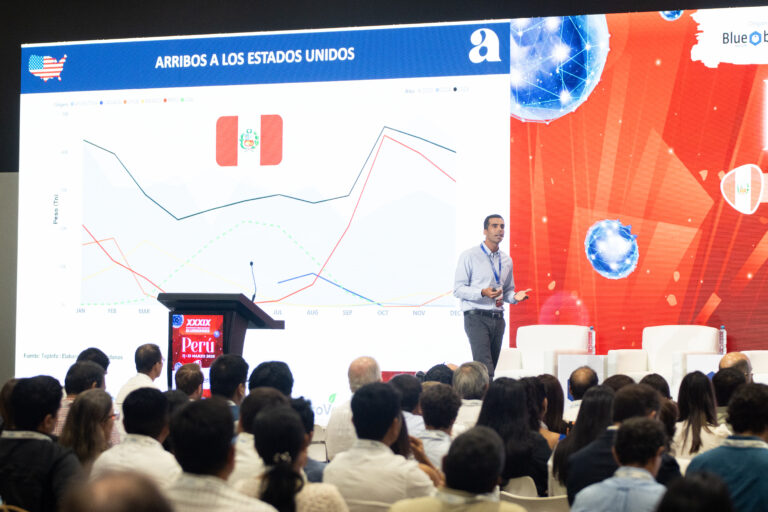
Luis Miguel Vegas: Leadership in numbers: Evolution of Peru's production and trade matrix in the last season. © Blueberries Consulting
Read the competitive map correctly
For Vegas, understanding the evolution of the international market is now one of the main tools for making strategic decisions.
In that regard, he highlighted the importance of events such as the International Blueberry Seminar, which allow for the sharing of information and the analysis of global trends.
“It’s important for the industry to be informed. Seeing how other countries are growing in planted areas or exports helps us understand where each one stands on the global stage,” he explained.
One of the aspects generating the most attention is the development of the Chinese market, which in recent years has shown significant growth in both consumption and local production. “China is a very interesting market, with a sophisticated and demanding consumer. But we also need to understand what role Chinese production will play in the future and how it could affect Peru's current market share,” he noted.

Luis Miguel Vegas: Leadership in numbers: Evolution of Peru's production and trade matrix in the last season. © Blueberries Consulting

New markets on the radar
While the United States will remain the primary destination for Peruvian blueberries, Vegas believes the country should more decisively explore new markets with growth potential. Among these, he mentioned Brazil and India, two large economies that could represent significant opportunities for the sector.
“Brazil is a huge market right next door that could be very interesting for Peruvian blueberries,” he commented. India, meanwhile, appears as a high-potential destination due to its population size, although it presents significant logistical challenges.
“India has a gigantic population. Even if we only target a premium segment of 80 million people, we’re already talking about a market equivalent to an entire country,” he explained. However, he cautioned that the development of this market will depend heavily on the logistical capacity to supply it efficiently.
“It is not enough to open a market; you also have to evaluate how efficient the logistics are to get there,” he said.

Luis Miguel Vegas: Leadership in numbers: Evolution of Peru's production and trade matrix in the last season. © Blueberries Consulting
How far can Peru grow?
Finally, the executive addressed one of the most frequently asked questions in the industry: what is the production ceiling for Peruvian blueberries? According to Vegas, the answer is still unclear.
“We don’t know what Peru’s ceiling is,” he acknowledged.
Currently, the planted area continues to expand at a rate of approximately 10% annually, which will inevitably lead to larger fruit volumes on the market. In this scenario, the main challenge will be to manage this growth intelligently to avoid imbalances between supply and demand.
“We have to navigate campaign by campaign, hoping that consumption keeps pace with the growth rate of supply,” he concluded.

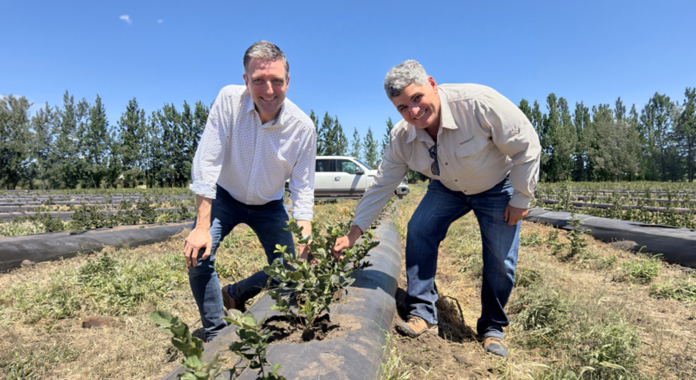
Luis Miguel Vegas © Blueberries Consulting
Revisa la entrevista realizada a Luis Miguel Vegas durante el XXXIX Seminario Internacional Blueberries Lima 2026:
Previous article
Morocco reorganizes its blueberry season: pressure in Russia and opportunity in the United Statesnext article
ARTÍCULOS RELACIONADOS