Peruvian blueberries: Euroandes plans to extend the window and compete with European production
By: Martin Carrillo

The next step of blueberry Peruvians in Europe might be less about opening new destinations than about extending the months in which they can compete within a market they already know.
This is the view of María Alejandra Arangurí, director of Euroandes, who pointed out during Fruit Attraction 2026 that Peru still has room to extend its commercial window and move from periods of lower supply to months in which there is also European production.
“Most producers are exporting the blueberry "between June and July and January and February," he explained.
According to Arangurí, the possibility of extending that calendar will depend both on the varieties available and on the capabilities that the Peruvian industry continues to develop in the field.

Expand the window beyond February
The first opportunity the executive identifies appears immediately after the window where a large part of the Peruvian supply is currently concentrated. “We must be able, through innovation in the different varieties and also with all the skills we are learning in the field, to continue expanding this commercial window,” she stated.
Arangurí specifically identified February, March, and April as the months in which, he explained, attractive prices can be observed when availability from other sources decreases. “Quite attractive prices in February, March, and April, months that are often short-stacked by other major sources like Morocco,” he noted.
The proposal involves extending Peruvian participation beyond its usual schedule before taking a more commercially demanding step: competing when Europe is also producing.

María Alejandra Arangurí, General Director of EuroAndes (Danper Group), together with Rosario Bazán, President of the Board of Directors of Danper and Vice President of AGAP, at Fruit Attraction. © Blueberries Consulting

Competing when Europe also produces
Arangurí argues that the expansion of the window should not stop during the months of lower availability. “We should also be able to finally compete with local production in Europe,” he stated.
The executive placed that European production mainly between April, May, June and July and maintained that, although there is a representative local volume during those months, the blueberry Peruvians can compete based on quality.
That comparison reflects Arangurí's assessment and not a general conclusion about all European production. His argument is that Peru should be able to shift its supply towards months when it would no longer be competing solely on availability, but directly with fruit produced on the continent.
Europe is already a significant destination for the Peruvian industry. According to the IBO Global Blueberry Report 2026, the continent accounted for approximately 27% of Peruvian blueberry exports. blueberries during the 2025/26 campaign, compared to 49% directed to the United States.
Extending the presence for more months would therefore allow for a deepening of a commercial relationship that already has an important weight within Peruvian shipments.
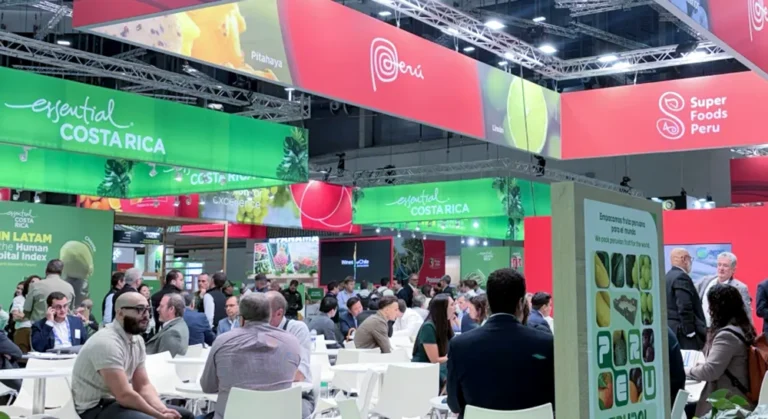
Fruit Attraction 2026 © Blueberries Consulting
Varietal innovation and broader programs
To move in that direction, Arangurí returns to two elements: varietal innovation and productive learning. His approach is not simply about producing for more weeks, but about developing varieties and field capabilities that allow for an effective extension of the commercial calendar.
That objective ultimately leads to European retail. “As producers in Peru, we definitely have to set that goal for ourselves so we can secure more significant programs with different supermarkets in Europe,” he stated.
The extension of the window thus appears as a two-stage strategy: first, to take greater advantage of opportunities in February, March and April; then, to move towards the months when European production is already present.
For Arangurí, the challenge of blueberry The Peruvian's goal is not simply to spend more weeks in Europe, but to convert that increased presence into more significant commercial programs with supermarkets across the continent.
Read also:
- Fruit Attraction 2026: Agualima and Euroandes chart new opportunities for Peruvian blueberries
- Miguel Bentín at Fruit Attraction 2026: “The peak of the Peruvian blueberry will be equal to or less than predicted”
- Few gateways, different import networks: this is how Peruvian blueberries are distributed at their destination
- Peruvian blueberries: the quality that defines their value in international markets
- Europe maintains high demand for blueberries, but quality defines the market.
- Daniel Bustamante: “The Peruvian blueberry is positioning itself globally thanks to its genetics”
- Peruvian blueberries enter a new stage, with premium fruit at the center
next article
ARTÍCULOS RELACIONADOS