Peruvian blueberries: the quality that defines their value in international markets
By: Alejandro Yoshioka

The Peruvian blueberry industry faces a challenge that goes beyond increasing its production and export volumes. As international supply grows, quality becomes increasingly important for product acceptance and can influence the continuity of trade programs and the returns obtained.
An analysis by Agronometrics based on SUNAT export records provides an indication of this segmentation. During the 2024/25 season, the average price difference between varietal groups in the upper and lower FOB price segments reached US$2,28 per kilogram. This gap does not represent a universal quality premium, but it does show a difference in FOB value associated with different varietal groups.
From field to market: a quality chain
Quality begins before harvest. Genetics, agronomic management, and harvest time all influence attributes such as firmness, flavor, size, and shelf life.
These characteristics, however, must be maintained during storage, transport, and distribution. A variety with good agronomic performance can lose competitiveness if it does not maintain the required condition until it reaches its destination.

Firmness and flavor: attributes that weigh heavily on the consumption experience
Firmness is a key attribute in international trade because it helps maintain the fruit's integrity during handling, transport, and distribution. But firmness doesn't mean excessive hardness: the texture must still be pleasant for the consumer.
Flavor completes the experience. Sweetness, acidity, and balance influence acceptance, so size and appearance alone are not enough if the sensory profile does not meet market expectations.
A study published in 2025 in the journal Foods found that appearance, firmness, and sensory characteristics influenced the acceptance of different varieties, with responses varying according to genetics and evaluation conditions. The results show that the perception of quality arises from the interaction between different attributes.
In the premium segment of markets like China, trade sources also highlight flavor, firmness, size, and post-harvest life. These attributes, however, do not in themselves guarantee a higher price: the commercial outcome depends on the buyer's conditions, the available supply, and the condition of the fruit upon arrival.
Calibre and bloom: appearance also communicates quality
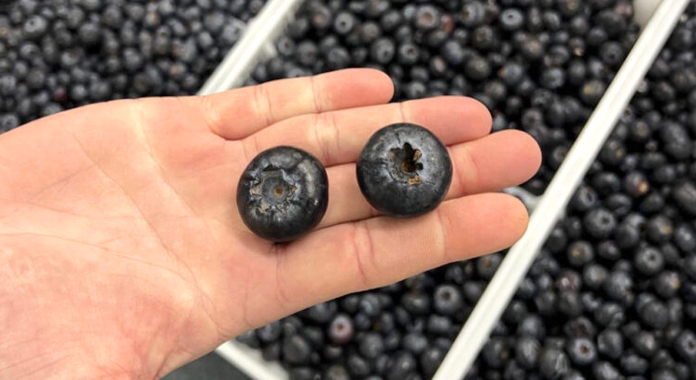
Size and uniformity influence presentation and compliance with commercial specifications. Larger sizes may be valuable in certain premium segments, but there is no single ideal size for all markets.
The bloom, the whitish, waxy film that naturally covers the blueberry, helps protect the fruit's surface and is often visually associated with freshness and good condition. Its preservation depends on careful handling during harvesting and packing.
The same Foods study recorded greater acceptance of samples that retained some bloom compared to those where it had been removed, although the response varied depending on the variety. Appearance contributes to the perception of quality, but it does not replace attributes such as flavor and texture.
© Colina Fruits

Postharvest life and arrival condition
In international business, quality doesn't end in the field or when the container leaves the port. It must be maintained until the fruit reaches the buyer.
Temperature, humidity, handling, and transit time all influence the preservation of firmness and appearance. A well-managed cold chain helps reduce deterioration, but it does not correct problems originating in the field or reverse mechanical damage.
Loss of firmness, dehydration, rot, or surface deterioration can lead to additional sorting, discounts, or complaints. Therefore, logistics must be evaluated not only for cost and transit time, but also for its ability to preserve the fruit's commercial value.
Exportable percentage and commercial result
One of the indicators that connects quality and profitability is the exportable percentage: the proportion of harvested fruit that meets the specifications of the destination market.
Increased production does not necessarily translate into a corresponding increase in marketable volume as fresh fruit. Damage, defects, out-of-specification sizes, or inadequate ripeness can reduce that proportion.
Therefore, exporters and producers must jointly consider the exportable percentage, selection discards, losses at destination, and claims to determine how much of the production actually ends up being marketed as exportable fresh fruit.
The format must also be suitable for the channel, protect the fruit, and facilitate its handling, distribution, and display.

Retail and consumer: quality that justifies the purchase
For retail, consistency is key. Chains need uniform batches, predictable quality, and the ability to maintain agreed-upon supply.
The consumer, for their part, does not necessarily evaluate technical parameters. They perceive the results: freshness, texture, flavor, appearance, and the relationship between the experience obtained and the price paid.
Other channels, including processing, have their own specifications and may offer alternatives for some of the fruit that doesn't qualify for certain fresh market programs. This doesn't mean that any fruit rejected from the fresh market is automatically suitable for another commercial use.
Compete on quality, not just volume.
The Peruvian industry has demonstrated its capacity to increase its offerings and serve diverse markets. The next challenge is to sustain that scale with a commercial proposition capable of responding to increasingly segmented demands.
A technically sound fruit meets parameters for firmness, size, ripeness, and safety. A commercially competitive fruit, moreover, meets the buyer's specifications and retains its attributes until distribution.
In a market with more supply and greater segmentation, value will be increasingly linked to the ability to consistently deliver the fruit that each commercial program requires.
Previous article
Chancay-Shanghai route accelerates in 2026: Peruvian and Chinese products that move the most cargonext article
ARTÍCULOS RELACIONADOS