Daniel Díaz: “In blueberries, growth regulators only express their potential if there is good nutrition.”

At the 39th International Blueberry Seminar held in Lima, Daniel Díaz addressed one of the most sensitive aspects of the crop's physiological management: the relationship between growth regulators, mineral nutrition, and fruit quality. blueberryWhere every agronomic decision can directly affect firmness, development and final condition, the interaction between these factors acquires a decisive relevance.
In a conversation with Blueberries Consulting, the specialist pointed out that simply applying hormones or regulators and expecting an automatic response from the plant is not enough. For these effects to be consistently expressed, the crop must have a nutritional and water base capable of supporting processes such as cell division, tissue growth, and fruit formation.

—Daniel, from your specialty in plant physiology, is there a benefit in the combined application of nutrients such as calcium and silicon along with growth regulators?
Yes, definitely. Each one fulfills a specific function within the plant's physiology. On the one hand, hormonal applications or growth regulators are involved in processes such as cell division, cell size increase, and various mechanisms associated with plant or fruit growth.
However, this function cannot be properly expressed without the necessary nutrition. If a cell is to divide or a tissue is to expand, the plant needs resources to carry out this process. In this context, nutrients such as calcium, silicon, and other elements play a fundamental complementary role. Therefore, rather than separate actions, there is a clear interdependence between hormonal regulation and nutrition.
—So, one component can't be conceived without the other?
Exactly. There may be hormonal application, but if nutrients aren't available to sustain the physiological response, the effect will be limited or inconsistent. The opposite can also occur: nutrients may be available, but if the appropriate physiological signal isn't present, that condition alone won't necessarily lead to the expected result.
Therefore, when working with growth regulators in blueberries, the approach must be comprehensive. It is not an isolated tool, but a decision that must be incorporated into a broader agronomic strategy.
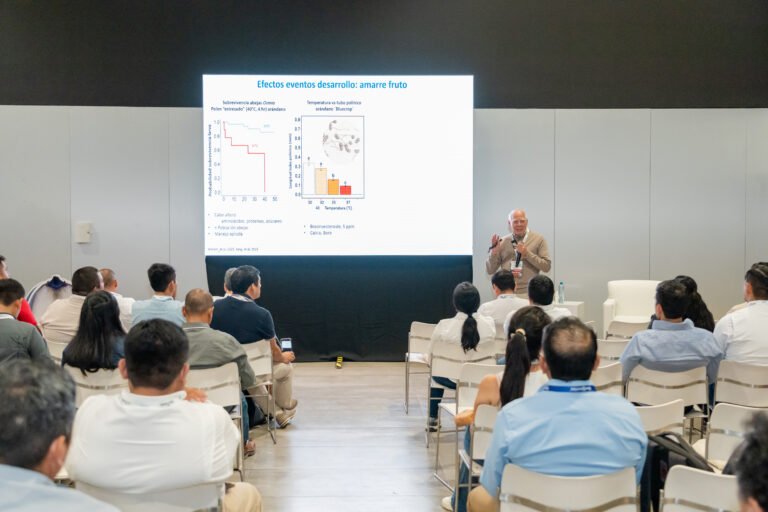
Daniel Diaz in the talk “Advanced strategies for managing thermal and oxidative stress in blueberries”.

—Is there a relationship between the vegetative vigor of the plant and the firmness of the fruit in blueberries?
Yes, definitely. That's also a key point. When a plant exhibits a lot of vegetative vigor—more growth, more succulence, more leaf development—a significant portion of its nutrients and resources tends to be directed toward that new growth.
This creates competition with the fruit. And for the fruit to develop firmness, it also requires a sufficient supply of elements and physiological processes that allow for proper cell formation. If most of the energy and nutrients are directed toward vegetative growth, the fruit may lose some of the firmness potential it could have achieved under other conditions.
—Could it be said, then, that the balance between vegetative growth and fruit load is crucial?
Yes, because the problem isn't growth itself, but when that growth starts competing with the fruit. In that scenario, the plant prioritizes vegetative development, and the fruit is left in a less favorable position to receive the resources it needs.
In blueberries, where firmness is a key commercial attribute, this balance must be carefully managed. The goal is not only to promote growth, but also to ensure that the plant allocates its resources according to the desired production and commercial outcome.
—What recommendation would you give to producers who are considering using hormones or growth regulators?
The main recommendation is that, if you are considering using hormones or growth regulators, you should first ensure you have a good nutritional foundation. Without adequate nutrition, the effects may be inconsistent or simply not manifest as expected.
Besides nutrition, water is also a critical factor. Therefore, before making a decision aimed at improving a particular attribute, the first step is to check if the crop has the necessary conditions to respond. This remains one of the keys to sound agronomic decisions in the field.
Participation in the International Blueberries Seminar Lima 2026
Daniel Díaz participated in the 39th International Blueberries Seminar Lima 2026 in two sessions of the technical program. In the main hall, he was part of the panel “Engineering Firmness in Blueberries: Nutrition, Hormonal Interaction, and Post-Harvest Strategies for Long-Distance Markets,” while in the secondary hall, he presented the talk “Advanced Strategies for Managing Thermal and Oxidative Stress in Blueberries.” Both presentations reinforced the same line of work for the industry: in blueberry cultivation, the plant's physiological response must be addressed from an integrated perspective, capable of linking nutrition, firmness, stress management, and final fruit quality.

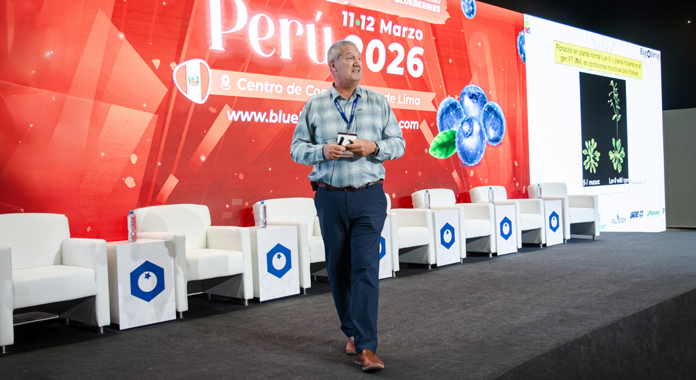
Daniel Diaz on the panel “Engineering firmness in blueberries: nutrition, hormonal interaction and post-harvest strategies for long-distance markets”.
More information:
Use of growth regulators to improve firmness and size in blueberries
Heat wave hits Morocco: Bioregulators, an alternative to save crops
Check out the full interview on our channel. Youtube Blueberries TV
Previous article
Blueberries become the star of healthy snackingnext article
ARTÍCULOS RELACIONADOS