Egypt emerges as a new player in the blueberry industry, with the United Kingdom as its main destination.

Egypt has gone from being on the blueberry industry's radar to becoming an emerging player already in the plans of numerous companies in Europe and the Americas. Two companies—one Spanish and one Dutch—have identified the country's potential and are developing projects with their own genetics.
As an example of this progress, a global company based in the Americas is implementing a 50-hectare trial near Alexandria, near the Nile River. If the results are positive, the next step will be to expand the area to larger-scale commercial plantations. Similarly, an international group working with genetics developed in Australia began new trials in Egypt in 2023, reinforcing the country's presence in the sector.
Egyptian industry would imitate Morocco
Until recently, most projects in Egypt were no larger than 8 hectares, concentrated primarily in the provinces of Cairo and Alexandria. It is estimated that, once fully expanded, the Egyptian season will largely replicate Morocco's in terms of production schedule. In fact, one of the investors—whose project is located at a similar latitude to Agadir—aims to reach peak yields in February.
While Egypt and Morocco share a strategic location in North Africa and proximity to Europe, Egyptian industry could diversify its destinations due to the distance between Alexandria and Agadir, which is approximately 5.000 km along the coast. In this context, European interest in Egypt is high, although export volumes remain low and are concentrated mainly in the United Kingdom, followed to a lesser extent by the Netherlands, France, and Malaysia.

Favorable conditions for blueberry cultivation
Egypt has a mostly flat surface, greater water availability than Morocco, and an abundant labor force. These three factors—easy irrigation, favorable topography, and accessible labor force—have been described as the "secret ingredient" for the industry's success, in a process similar to that experienced by Peru.
Another factor that reinforces the sector's development is the size of its domestic market: Egypt has more than 100 million inhabitants. Although the per capita income is relatively low, it is similar to that of South Africa, where the berry industry has managed to consolidate a constantly expanding domestic market. In fact, a farmer who conducted consumer surveys in Egypt found that one in five people would be interested in purchasing blueberries.

United Kingdom, the main market
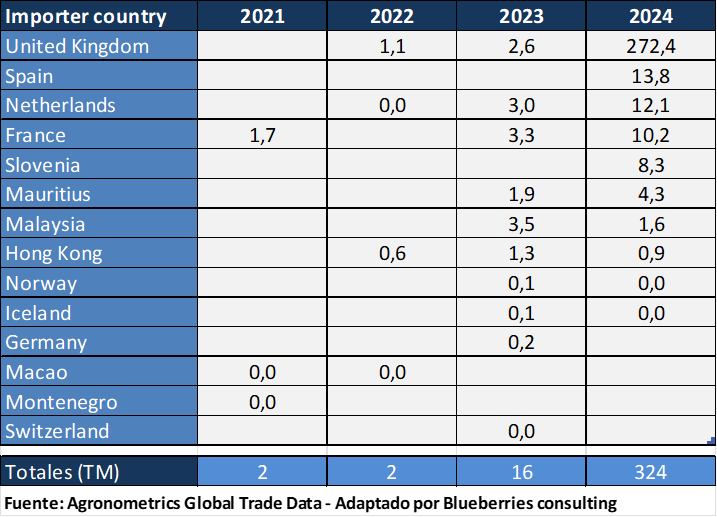
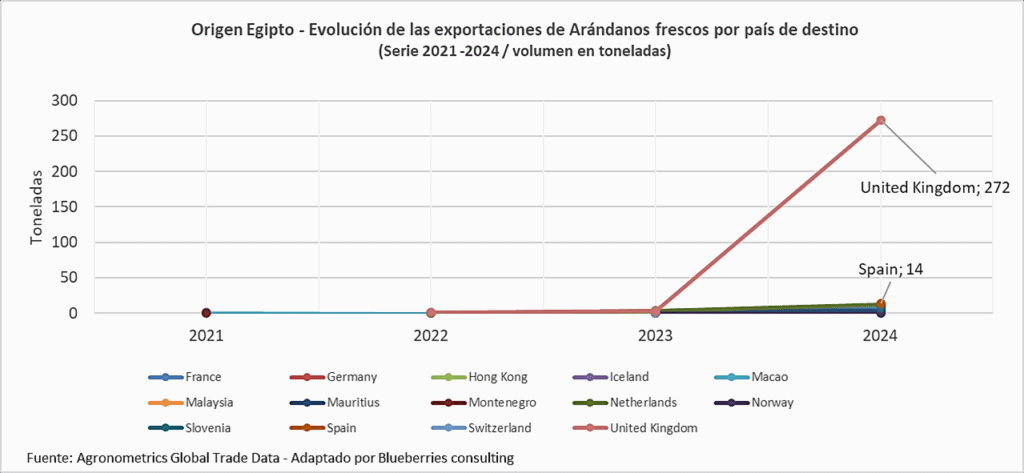
The United Kingdom has established itself as the main destination for Egyptian blueberries, recording significant growth in 2024, reaching a peak of 272 tons.
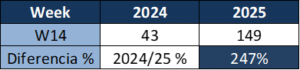
The comparison between 2024 and 2025 shows a 247% increase, from 43 tons accumulated by week 14 of 2024 to 149 tons in the same period of 2025. It is worth noting that the total volume exported in 2024 reached 324 tons, confirming the acceleration of this growth.
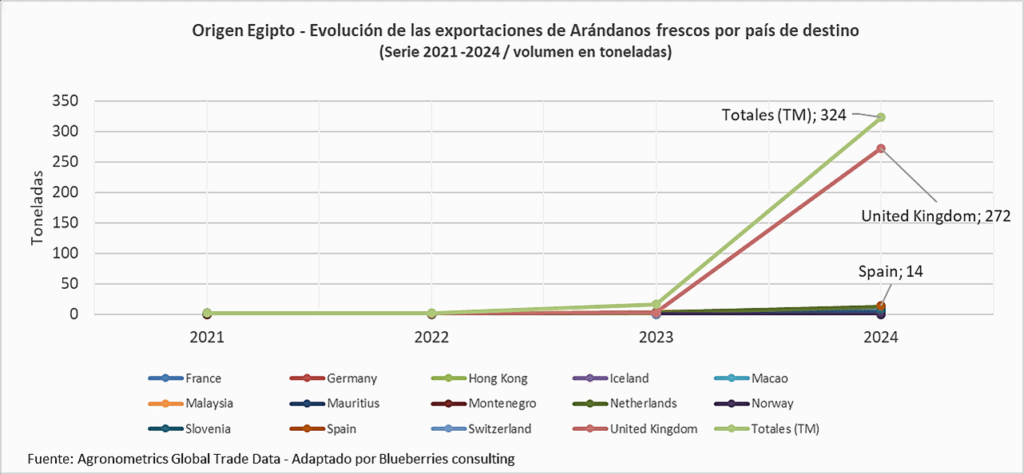
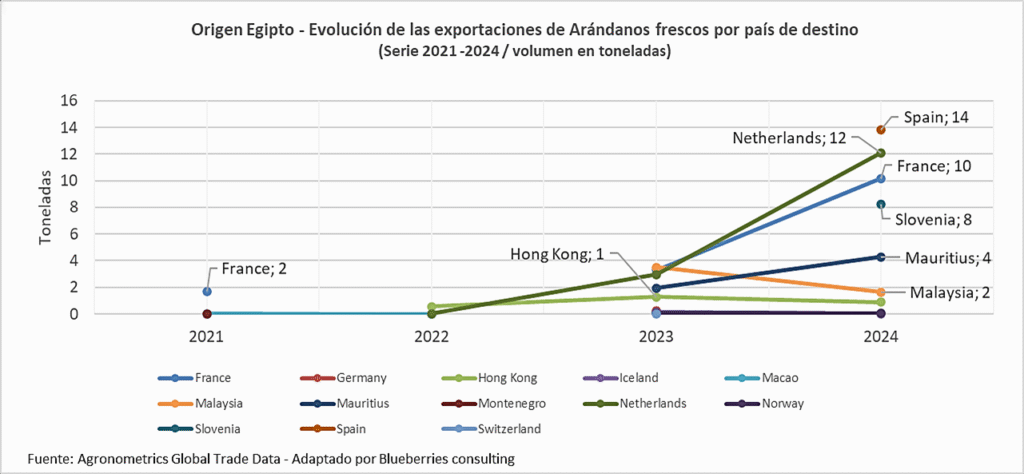
Other key markets for Egyptian blueberries in 2024 were Spain (13,8 tons), the Netherlands (12,1 tons), and France (10,2 tons). On a smaller scale, shipments to Slovenia, Mauritius, and Malaysia were also recorded.
Egypt's potential in the blueberry industry
Egypt has enormous potential to excel in the blueberry industry, supported by its fertile soils and accumulated experience in other crops such as wheat, rice, and citrus fruits. Its climatic and geographical advantages are reinforced by the growing commitment to agricultural technology and government support to consolidate the sector.
Thanks to these factors, Egypt is emerging as an emerging player with the potential to gain prominence on the global blueberry map.
Previous article
Blueberry consumption continues to grow, even in established regionsARTÍCULOS RELACIONADOS