Gonzalo Salinas: "There is still room for Chile, but not for just any blueberry"
By: Natalia Rubio Iversen
Chile still holds a foothold in key markets, but that margin no longer allows for just any fruit. In a more competitive landscape, with more players and increasingly demanding consumers, the opportunity lies in delivering a consistent blueberry that aligns with market demands.
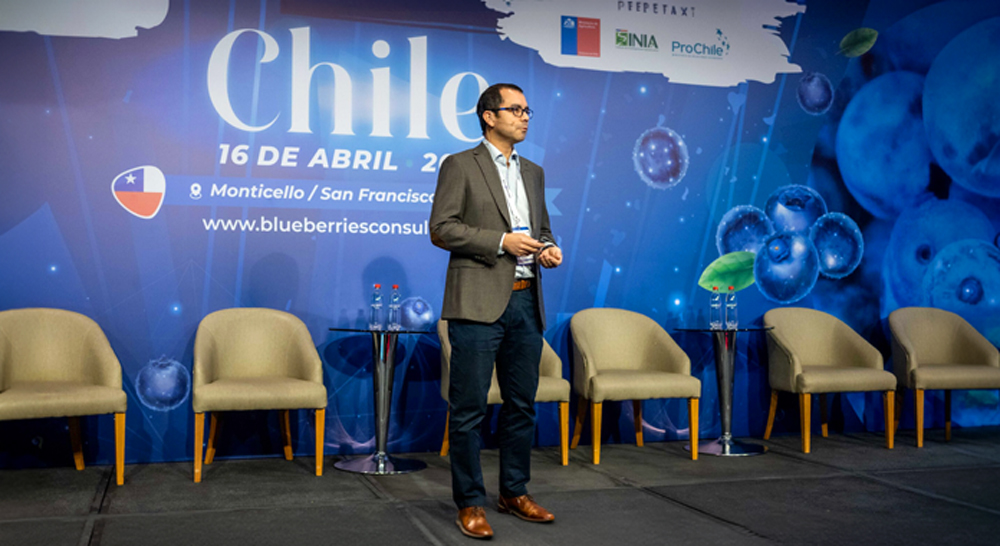
That was one of the central messages of the presentation by Gonzalo Salinas of Rabobank, at the XL International Blueberry Seminar Chile 2026, where he showed that both in Europe and the United States there are still attractive opportunities for Chile, although in a context where competition is no longer defined by putting in more volume, but by maintaining quality and consistency week after week.

The opportunity is still there, especially in Europe and the US.
One of the points Salinas highlighted is that the category's growth in the United States continues to be heavily influenced by imports. While in the 2017-2018 season the local and off-season supply was much more balanced, today almost two-thirds of what reaches that market is imported fruit, with Peru, Chile, and Mexico playing a central role in that supply.
Within that scenario, Chile still has an available window, especially in the transition to Mexico. But that opportunity isn't sustained by availability alone. It requires a blueberry capable of responding with quality to what the market demands. As Salinas stated, “you can’t just arrive with any kind of blueberry".
The landscape is more competitive.
The opportunity still exists, but the competitive landscape has changed. In Europe, Salinas showed that Peru is no longer just a transitional player, but a competitor present throughout the entire Chilean campaign. Added to this are other countries that have gained visibility, including Morocco, whose presence is beginning to be felt during the same part of the calendar as Chile.
Europe, in fact, has consolidated its position as Chile's main export market. But this position now coexists with a more demanding landscape, not only due to the greater number of players, but also because of the type of fruit each origin competes with. In this context, the difference once again comes down to quality and consistent supply week after week.
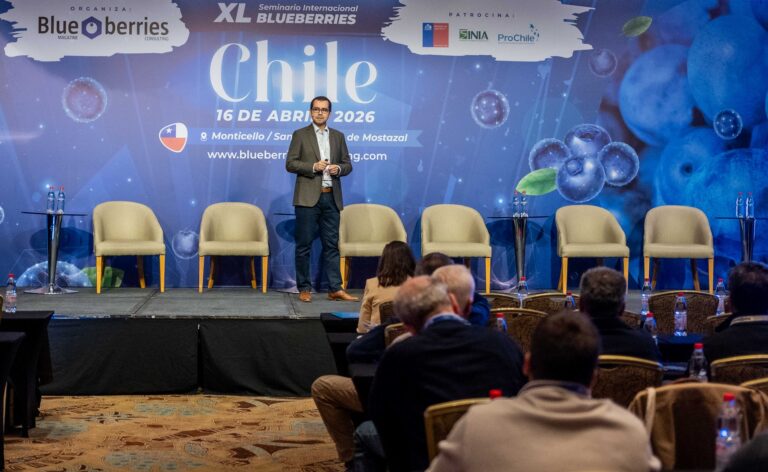
Gonzalo Salinas at the XL International Blueberry Seminar Chile 2026 © Blueberries Consulting

Consistency shifted to the center
If there's one variable that runs through the entire presentation, it's consistency. Salinas emphasized that the market can open up space for different fruit profiles, but the consumer experience needs to be repeatable. Chile, he said, is in a transition where it must leave behind the logic that the box of blueberries be an unknown quantity and move towards a fruit that provides security of purchase and repurchase.
From that perspective, consistency ceased to be a complementary attribute and became one of the most decisive criteria for sustaining value. The opportunity remains, but the market no longer rewards simply the presence of fruit, but rather the ability to repeat a positive experience.
Europe consolidates, while China changes
Another key aspect of the presentation was the analysis of export destinations. Salinas showed that Europe has established itself as the main market for Chilean fruit and that shipments of organic blueberries have been growing strongly in that continent during the last few seasons.
China, on the other hand, appears to be a market that requires closer scrutiny. Salinas warned that Chile has been withdrawing from that market and that price trends and the end of the season necessitate closer monitoring of this shift. Meanwhile, Europe and the United States continue to offer more favorable signs for Chilean fruit, albeit within a much more competitive environment.

Gonzalo Salinas at the XL International Blueberry Seminar Chile 2026 © Blueberries Consulting

A young market, with more consumers and different types of blueberries.
Despite this increased competitive pressure, Salinas emphasized that the market is still young and that there isn't a single blueberry that suits all consumers. There are different preference profiles—based on size, texture, or flavor—and that opens up space for a category that continues to expand.
In the United States, consumption is still heavily concentrated in the premium segment, indicating that the category still has room to expand without losing value. Salinas sees this tension between democratization and maintaining a premium position as a category that will continue to grow, incorporating new consumers and coexisting with different types of fruit depending on the occasion and preference.
For Chile, this scenario continues to offer opportunities, but under an increasingly clear condition: competing with a blueberry that consistently meets market expectations. In this competition, the difference isn't solely determined by volume, but by the experience the fruit delivers with each purchase.
Check out the video of Gonzalo Salinas on our YouTube channel Blueberries TVwhere he explains that the blueberry has established itself as a truly global fruit, with growing demand and greater market diversification.
More news about the International Blueberries Seminar Chile 2026:
- Pilar Bañados: the transformation of the Chilean blueberry requires more than just new varieties
- Rodrigo Ferreyra: In substrate, water management requires more control
- From heat stress to final quality: the physiology that defines the modern blueberry today
- From root to fruit: the physiological and nutritional keys to today's blueberry
- Market, genetics and global competition: the signs for the Chilean blueberry business
- International Blueberry Seminars 2026: Blueberries travel through Peru, Chile, Mexico, Morocco and China
ARTÍCULOS RELACIONADOS