Jessica Rodriguez: Reducing the time between harvesting and cooling will be key to protecting the firmness of blueberries
The condition of blueberry It can begin to deteriorate before reaching the packing facility. In higher temperature scenarios, the fruit's exposure to the sun, the time between harvest and cooling, gasification, pre-cooling, and humidity in the storage chamber can all affect firmness and post-harvest life.
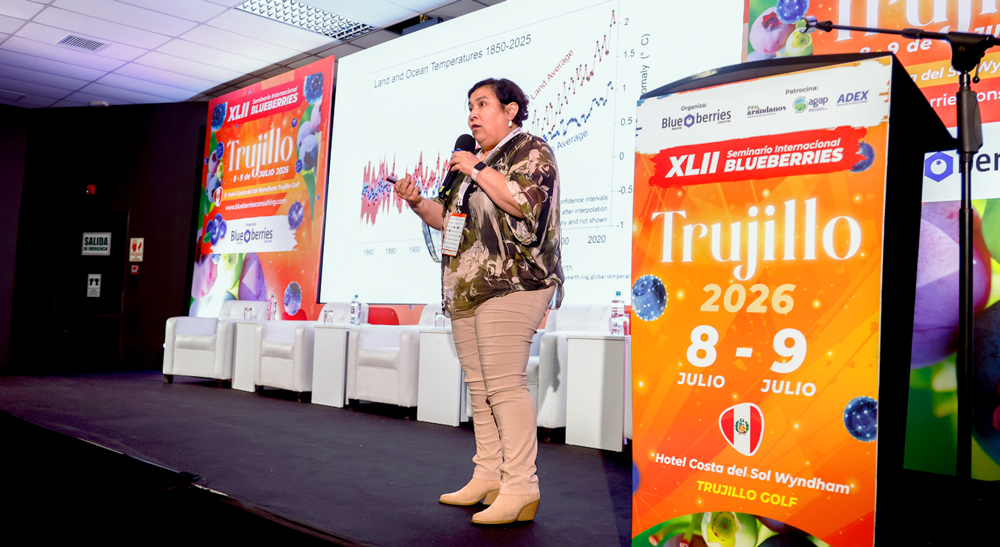
That was the perspective presented by Jessica Rodríguez, an agronomist, Master of Science and advisor on post-harvest, marketing and sales of fresh products, during her talk “Climate change and fruit quality: Implications for post-harvest condition and life”, at the XLII International Blueberries Seminar Trujillo 2026.
Rodríguez distinguished between El Niño and climate change: the former is a well-known event in the industry; the latter is making its cycles and impacts more complex. From there, he steered the discussion toward a practical question: how to reduce deterioration once the heat begins to affect the fruit.

The fruit may be warmer than the surrounding environment.
One of the clearest examples of his presentation was a field measurement: with the air at approximately 24°C, a blueberry exposed to the sun it reached 30,6°C.
For Rodríguez, that difference matters because the blueberryBecause it is a dark fruit, it can absorb more heat than other fruits exposed to the same conditions. Therefore, an ambient thermometer does not always reflect the actual level of heat stress the fruit is experiencing.
The consequence is direct: harvest time, exposure time, transport and cooling cease to be operational details when the fruit already arrives hotter from the field.
Water loss is also a loss of firmness
Dehydration was one of the central points of the discussion. Rodríguez emphasized that, in blueberriesLosing water doesn't just affect appearance.
“Maintain, avoid dehydration of blueberry "It's extremely important. Because it's not just that the blueberry wrinkles, it loses firmness," he pointed out.
Fruit that loses water in the field, during waiting, or in poorly controlled processes arrives with less capacity to withstand transit, marketing, and destination.
The specialist also showed that when temperatures rise and there isn't adequate nighttime cooling, firmness can deteriorate quickly. In one of her measurements, fruit from the same orchard showed reduced firmness just two days after a sharp temperature increase.
The risk increases when a fruit already exposed to heat enters a slow operation, with prolonged waiting or handling that favors water loss.
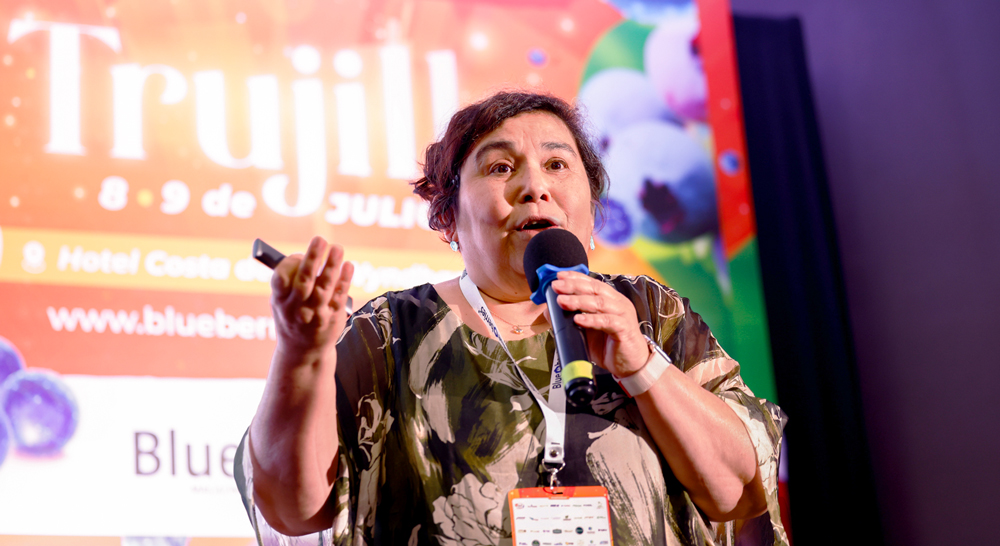
Jessica Rodriguez International Blueberries Seminar Trujillo 2026 © Blueberries Consulting

Shorten times before cooling
Rodríguez summarized the contribution of post-harvest in one simple idea: efficiency.
“What is the greatest contribution I can make in post-harvest? To be efficient,” he stated.
If the weather cannot be changed, it is possible to reduce times, avoid unnecessary waiting, reach the cooling stage sooner, cool well, process as soon as possible and pack with a more disciplined operation.
In their assessments, a process like gasification could concentrate water loss in just a few minutes, especially due to the ventilation required to circulate the gas. The problem isn't gasification itself, but the loss of profit margin when the fruit is already exposed to heat.
He also stressed the importance of paying close attention to pre-cooling, storage chambers, and relative humidity. The longer the time before the fruit is stabilized, the greater the risk of water loss. And if that loss results in reduced firmness, the impact extends beyond operational issues to become commercial ones.
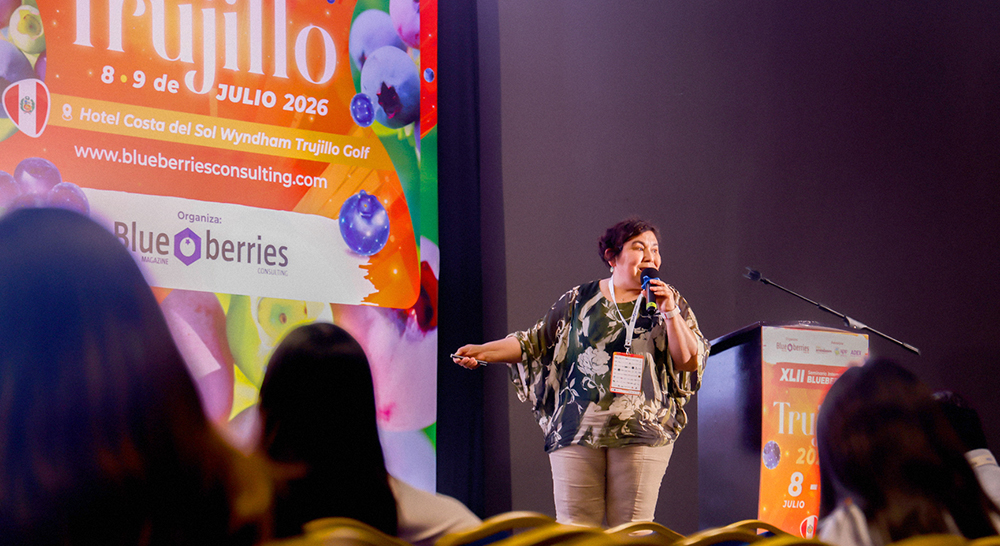
Jessica Rodriguez International Blueberries Seminar Trujillo 2026 © Blueberries Consulting
Measure varieties to make better decisions
The presentation concluded with a discussion of varietal adaptation. Rodríguez demonstrated that different varieties can respond differently to temperature increases.
In some cases, heat can affect size, solids content, or compounds associated with quality; in others, the effect may be less pronounced. Their conclusion was clear: it is not enough to assume that a variety will perform the same in all areas or under all climatic conditions.
“One way to combat this effect of climate change is to study the varieties, see how they behave, measure and select,” he said.
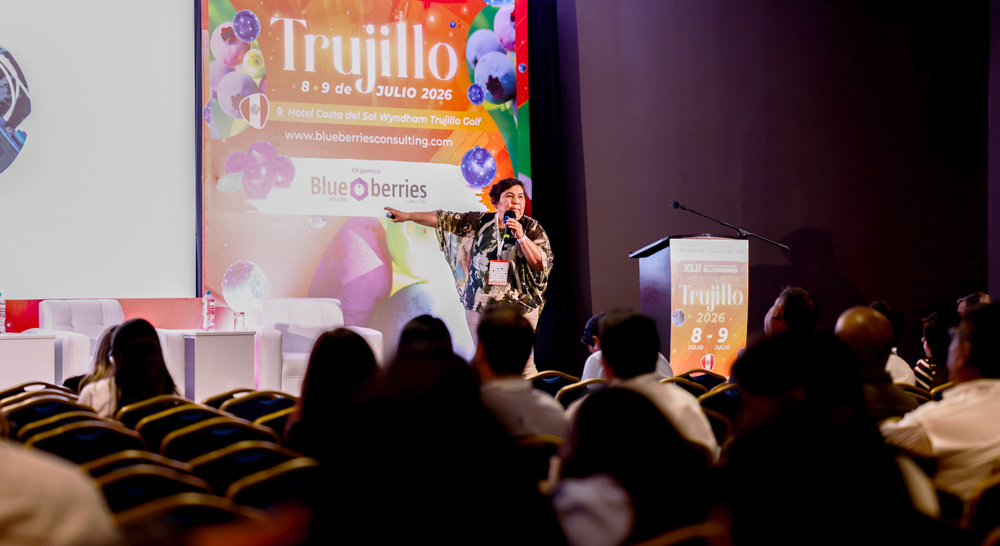
Jessica Rodriguez International Blueberries Seminar Trujillo 2026 © Blueberries Consulting
In Peru, with more than 29 hectares cultivated and a wide varietal matrix, measuring the response of each variety to heat is directly involved in campaign planning.
Rodríguez also mentioned mitigation tools, such as netting, roofs, covers, or harvesting during cooler hours. But his message didn't focus on a single solution, but rather on understanding what problem needs to be corrected and what effect each management practice might have on temperature, humidity, and firmness.
For producers and exporters, the message is clear: don't expect the cold to correct what the fruit lost earlier. In seasons more exposed to heat, maintaining firmness will depend on time, measurement, and operational discipline from harvest to cooling.
Read also:
- Luis Miguel Vegas: Peru doubles blueberry production, but El Niño forces cautious projections
- Market, genetics and quality in the planning of the Peruvian blueberry
- Jessica Rodríguez: "There is little awareness of how valuable the times between harvest and cooling are"
- International Blueberry Seminars 2026: Blueberries travel through Peru, Chile, Mexico, Morocco and China
ARTÍCULOS RELACIONADOS