"We need to look for collaborative systems that allow for more robust negotiations with shipping companies."

Manuel José Alcaino, President of Decofrut, is an international consultant recognized by the fruit industry, not only for his experience and his excellent market analysis, but also because his vision goes far beyond the mere interpretation of data and he dares with great certainty to create theses or strategic courses for the industry in its quest to overcome the challenges posed by the market, consumers, and competition.
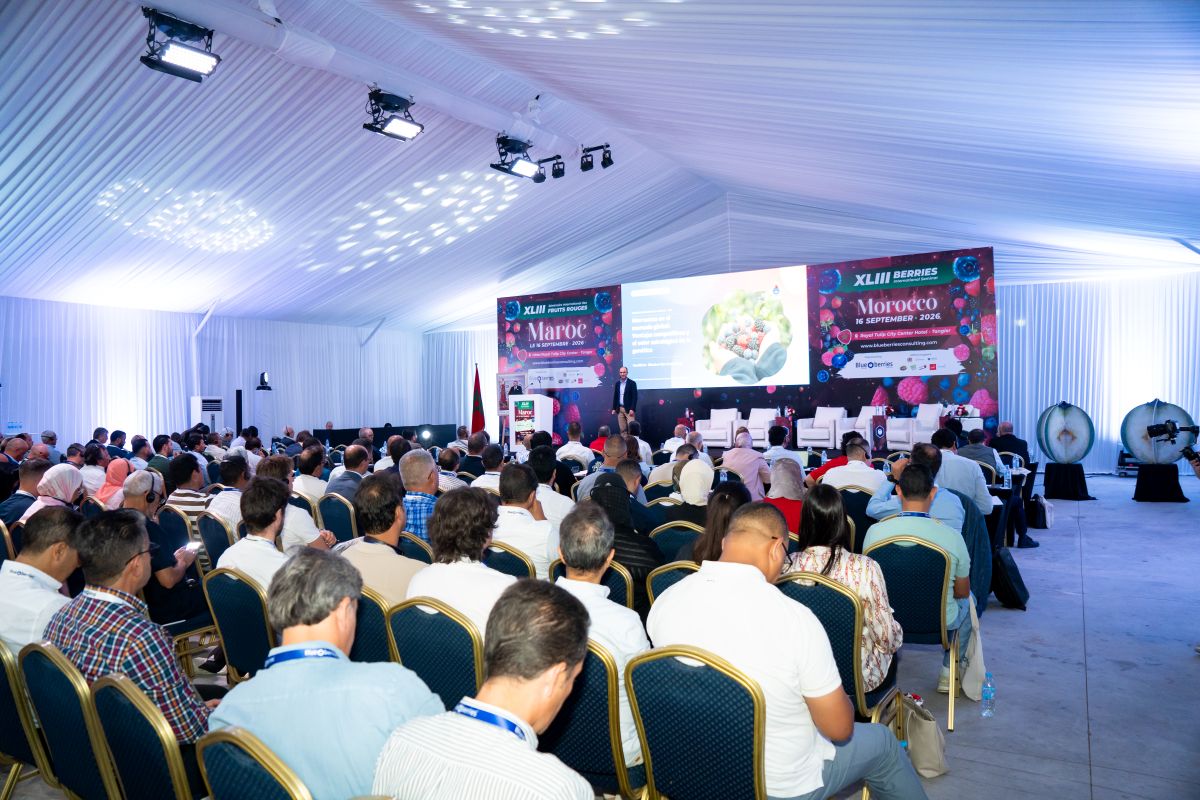
We spoke with the specialist in the 2025th International Blueberry Seminar Chile XNUMX held in Monticello, Chile, on opportunities for collaboration between the blueberry and cherry industries, the role of the development state, and the main challenges faced by the blueberry sector in Chile.
What opportunities could arise if joint international promotion strategies were developed between the blueberry and cherry industries, especially in markets such as China and the United States?
– I would expand the question to include collaboration, not only in terms of promotion, but also in other aspects such as logistics, because our challenges in the blueberry business largely come from the logistics side. Therefore, in order to reach distant markets, such as Europe and Asia, we need to look for collaborative systems that allow for greater volume and, therefore, more robust negotiations with shipping companies.
In the case of cherries, there's a wonderful example: the so-called "Cherry Express," which brought the industry together with shipping companies and addressed the problem, bringing forward this project, which is both marvelous and iconic in the industry. In the case of blueberries, we have a significant gap with Europe, for example, where 40 percent of the fruit normally goes. We have very slow transit, very poor, let's say, a very poor logistics operation, and therefore it would be interesting to be able to sit down with the shipping industry and find a solution to that effect, because greater volume is more attractive to shipping companies. So, this is an interesting collaborative opportunity.
Now, from a promotional perspective, in my opinion, good work is being done.
Chile Fruits, which leads the field of promotion abroad, has done an extraordinary job and the collaboration that exists is already underway, it is already being implemented.
That's where my ideas go, let's say. And certainly, in the commercial issue itself there are certain strategies that could be worked on together, but they are specific to each company, because obviously the State cannot enter the trade organizations to interfere in the commercial issue.

Alcaino explains that the State has no involvement in the commercial aspect of industrial agriculture. "With the trade organizations that govern the industry, yes, because today there's a lot of collaborative work that can be done, I say, but it's not the responsibility of the State; this falls to the trade organizations that govern it, as is the case with Frutas de Chile, or with exports in the case of fruit.
Other aspects, such as the availability of labor or negotiations of this type, could support the State or collaborate in other efforts.
In the case of the special visa for harvesters, for example, it's an issue in which the State has a lot to say, but that initiative has to come from the industry."
Challenges and mistakes
Finally, we asked him about the main challenges or mistakes he felt the Chilean blueberry industry faced in its development and what lessons have been learned.
“Wow, what a question! Right? Well, I'd say that, let's see... the off-season blueberry industry was invented by Chile. The great ideologist was Don Victor MollerRest in peace. I think the idea was very well-directed, let's say, considering that Chile had the capacity to supply more than 90 percent of the American counter-season; almost 100 percent went to the American market at that time. I'm talking about about 20 years ago, with the varieties and quality offerings available at the time. Let's just say it wasn't very good, but it addressed a need, a demand that was being created at that time because American production was ending, and there was a long period of no production until the next season came, and that's when Chile stepped in with a wonderful window.
Well, time passed and this window began to close.
Early bidders began to appear, late bidders began to appear, and the window kept closing, closing, closing, until finally it closed completely.

What didn't we learn? What did we fail to do? It was not adapting our offering quickly, or quickly enough, to the quality that the market was demanding, which was increasingly changing and which was what these new players, who began to fill these windows, were delivering. Today, we have an offering in which more than 50% is made up of two varieties that were very good at the time, but which have aspects that the market no longer wants.
We're talking about the size, for example. The market demands a minimum of fourteen millimeters, so if you look at these two varieties and take out what's under fourteen millimeters, you're cutting off forty or fifty percent of the supply.
Plot industry
So, we have had to make this transition to new varieties, with better sizes, good firmness, and good sugar, slowly, and this is largely due to the fact that the Chilean industry, at its inception, at its creation, was what Don Víctor Moller once called: "An industry of plots," four hectares here or six hectares there. The ones involved in this game weren't big players, and that's what we're trying to change now with the arrival of large investors, new players, who are planting much larger areas."
The specialist exemplifies with the case of Peru and comments that in Peru it started Camposol producing blueberries, and planted 1,000 hectares in the first year. “1,000 hectares,” he emphasizes, recalling that the largest producer in Chile at the time had no more than 100 hectares. “So, what have been our mistakes? I don't know if I should call them mistakes. They are the characteristics and conditions as they developed, as the industry developed. And that is a reality, that is the reality we have to face now, and we have to adapt to that change.”

The change
"Change has to come now, but...why? So we can differentiate ourselves with a different product."
Alcaino highlights the different conditions in Chile and focuses on the country's abundant winter cold, which Peru lacks, emphasizing that High Chill varieties produce fruit, or tend to produce fruit with more sugar and better quality.
"But we have to look for varieties that combine more sugar with larger caliber and good firmness, and those three elements are what we need today. That's the battle we have."
We look forward to seeing you at our next event, XXXVI International Blueberry Seminar, Guadalajara, Mexico, May 28-29. To participate as a sponsor click HERE. To purchase tickets click HERE
Discover the International Seminars that Blueberries Consulting carries out in Lima-Peru, Trujillo-Peru, Chile, Mexico and Morocco.
ARTÍCULOS RELACIONADOS