Egyptian blueberries: volume is growing, but value depends on destination
By: Natalia Rubio Iversen
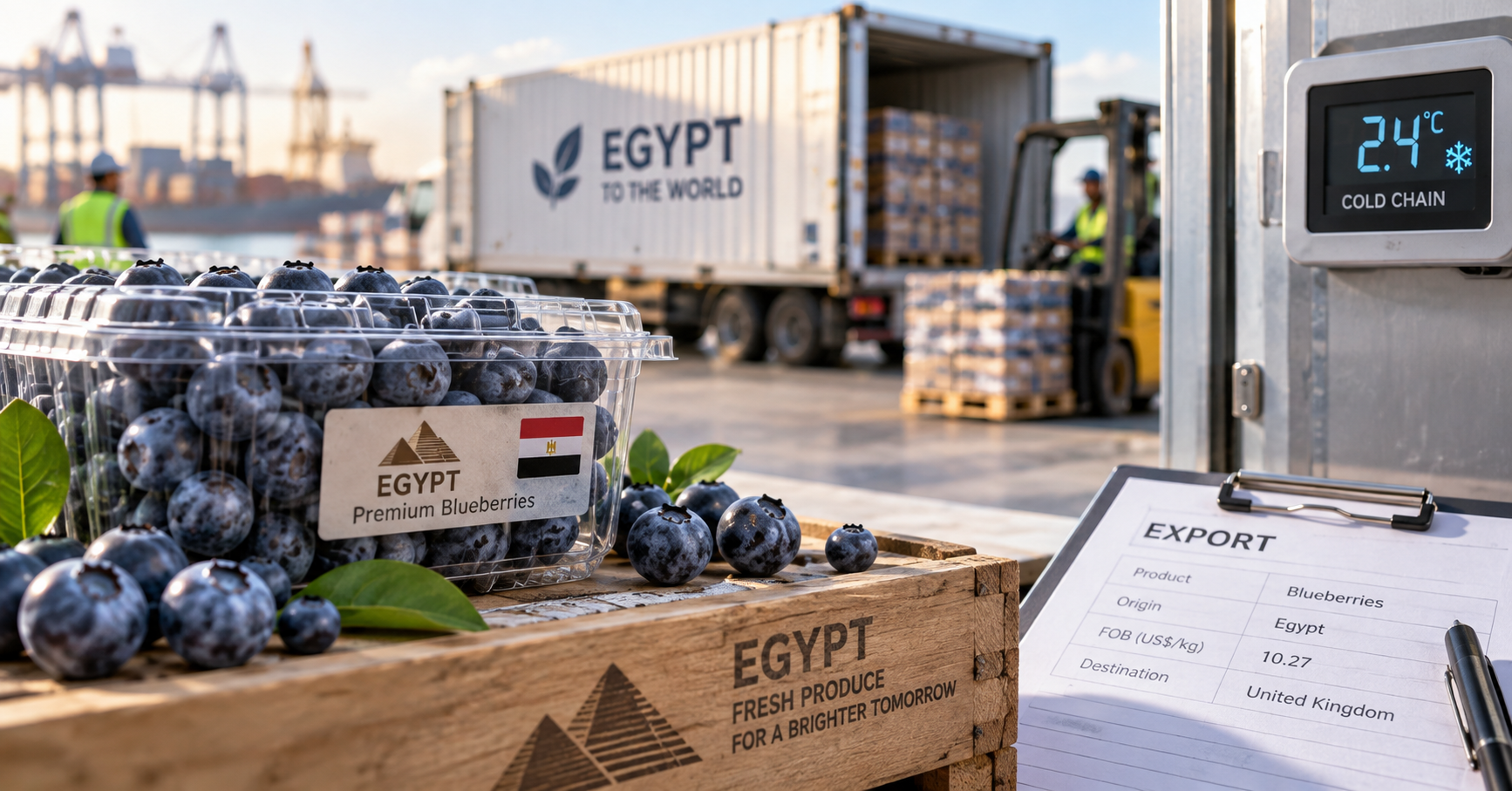
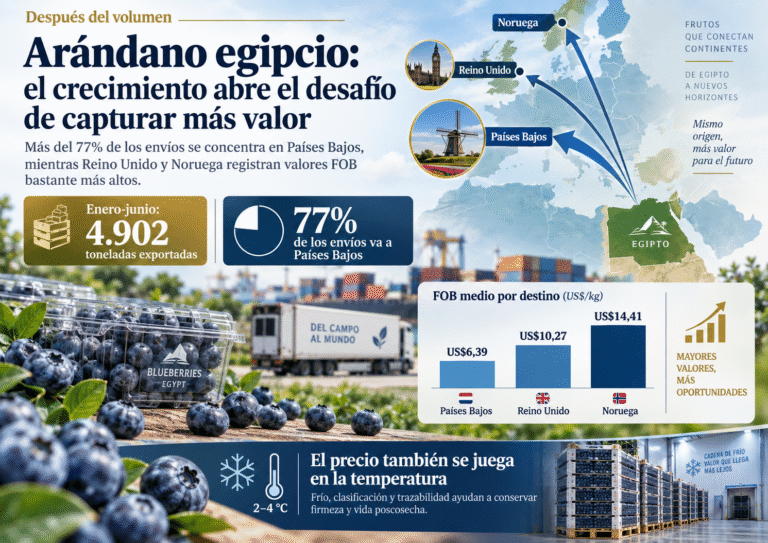
Egypt has already moved beyond the experimental stage. Between January and June, it exported 4.902 tons of blueberries and confirmed that it can move more fruit to Europe.
From there, the question changes. It's not enough to look at volume. Where that fruit ends up and its value in each destination also matters. Data from Blueberry World Analytics, by Blueberries Consulting, shows that this expansion doesn't achieve the same value in all markets.

The Netherlands accounts for the volume
77% of shipments end up in the Netherlands, which remains the main gateway for Egyptian blueberries to Europe. For a rapidly growing industry, this market accounts for a significant portion of the exported volume.
That doesn't mean all the fruit has to follow the same path. Some of the supply can find better prices in other markets, provided it meets the quality, condition, and volume requirements of those destinations. The Netherlands handles the majority of shipments, while other markets show higher FOB values.

The price varies depending on the destination
The Netherlands registers an average FOB price of US$6,39 per kilo, compared to US$10,27 in the United Kingdom and US$14,41 in Norway. The difference is significant and shows that Egyptian blueberries do not fetch the same price in all markets.
That doesn't necessarily mean the UK or Norway are more profitable. Each transaction is influenced by factors such as size, quality, shipping week, packaging, specifications, and commercial terms. Furthermore, the available resources don't allow for a fair comparison of the volume shipped to each destination, so the FOB price difference should be interpreted with caution.

The price is also influenced by the temperature.
The price difference isn't solely due to the destination. To reach markets that pay more, the fruit must maintain its condition from harvest onward. When blueberries are exposed to high field temperatures after harvesting, respiration and water loss increase, affecting firmness and post-harvest life.
This is where the link between handling and business comes in. Proximity to Europe helps, but it's not very useful if the fruit loses quality before leaving the packing facility. Cold storage, grading, and traceability must keep pace with export growth. The question, then, is which fruit is best moved through a high-volume channel and which has the necessary quality to command a better price. This difference begins in the field and is preserved—or lost—during post-harvest.
Read also:
- Egypt gains scale in blueberries and accelerates its exports
- Peru opens the Egyptian market for blueberry exports, bringing its total to 76 destinations.
- Peru adds Egypt as a destination for its blueberry exports
- Egypt begins its blueberry season
- Egypt emerges as a new player in the blueberry industry, with the United Kingdom as its main destination.
- Conventional blueberry production sustains Peruvian blueberry export growth, while organic production falls 33% short of projections.
- Chile is betting on Morocco to open up a market for its fresh fruit in North Africa
Previous article
Chile is beginning to show signs of repositioning itself in the global blueberry marketnext article
ARTÍCULOS RELACIONADOS