Egypt gains scale in blueberries and accelerates its exports
By: Natalia Rubio Iversen
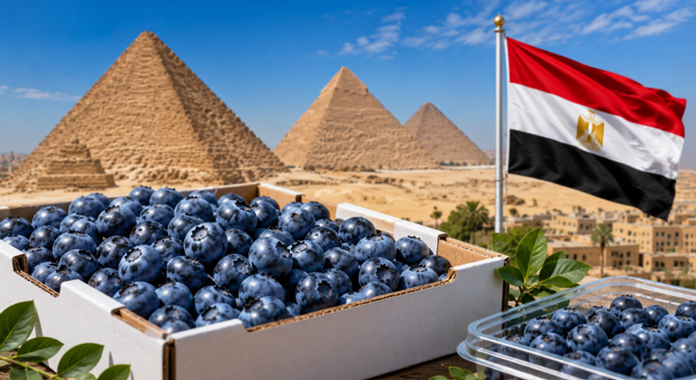
Egypt ended 2025 with a blueberry production of 2.100 tons, double the 1.050 tons recorded the previous year, while its exports increased from 320 to 1.450 tons, according to the IBO Global Blueberry Report 2026. Although its volumes are still small compared to the main producing origins, the growth confirms that Egypt is beginning to gain scale as a source.
That growth accelerated in 2026. According to Blueberry World Analytics, from Blueberries Consulting, between January and June Egypt exported 4.902 tons, compared to 1.336 tons in the same period of 2025, an increase of nearly 267%.
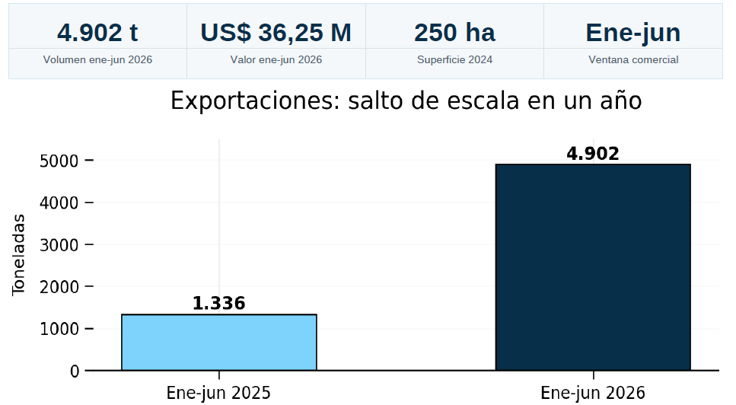
Image: Egyptian blueberry exports, January-June 2025 vs. January-June 2026. Source: Blueberry World Analytics, Blueberries Consulting.
During that same period, the value of exports increased from US$10,29 million to US$36,25 million. Furthermore, 77% of the volume was destined for the Netherlands, followed by the United Kingdom and Norway.

Projects change scale
Until a few years ago, most projects in blueberries The areas identified in Egypt did not exceed 5 to 8 hectares. The IBO notes that new plantations by professional operators now start on scales of 30 to 50 hectares, while some developments reach 300 hectares.
The increase in the size of the projects coincides with a greater presence of international companies. Several of them reported their first commercial harvests in Egypt during 2025, while new operators continue to enter the sector.

Image: Blueberry production in Egypt increased from 620 tons in 2023 to 2.100 tons in 2025. Source: IBO Global Blueberry Report 2026.
The scale the industry can reach is also reflected in the plans of its main producers. One of the two leading operators interviewed by the IBO projects reaching around 10.000 tons of its own production by 2028, as the plantations under development come into production.

A still young industry
Production is concentrated mainly in agricultural projects near the Nile River, between Cairo and Alexandria, and is primarily carried out in greenhouses. The report also identifies some shade-grown plantations in areas further south.
Despite rapid growth, the industry of blueberry Egyptian cultivation is still in its infancy. Sources consulted by the IBO indicate that local production knowledge is still limited and emphasize the need to strengthen training for teams entering the field. They also caution about compliance with varietal licenses as new operators become involved.
Post-harvest is another challenge that accompanies this expansion. Blueberry World Analytics Harvest temperatures above 40°C are identified as a factor that can compromise the firmness and post-harvest life of the fruit. Under these conditions, timely pre-cooling and continuity of the cold chain are relevant factors for preserving the fruit's condition upon arrival.
The early window is not yet reflected in shipments
Blueberry World Analytics The IBO identifies January-March as an early window with potential for origin. It also includes the estimate that the blueberries Egyptian crops could be harvested between four and six weeks earlier than those from Morocco.
However, this potential advantage is not yet clearly reflected in trade flows. The IBO itself points out that export trends for Egypt and Morocco show similar patterns, with shipments increasing since February and their highest volumes concentrated between April and May.
Egypt is already showing a larger scale of production and exports. The coming cycles will reveal how market diversification evolves, the condition of the fruit upon arrival, and the potential differentiation of its market window compared to Morocco.
Read also:
- Peru opens the Egyptian market for blueberry exports, bringing its total to 76 destinations.
- Peru adds Egypt as a destination for its blueberry exports
- Egypt begins its blueberry season
- Egypt emerges as a new player in the blueberry industry, with the United Kingdom as its main destination.
- Conventional blueberry production sustains Peruvian blueberry export growth, while organic production falls 33% short of projections.
- Chile is betting on Morocco to open up a market for its fresh fruit in North Africa
ARTÍCULOS RELACIONADOS