Morocco strengthens its position in the global blueberry market with increased production and export volumes
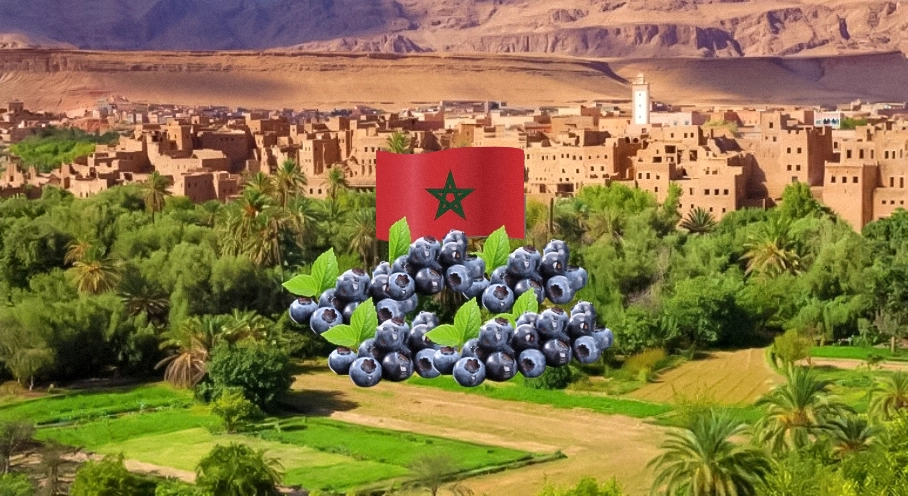
The production and exports of blueberries Blueberry production continues to grow in Morocco, solidifying the country's position as a key supplier to the international market, particularly to Europe. Recent data from the International Blueberry Organization (IBO), Morocco Foodex, and international trade sources demonstrate the rapid transformation of the Moroccan industry, although this expansion also presents significant climatic, production, and commercial challenges.
Growth has been driven by an increase in cultivated area, improvements in productivity, investments in protected production, and rising demand for fresh fruit. However, the 2025/26 season also highlighted the sector's vulnerability to heavy rainfall, low temperatures, strong winds, and other weather-related disruptions.
Morocco is gaining ground among the top producers
According to the most recent IBO assessment, Morocco was projected to be among the world's top five producers by 2025. blueberriesAfter surpassing several traditional producing countries, the organization reported a production of 84.940 tons and projects that both the cultivated area and volumes will continue to increase.
The IBO also identifies Morocco as one of the fastest-growing origins within Europe, the Middle East, and Africa. Previous data from the organization placed production at blueberries Fresh production is projected at approximately 71.700 tons in 2024, with yields close to 18.343 kilos per hectare. Nearly 95% of production is expected to be destined for international markets, reflecting the sector's strong export orientation.
The magnitude of the change becomes clear when reviewing its trajectory. In 2009, Morocco exported around 636 tons of blueberriesBy 2024, shipments had increased to approximately 83.000 tons, according to international data cited in recent reports.
With that growth, the country quickly rose to become one of the world's leading exporters. Data from 2024 placed it among the top four exporters, along with Peru, Chile, and Spain, with a share of nearly 8% of global shipments.
Globally, blueberry exports that year were estimated at around one million tons, with an approximate value of US$6.700 billion.

Exports continue to expand
Data for the 2025/26 agricultural season confirms that growth continued. Morocco Foodex reported that Moroccan exports of blueberries They reached 102.141 tons, of which 92.510 corresponded to fresh fruit and 9.631 to processed products. The combined volume was 7% higher than the previous season.
The differences between annual production figures and seasonal exports are explained by the fact that both statistics consider different periods and categories. Production estimates usually refer to a calendar or production year, while export figures can cover a specific agricultural season and include both fresh fruit and processed products.
Geographic location remains one of Morocco's main advantages. Its proximity to Europe allows for the faster transport of fresh fruit than from suppliers located farther away. Spain, Germany, and the United Kingdom are among the key destinations for Moroccan fresh produce, although the industry is also looking to expand its presence beyond Europe.
The IBO also highlighted Morocco's growing role as a supplier during the winter and spring. Its production season can extend from November to July, allowing it to supply the European market during periods when the supply from some competing origins is more limited.
At the same time, there is increasing interest in developing markets in Asia and the Middle East.
Genetics, technology and quality accompany growth
The sector's expansion has been supported by investments in new varieties, protected production, post-harvest handling, and logistics. Producers are incorporating improved genetics and new cultivation technologies to increase yields and meet the quality demands of major international buyers.
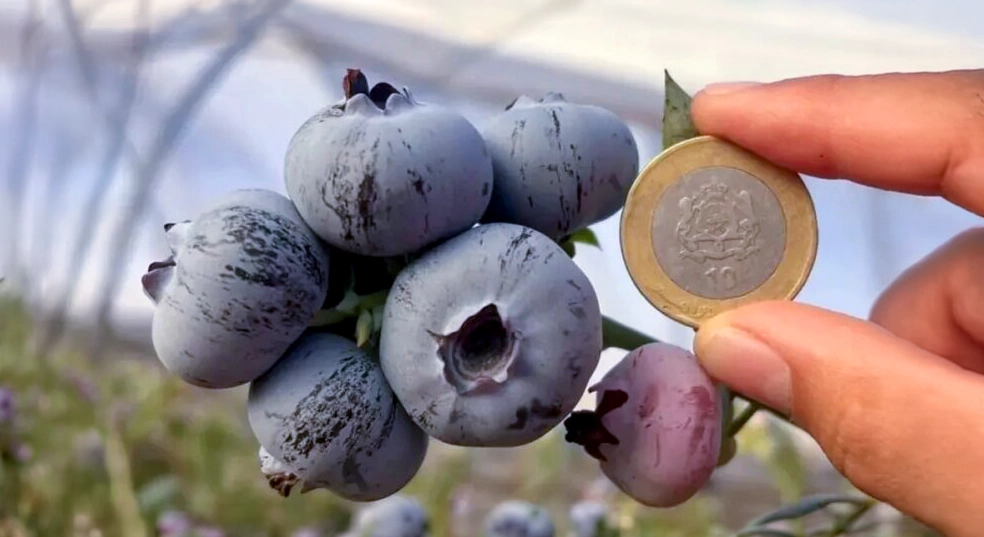
Blueberries produced in Morocco alongside a 10-dirham coin, used as a visual reference for their size. © talianberry.it
However, rapid growth has also made some risks more visible.
Weather conditions were particularly challenging during the 2025/26 growing season. Morocco experienced heavy rainfall and unusually low temperatures from late 2025 to early 2026, especially in the northern growing areas.
In the south, strong winds caused damage to greenhouses, plastic coverings and other infrastructure used in protected production.
The impact became especially evident during the first months of 2026. The IBO reported that the storms that affected Souss-Massa in February caused significant damage to production structures. Some estimates pointed to reductions of between 15% and 25% in volumes of blueberries towards the ninth week of the season, with considerably greater losses in certain locations.
Successive rains, low temperatures and less solar radiation would also have contributed to reducing the volume and size of the fruit in some areas.
Despite these difficulties, Morocco maintained relatively strong export activity. Shipments declined during February and March, but subsequently recovered and exceeded normal levels in April and May.
This evolution showed the industry's ability to partially compensate for the initial disruptions thanks to the contribution of different producing regions and later harvests.

Water and labor, long-term challenges
Water availability is another structural challenge.
The cultivation of blueberry It requires a reliable water supply, while Morocco faces persistent shortages and prolonged periods of drought. Therefore, the expansion of high-value crops will increasingly depend on efficient irrigation systems, improved water resource management, and technologies capable of sustaining productivity under more restrictive conditions.
The availability of workers also becomes more important as production increases. The IBO has warned that the sector's rapid expansion is increasing the demand for seasonal labor, and that producers in various regions are finding it difficult to secure enough workers during peak harvest periods.
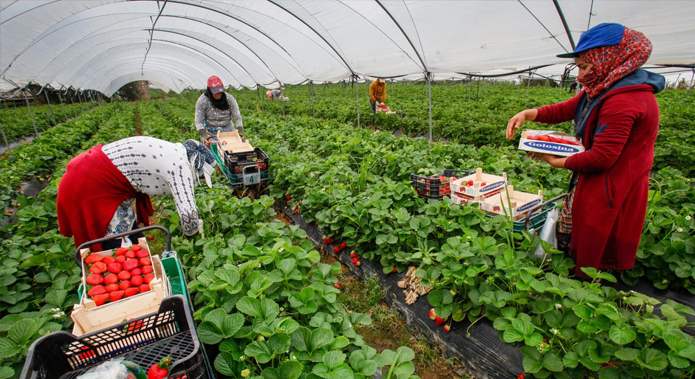
Moroccan workers during the red fruit harvesting campaign © Blueberries Consulting
A global industry with greater supply
Moroccan growth is occurring within a global industry that is also continuing to expand.
According to the IBO, global production of blueberries It reached approximately 2,15 million tons in 2024, 21% more than the previous year. Fresh fruit accounted for about 78% of that volume, and the remaining 22% was destined for processing.
Global production should continue to increase over the next few years due to new plantations coming into commercial production and improved yields.
The Americas remain a major production hub, while Asia-Pacific is rapidly increasing its share, driven primarily by China. Europe, the Middle East, and Africa are also expected to see significant growth, with Morocco identified by the IBO as one of the main drivers.
Projections indicate that Moroccan production could grow by about 70% from a baseline level of approximately 85.000 tons over the next few years.
That scenario could further narrow the gap with the countries that currently lead global production.
The next challenge is no longer just growth
For Morocco, the challenge in the coming seasons will be to sustain this growth without losing competitiveness or profitability.
The increase in global supply, greater overlap between the growing seasons of different origins, and increasing buyer demands necessitate looking beyond volume. The consistency of commercial programs, fruit quality, production efficiency, water and labor availability, the introduction of new varieties, and market access will become increasingly crucial.
As production increases, Morocco will also need to diversify its export destinations. Europe continues to account for a large share of the export business, but developing other markets will become increasingly important to absorb new volumes and reduce dependence on a limited number of destinations.
Reaching more distant markets will also require further strengthening of the cold chain, packaging, selection, logistics and post-harvest technologies to prevent the greater distance from compromising the condition of the fruit.
Morocco puts its next challenges up for discussion
In this scenario, the debate is no longer focused solely on how much Morocco can continue to grow, but on how to sustain that expansion with greater competitiveness, efficiency and adaptability.
That will be precisely one of the central themes of XLIII International Seminar on Red Fruits Morocco 2026, that the September 16 and will bring together specialists, companies, researchers and representatives from different links in the international industry.
The program will address several of the challenges that accompany this rapid growth. Cindy van Rijswick, Rabobank Research, will analyze the global industry of blueberry, trade flows and consumption habits; Álvaro Villalba, from HortifrutIt will delve into Morocco's competitive advantages and the strategic value of genetics; while Thomas Grandperrin, by Agronometrics, will present the experience of the Morocco Data Club and the use of real-time information in the face of the uncertainty of the 2025/26 campaign.
Production challenges will also occupy a central place. Moisés Cohen Amar will address precision water management in blueberries; Daniel Manríquez will analyze the importance of the cuticle in the face of biotic and abiotic stress; and Reinaldo Campos-Vargas, from the University of Chile, will delve deeper into the use of pre-harvest growth regulators to improve quality and prolong the post-harvest life of the fruit.
This will be complemented by the panel “Analysis of the global soft fruit industry: challenges and strategies for competitiveness”, moderated by Amine Bennani, President of the Moroccan Association of Producers of Red Fruits, which will bring together representatives from production, the market, research, international companies and organizations linked to health and export.

Amine Bennani, President of the Association of Red Fruit Producers of Morocco – XXXIII International Seminar on Red Fruits Morocco 2024
The conversation will allow for an analysis from different perspectives of some of the main challenges that accompany the expansion of the industry: productivity and labor, quality and operational efficiency, market diversification, applied research, phytosanitary compliance and the ability to sustain competitiveness in the face of a growing global supply.
The meeting will thus put into discussion a question that is becoming increasingly important for Moroccan industry: what does a sector that has already reached scale need to continue growing without losing quality, profitability or international competitiveness?
Blueberries within the Moroccan agricultural export growth
The growth of blueberries is also part of a broader expansion of Morocco's agricultural exports.
Morocco Foodex reported that agri-food exports reached US$9.100 billion in 2025, a 38% increase compared to 2020, with volumes reaching 4,7 million tons. The agricultural export sector accounted for approximately 18% of the country's total merchandise exports.
Blueberries constitute only one part of this export system, but their rapid expansion reflects the growing importance of high-value fresh fruit within Moroccan international trade.
In less than two decades, Morocco has gone from being a relatively small blueberry producer to a major player in the global trade. The next step will be to demonstrate that this growth can be sustained in the face of increasing production, environmental, and commercial demands.
That challenge will also be part of the conversation that will bring together the international industry on September 16 in Morocco.

Read also:
- Morocco Data Club: data to anticipate the blueberry market
- Morocco becomes Norway's top supplier of berries
- Morocco: the new berry giant that now faces the challenge of consolidating its leadership
- Tangier will be the meeting point for a rapidly expanding berry industry
- Fruits of Chile celebrates the signing of an agreement between Chile and Morocco to strengthen health cooperation and facilitate food trade
- ProChile invites Chilean agricultural suppliers to explore business opportunities in Morocco
- Chile is betting on Morocco to open up a market for its fresh fruit in North Africa
- International Blueberry Seminars 2026: Blueberries travel through Peru, Chile, Mexico, Morocco and China
Previous article
The competitiveness of blueberries is not only in the resultsARTÍCULOS RELACIONADOS