Tangier will be the meeting point for a rapidly expanding berry industry
By: Martin Carrillo
Morocco is no longer just an emerging source. In just over two decades, the country transformed its industry from a mere source of inspiration. berries through new investments, technology, genetics and a privileged location facing the main European markets.
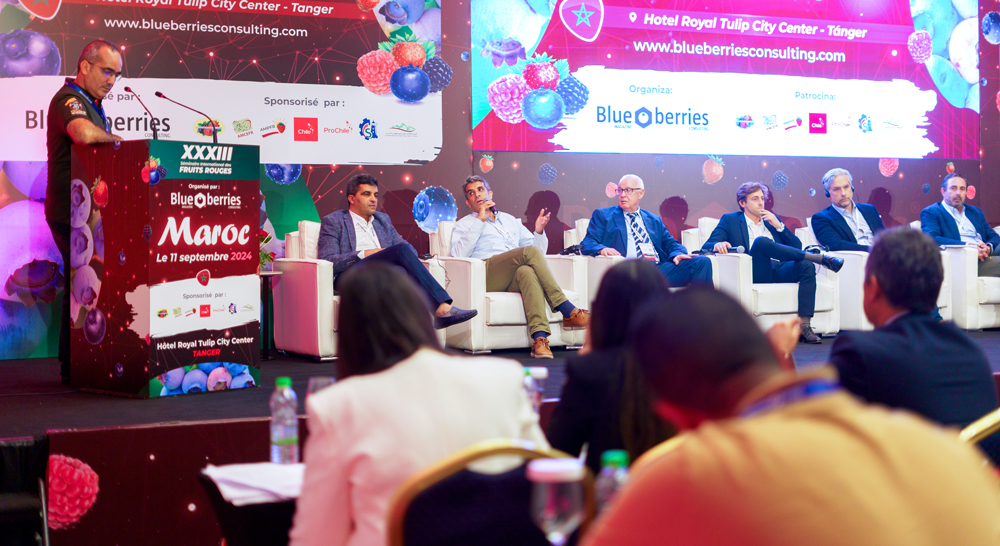
This growth will have one of its meeting points on September 16 in Tangier, when producers, exporters, researchers, consultants and supplier companies will meet at the XLIII International Seminar on Red Fruits Morocco 2026, organized by Blueberries Consulting.
An industry that continues to grow
Moroccan production, initially concentrated on strawberries, diversified into raspberries and especially blueberries, spreading to areas such as Loukkos, Kenitra and Agadir.
Protected agriculture, soilless production, advanced irrigation, and new varieties have accompanied this expansion. Today, Moroccan exports are approaching 100.000 tons annually. blueberries fresh, positioning the country as the main African exporter of this fruit.
Added to this is an advantage that is hard to match: its proximity to Europe. berries Moroccans can reach distribution centers in Spain, France, Germany or the United Kingdom in less than 48 hours, while their production window, between January and May, coincides with the decrease in supply from the southern hemisphere.
The results are already being seen in various markets. During the 2025/2026 season, Morocco accounted for more than half of Norway's imports of fresh raspberries and blackberries, with shipments totaling 707 tons, 22% more than the previous season.

Investments that confirm the potential
International capital continues to flow into the sector. One recent transaction involves Elite Agro Holding, which, through Elite Harvest Maroc, inaugurated its seventh farm in Morocco: 200 hectares in Kenitra destined for blueberries and raspberries.
The group's direct investments in the country exceed 500 million Emirati dirhams and, according to the company, have contributed to generating more than 8.000 jobs.
These are signs of an industry that no longer competes solely on volume. Morocco is also building competitiveness based on technology, productivity, quality, logistics, and market access.
Tangier, a strategic location
In this context, Tangier acquires an importance that goes beyond being the host city of the seminar.
The city is located near some of the agricultural areas that are driving the expansion of the berries in northern Morocco and is connected to an international logistics infrastructure.
Tangier Med, one of Africa's leading port complexes, maintains connections with over 180 ports and has transformed northern Morocco into a natural hub between Europe, Africa, and the Mediterranean. For an export-oriented industry, this infrastructure is not a secondary element: it is fundamental to its competitiveness.


The recent season showed, however, that this strength can also be strained. Floods that affected the north of the country disrupted soft fruit exports and caused problems in fields in Kenitra, Sidi Slimane, and Larache. Producers reported damage to greenhouses, plants, crops, and worker availability.
Some exporters even had to destroy shipments after they remained in the port of Tangier for too long without reaching their European customers.
The situation encapsulates a key tension for the industry: logistics is one of Morocco's greatest strengths, but it can also become a vulnerability when the chain is disrupted.
Tangier 2026: analyzing the next stage
This combination of growth, competitiveness, and new challenges gives special relevance to XLIII International Seminar on Red Fruits Morocco 2026.
The meeting of the September 16 It will allow for the analysis of sustainability, climate change, new production technologies, varieties, logistical efficiency, emerging markets and profitability, bringing together different protagonists of an industry that is undergoing accelerated transformations.
The program also includes an International Technical Tour of northern Morocco, which will allow the discussion to move from the seminar rooms directly to the fields, to learn about production systems and technologies used by Moroccan producers.
This on-the-ground component is particularly relevant because Morocco is no longer just of interest as an exporting source. It is also beginning to position itself as a case study for technologies, production systems, and adaptation strategies in berries.
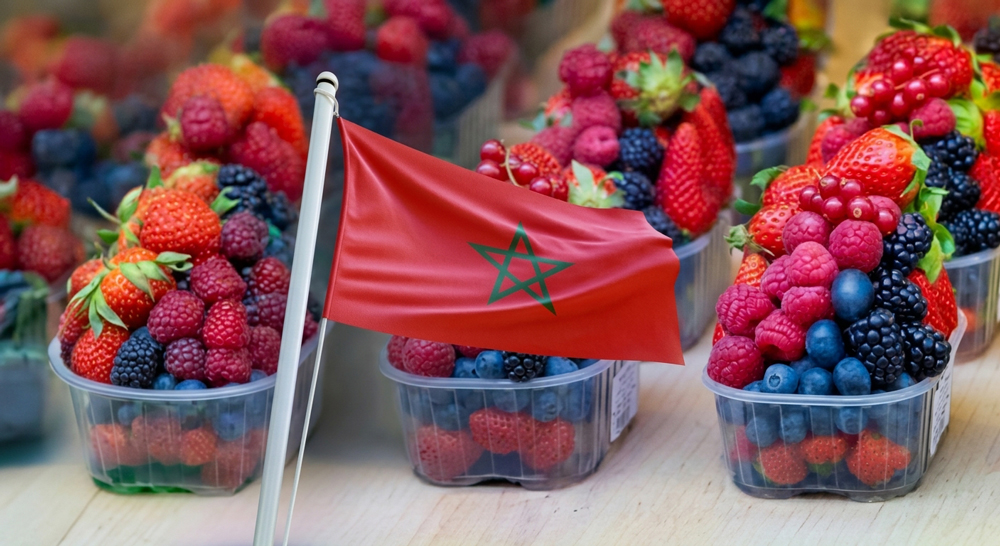
© Morocco World News
A necessary conversation for the industry
Morocco possesses advantages that are difficult to replicate: proximity to Europe, logistical infrastructure, productive investment, technological development, and a strategic trade window. But it also faces challenges common to much of the global industry: water, climate, labor, costs, logistics, productivity, and the need to diversify markets.
That's why the September meeting comes at a particularly opportune moment.
El International Seminar on Red Fruits Morocco 2026 It will not only be an opportunity to analyze how much the country has grown. Above all, it will be an opportunity to discuss how it can sustain that growth and what its place will be in the next stage of the global industry. berries
In that scenario, few cities seem more suitable than Tangier: a gateway between Africa and Europe that today is also projected as a meeting point to think about the future of the berries.
Check out the interview conducted by Blueberries Consulting to Mohamed Amouri, President of the Moroccan Federation of Red Fruits at the XXXIII International Seminar of Red Fruits Morocco 2024.
Read also:
- South Africa is making strong progress: the United Kingdom, the Netherlands, and the United Arab Emirates are leading the way.
- Chile is betting on Morocco to open up a market for its fresh fruit in North Africa
- Morocco strengthens its export offering with a new blueberry and raspberry operation
- Morocco: the new competitive frontier of the global blueberry
- Fruits of Chile celebrates the signing of an agreement between Chile and Morocco to strengthen health cooperation and facilitate food trade
- ProChile invites Chilean agricultural suppliers to explore business opportunities in Morocco
ARTÍCULOS RELACIONADOS