Morocco: the new competitive frontier of the global blueberry
By: Martin Carrillo
Just two decades ago, Morocco was an emerging player in the industry of blueberry. Today, Morocco is the world's fourth-largest exporter, one of the countries with the highest productivity per hectare, and a leader in genetic innovation, precision agriculture, and logistical efficiency. This rapid transformation explains why the upcoming Morocco 2026 International Red Fruit Seminar, to be held in Tangier in September, will bring together producers, researchers, and companies to analyze one of the most dynamic production models in the global market.
For years, the growth of blueberry It was primarily associated with countries like the United States, Chile, and later Peru. However, the global landscape of the industry has continued to evolve, and today Morocco is a major player.
Its development has been rapid. In just over twenty years, the country went from having incipient production to consolidating itself as the fourth largest exporter in the world, sustaining its growth on a combination of foreign investment, genetic innovation, agricultural technology, and a privileged geographical position facing Europe.
Currently, Morocco has over 7.500 hectares planted with blueberries and official projections aim to reach 10.000 hectares by 2030, consolidating an expansion that continues to attract international investment.
Productivity
But the true indicator of competitiveness isn't just on the surface. Moroccan industry registers average returns that compete directly with the levels achieved by Peru, the world's leading exporter.
During 2024, exports ranged between 74.000 and 80.000 tons, representing a year-on-year increase of approximately 15%, generating revenues exceeding USD 500 million. Estimates for 2025 projected exports exceeding 82.500 tons, with an annual volume approaching 95.000 tons. More than expanding its cultivated area, Morocco is growing in efficiency.

Genetics as a competitive strategy
One of the cornerstones of the Moroccan model has been the rapid incorporation of protected genetics. While other countries still maintain significant areas planted with traditional varieties, Morocco has accelerated the shift towards materials with low and zero chilling requirements, incorporating genetic programs from the United States, Australia, and Spain. These programs are part of a strategy aimed at maximizing productivity, fruit quality, and climate adaptation.
This ability to quickly adopt new varieties is one of its main competitive advantages over other origins.
Logistics as a structural advantage
Geographic location represents another decisive factor; while South American producers face long sea journeys to Europe, Morocco supplies that market in a few hours or days, reducing logistical costs and improving the condition of the fruit upon arrival.
Its main trading window —between January and May— also coincides with a period of lower availability from the southern hemisphere, allowing it to capture value before the start of the European season.
This combination of proximity, quality and speed explains the strong growth experienced in recent years.
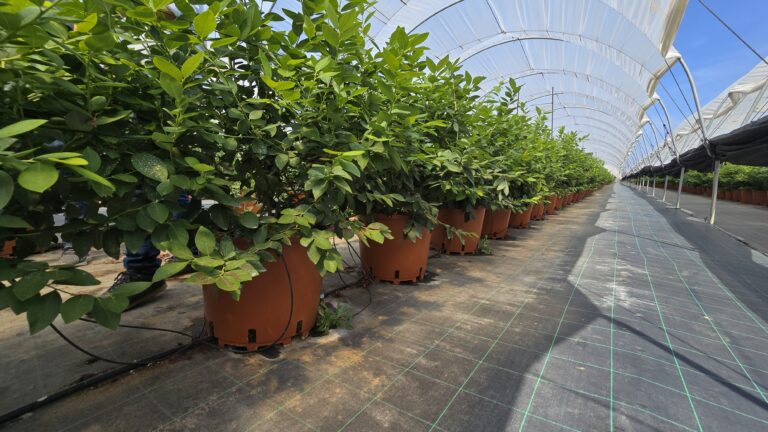
Blueberry production fields in northern Morocco. © Blueberries Consulting

A highly technological model
The expansion of blueberry Moroccan agriculture has also been accompanied by a strong technological integration. Hydroponic substrate systems, high planting densities, smart irrigation platforms, and digital monitoring are now standard features of new agricultural projects.
The use of precision agriculture tools has made it possible to document reductions of around 15,8% in water consumption, while maintaining productivity levels.
In a country where water availability is one of the main structural challenges, efficient water use has become a central element of the production model. However, growth is not without risks.
The 2026 season revealed a new vulnerability for the industry. Severe storms with winds exceeding 110 km/h damaged macro-tunnels and production infrastructure during February, reducing the early estimated volume by 15% to 25%. The consequence was immediate. May exports plummeted from 22.257 tons in 2025 to a mere 1.026 tons in 2026, creating a significant supply constraint.
Conversely, average FOB prices increased from USD6,86/kg to USD8,40/kg, even reaching highs of USD10,95/kg during May.
The episode highlighted that the main risk is no longer just water scarcity, but also the increasing intensity of extreme weather events.
A market seeking to diversify
Another strategic challenge is the high concentration of trade. Currently, approximately 84% of Moroccan exports continue to go to Spain and the United Kingdom, increasing dependence on the European market. Therefore, the industry is actively working to open new markets.
The United States has shown rapid growth in recent years, while Asia appears to be the major medium-term bet. The future opening of the Chinese market could represent a turning point for the sector's development.
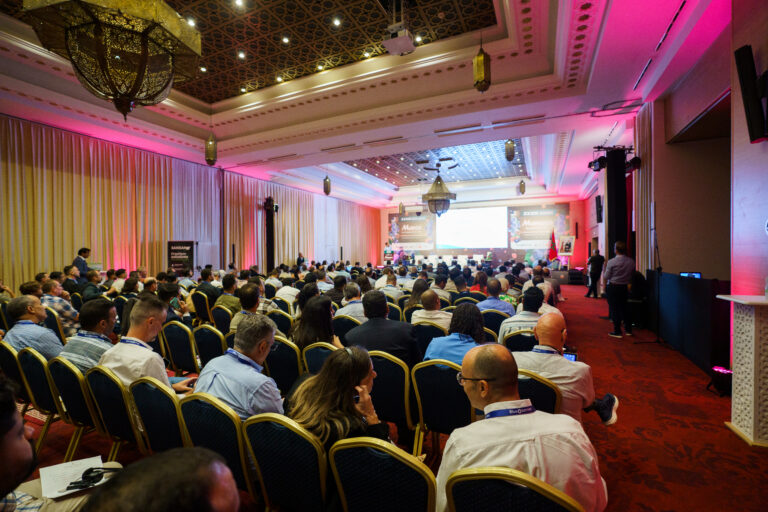
XXXVIII International Seminar on Red Fruits Morocco 2025. © Blueberries Consulting
Tangier: a stage for discussing the future
In this context, the next XLIII International Seminar on Red Fruits Morocco 2026The event, which will take place on Wednesday, September 16th at the Royal Tulip City Center Hotel in Tangier, takes on special significance.
More than a technical meeting, the event will allow for an analysis of one of the production models that is redefining international competitiveness in the blueberry. Genetics, productivity, water efficiency, logistics, climate change, and access to new markets will be some of the topics that will shape the discussion. Because understanding what is happening in Morocco today means not only knowing the reality of a new producing country. It means observing how the global blueberry industry is evolving and what factors will determine competitiveness over the next decade.
The International Technical Tour of Morocco will take place in the northern part of the country, visiting blueberry fields so that producers from different countries can learn in situ Morocco's production and technological techniques.
Do you want to be part of the annual meeting of Mediterranean Red Fruit Producers and Technical Tour? Booths and sponsorships available!
Read also:
-
- ProChile invites Chilean agricultural suppliers to explore business opportunities in Morocco
- Chile is betting on Morocco to open up a market for its fresh fruit in North Africa
- Morocco is growing steadily and consolidating its position in the global blueberry industry.
- North Bay Produce expands its blueberry base in Morocco and calls for collective export visibility
- Morocco strengthens its export offering with a new blueberry and raspberry operation
- International Blueberry Seminars 2026: Blueberries travel through Peru, Chile, Mexico, Morocco and China
ARTÍCULOS RELACIONADOS