Fruit Attraction 2026: Chilean blueberries redefine their competitiveness through genetics, condition, and new markets
By: Natalia Rubio Iversen

Chilean blueberries face a double challenge: improving the profitability of the production project and having fruit capable of maintaining its condition during prolonged transits, while expanding markets and responding to higher quality demands.
From Fruit Attraction 2026 in Madrid, Blueberries Consulting spoke with Ernesto Pino, Regional Director for the Americas at Fall Creek, and Iván Marambio, President of Frutas de Chile. From the perspectives of genetics and production, on the one hand, and markets and logistics, on the other, both viewpoints show how productivity, post-harvest handling, and destination are beginning to define a single competitive debate.
Genetics must address the entire chain.
For Ernesto Pino, a new variety must demonstrate performance both from a production standpoint and in the eyes of the consumer. At Fall Creek, he explains, varietal development starts from a base of already high size, flavor, and firmness: he mentions fruits measuring 18 to 20 millimeters, a balanced flavor between sweetness and acidity, and an increasingly demanding approach to post-harvest performance.
It is precisely in this last attribute that Pino places one of the new objectives of the genetic program.
"These days, the variety is really attractive in terms of firmness after 60 days."
For Chile, this search has particular relevance. Pino links these extended periods to the need for the fruit to maintain an adequate condition until it reaches the consumer, even after long transits.
The demands, however, don't end with the fruit. They also extend to the economic performance of the crop.
Pino points out that investments are increasing and that earliness is becoming a key factor in evaluating new varieties. The goal is for projects to begin producing fruit in significant volumes from the first year and to recoup the investment within three years, for both high- and low-chilling-requirement varieties.
Harvest concentration also comes into play. Ideally, a variety should not require more than three passes over a period of three or four weeks, thus reducing the pressure of harvesting costs.
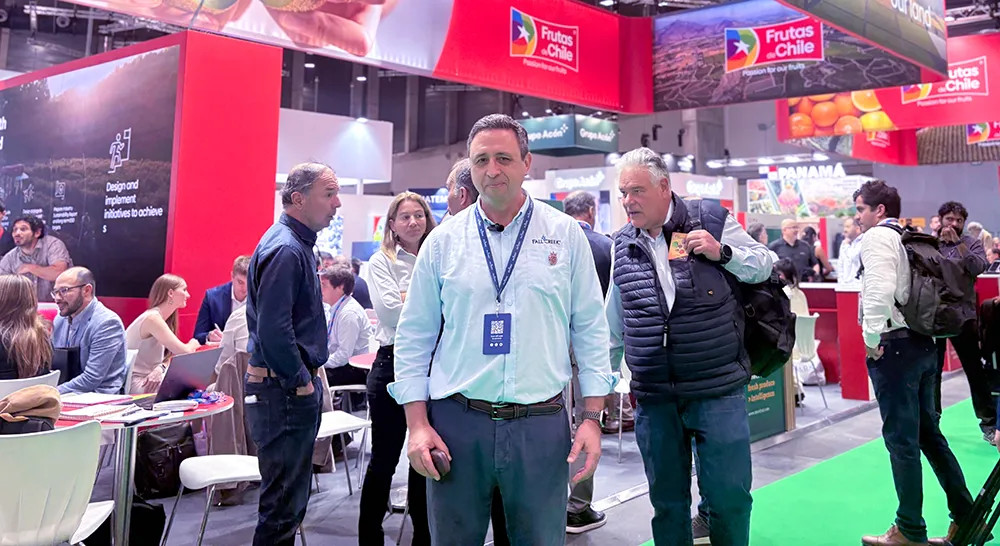
Ernesto Pino, from Fall Creek, addressed the new challenges of genetics, productivity, and post-harvest handling in Chilean blueberries at Fruit Attraction 2026. © Blueberries Consulting

New markets raise the bar
The question is also where to place that fruit.
Iván Marambio places market diversification within a broader challenge. As global blueberry volumes increase, he argues, the industry also needs to expand the category and stimulate demand capable of keeping pace with that growth.
In the case of Chile, the United States has historically been the main market, while during the last season Marambio has observed a greater focus on Europe. Korea remains a relevant destination and, looking ahead, identifies opportunities in Southeast Asia, India, Africa, and Latin America.
The opening of new destinations, he warns, does not in itself guarantee new opportunities for Chile.
“We are going to have to have more products and good quality products, not just any product.”
Commercial growth, therefore, will be conditioned by the ability to place an offer that meets the standards that those markets are demanding.
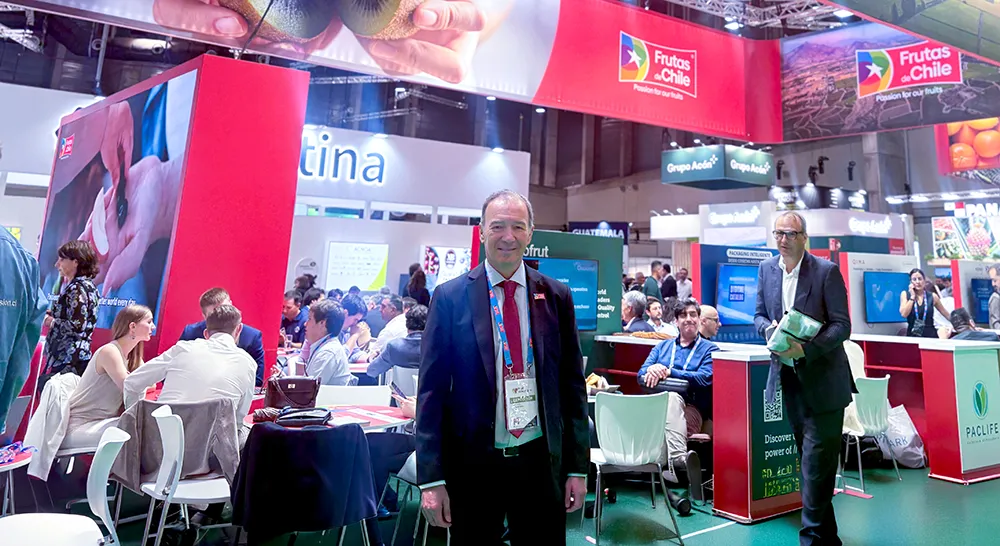
Iván Marambio, president of Frutas de Chile, analyzed the markets, logistics, and competitiveness of Chilean blueberries at Fruit Attraction 2026. © Blueberries Consulting


Distance puts pressure on the condition
But opening markets alone does not solve the Chilean challenge. Distance remains a significant factor.
Marambio clearly identifies what is currently one of the main points of pressure for the national fruit industry:
“What affects us most are the transit times.”
In Europe, he explains, these times have been lengthening and have made it difficult for Chilean fruit to arrive in the best condition, a particularly sensitive problem for an origin far from its destination markets.
This is where the two interviews begin to converge. For Chile, the more demanding the transit times, the greater the value of varieties capable of maintaining firmness and condition over extended periods.
The relationship between genetics and logistics then ceases to be secondary. Post-harvest behavior becomes part of the origin's capacity to sustain more distant and demanding commercial programs.
Productivity and post-harvest are gaining importance
When asked what weighs more today between productivity, fruit quality and post-harvest, Pino prioritizes two variables.
“Productivity definitely, because that allows the producer to have a competitive cost, and post-harvest because the markets are becoming increasingly demanding.”
The answer encapsulates much of the Chilean challenge. Varietal replacement can no longer be viewed solely in terms of yield, just as opening new markets cannot be separated from the quality of the fruit that reaches them.
For Chile, the discussion is no longer just about how much to produce or where to sell. The challenge lies in connecting productivity, quality, and destination: sustaining a competitive project in the field while simultaneously delivering fruit capable of meeting increasingly demanding markets.
Blueberries Consulting at Fruit Attraction 2026
Blueberries Consulting will continue its presence at Fruit Attraction 2026, from October 6th to 8th in Madrid, meeting with companies and industry leaders to gain firsthand knowledge of the sector's production, technological, and commercial challenges and to advance the development of its 2027 international agenda. Companies interested in exploring opportunities for participation, positioning, and business development at upcoming events can schedule a meeting with the team during the trade fair.
Contact: contact@blueberriesconsulting.com
WhatsApp: + 56 9 3469 3871

© Blueberries Consulting
Read also
- Blueberries Consulting kicks off its 2027 business agenda at Fruit Attraction
- Agricultural producers and entrepreneurs from Peru and Latin America met in Lima.
- Stands, meetings and technical conversation: the value of networking at Blueberries Chile 2026
- Chilean blueberry industry: signs of adjustment and repositioning in the global market
Previous article
Peruvian blueberries: when the container is filled before reaching its weight limitnext article
ARTÍCULOS RELACIONADOS