Varietal innovation: the search for crispier, tastier, and more profitable blueberries
In many ways, fruit breeding is a numbers game, and that's especially true for berries. Breeders take pollen from one variety, cross it with another, and then literally reap the fruits of their labor. From these crosses, they obtain seeds that will give rise to genetically unique seedlings, which are then progressively evaluated and culled in field trials and sensory tests.
“It’s a huge investment,” says Brian Bocock, CEO of MBG Marketing. “We’re working on materials that might not reach stores for another 15 years.”
MBG and Naturipe invited media to learn about their breeding program in Grand Junction, Michigan, where they are seeking to develop the next generation of blueberry varieties.
Julie Cromie, plant breeding manager at Naturipe, explains that her team performs around 100 different crosses each year. Each seed obtained from these crosses is a genetically unique seedling. Seeds from the same cross may be similar, but not identical.
“Each seed obtained from the pollination of an individual flower is genetically unique, just like siblings,” he explains. “To find that new variety that can make Michigan the number one producer, we need to look at every single unique genetic combination.”
Naturipe performs crossbreeding for northern highbush and southern highbush varieties. The former are better adapted to cold climates, while the latter require fewer chill hours and are more suitable for warm areas.
The breeding season extends over several months.
“We like to say that breeding is both an art and a science,” says Cromie. “There’s a lot of data collection and observation involved as our team of breeders and technicians works in various trial fields. We also record everything our growers share, compile that information, and make the best statistically possible decisions to arrive at the next great variety.”
There is also a degree of uncertainty, Cromie adds. Part of that challenge is to place each experimental selection in an area of the country where it has a real chance of expressing its potential.
“In a sense, we’re crossing our fingers hoping to find something interesting,” he says.
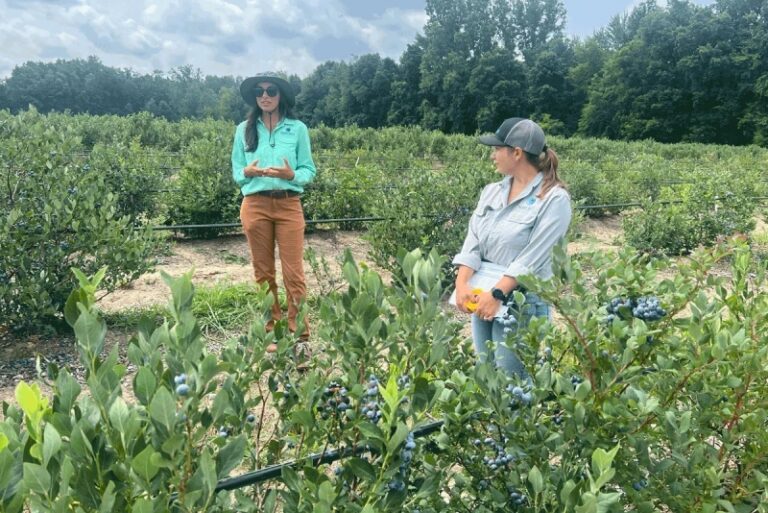
Julie Cromie, plant breeding manager, and Beth Alger, breeding expert at Naturipe Farms, present some of the company's varietal trials at Brookside Farms ☺The Packer

The team evaluates each selection based on 60 different characteristics. Approximately half of these correspond to attributes desired by consumers, and the other half to the needs of producers.
“When we do a crossbreeding, there are several years of evaluation and testing, both in our internal experimental field and with the producer members of our cooperative, to see how they behave under their commercial management systems,” he explains.
Naturipe's improvement team also evaluates the harvest scar on the fruit, since "an open scar can lead to water loss, wrinkling, or the appearance of mold," Cromie explains.
The goal is to find the selections with the best combination of attributes. At the end of the evaluation process, Cromie expects to have between three and five advanced selections.
“It takes a lot of work, time, energy, and collaboration to make it all happen,” he says. “But the end result will be a variety that the grower will want to plant in their field.”
Responding to the demand for texture, sweetness and post-harvest life
The Naturipe team carries out these crossbreedings with the future demands and expectations of consumers in mind.
Bocock points out that Naturipe seeks to develop varieties "that delight, that make the consumer happy every time."
This goal includes reducing the mealy texture in the berries and responding to consumer demand for firmer, crisper fruit. Cromie explains that the team processes the selections in the lab to evaluate their storage performance, sugar and acidity content, firmness, consistency, and overall eating experience.
“All of that matters to our retailers and consumers,” he says.
Cromie adds that a firmer, crispier texture not only enhances the eating experience but also allows the fruit to “last longer in the refrigerator.” Delivering a consistent experience is a core objective.
Although texture, crispness, and firmness are critical attributes for the next generation of blueberries, Bocock argues that "the flavor of blueberries is taking on a life of its own."
Cromie points to the steady growth of the category.
© Brookside Farms Fritz's Blueberries

“There are jumbo fruits, extra sweet fruits, and when we find something interesting in the field, like a novel flavor that we think our friends and families would love, we are the ones who can propel it to the next stage,” he says.
According to Cromie, his team has succeeded in developing blueberries with mango and peach flavors, demonstrating that this future-oriented innovation is possible.
“Mango, passion fruit, pineapple, popcorn-like flavors, like a package of jelly beans; there’s a market opportunity for these novel flavors,” he explains. “Imagine a package of blueberries in 10 years with mango, cinnamon, and peach in the same triple-pack format.”
Bocock clarifies that these flavors come from natural improvement, not genetic modification. The fruit looks like a standard blueberry, but has a different flavor profile.
“It’s truly amazing,” he says.
Joe Klick, associate vice president of product management at Naturipe Farms, notes that berries are “nature’s dessert” and a healthy, ready-to-eat snack. Consumers are also looking for new eating experiences, whether through “a new flavor or a new nuance.”
“We’re moving toward proprietary varieties that will truly propel us into the future, with the flavor, quality, and post-harvest life that the market demands for the next 10 to 15 years,” he says. “Having those kinds of flavors and getting people excited about such a healthy product is a very powerful thing to look ahead to.”
© Brookside Farms Fritz's Blueberries
Balancing flavor innovation with high yields for producers
Bocock maintains that Naturipe seeks to develop next-generation varieties that not only excite the consumer, but are also economically viable for the blueberry grower.
“The goal of the program is to find varieties that connect consumer needs with grower needs,” he explains. “That means ensuring a plant that the grower can successfully harvest, that the harvester can pick at a rate that allows them to truly earn a living for their family, and that the yield per acre allows the grower to afford a Thanksgiving dinner and send their child to college.”

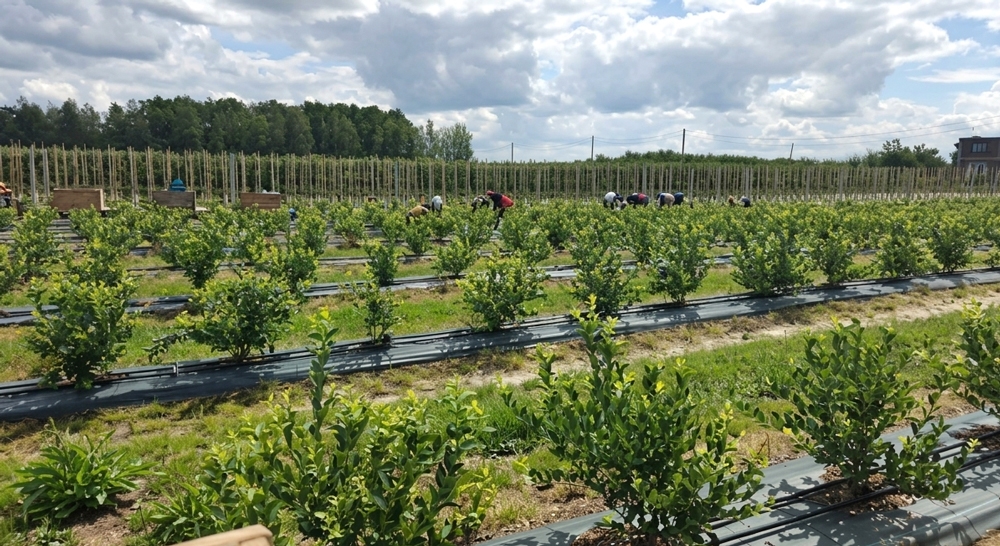
Lance Fritz, owner of Brookside Farms and a partner producer with MBG, notes that when thinking about the next generation of fruit, he looks for easy-to-grow varieties. Part of Brookside Farms is dedicated to field trials of Naturipe varieties.
Fritz considers it an advantage to be able to walk to the trial field. “We can go and see it, we can taste the fruit whenever we want,” he says. As a third-generation grower, he says his family is proud to receive experimental varieties and trials.
“One of the best things about having that is that you can see what’s coming next,” he says. “For the future of the industry, even here in Michigan, if we want to compete with other producing regions, our quality and our yields have to improve. And that starts there.”
Fritz explains that specific production windows are also a crucial part of the evaluation process, as he looks for varieties that allow for a balanced season rather than creating peaks and troughs.
It also ensures that the plants have a suitable shrub structure, ease of harvesting, and the consumer attributes that buyers are looking for.
“We want something that will perform really well for us,” he says. “Here in Michigan we have harsh winters, so we need something that can withstand the winter. We want good quality fruit; something we can harvest, that will hold up from harvest, through packing, and all the way to the consumer. We look at size, we look at flavor, and as growers, we also look at the structure of the bush.”
Fritz prefers plants with a more upright structure, which do not bend when loaded with fruit.
Typically, when there is a more advanced selection, he plants a block of about 2,5 acres "to see if it's something that can work for us in the future."
Bocock points out that profit margins are no longer what they used to be, so producers have had to focus on efficiencies in production, harvesting, collection, packaging, field management, and other aspects. In this context, varieties that help producers in some of these areas are also important.
“We can be the most efficient organization in the world and still be out of business,” he says. “But here in the field, we can achieve an exceptional cross and make a difference. We can win several years in a row because that exceptional cross is far superior to anything else on the market.”
Previous article
Morocco becomes Norway's top supplier of berriesnext article
ARTÍCULOS RELACIONADOS