Juan Hirzel: "New blueberry varieties demand precision nutrition"
By: Natalia Rubio Iversen
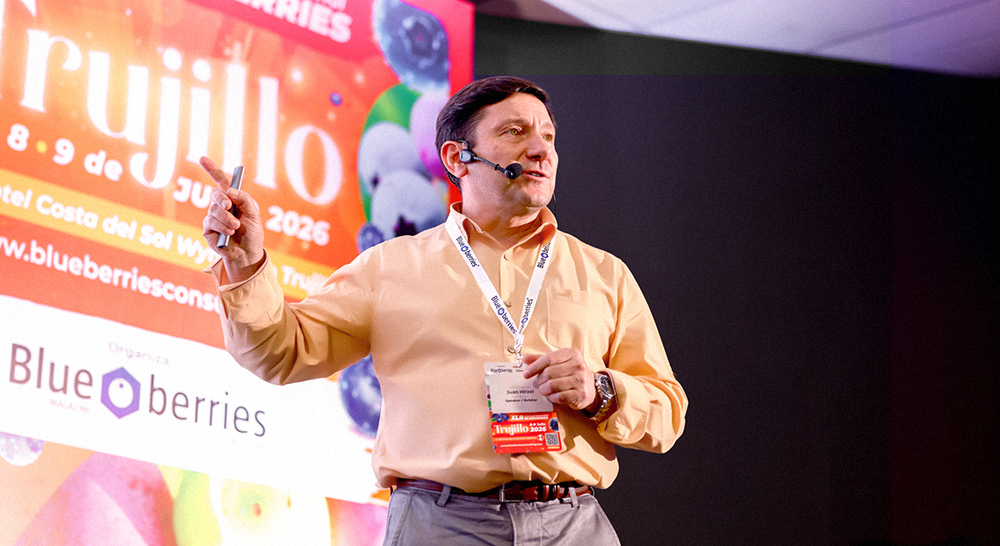
During the Trujillo 2026 International Blueberries Seminar, Chilean researcher Juan Hirzel delivered a clear message to blueberry producers: plant nutrition can no longer be managed using general criteria. In his presentation, "Nutritional Diagnosis and Biostimulation in New Blueberry Varieties: Are We Doing the Right Thing?", he argued that many of the practices currently used in the Peruvian industry need to be rethought to meet the demands of new genetics and increasingly efficient production.
According to Hirzel, one of the most frequent errors he observes in Peruvian fields is that all varieties receive practically the same nutritional management, ignoring that each one has different genetic characteristics that determine its physiological behavior, its ability to absorb nutrients and its productive response.
"Genetics makes a big difference. We can't handle all varieties exactly the same way," he emphasized.
Each variety requires its own nutritional standard
The specialist explained that fertilization programs should be built on scientific information obtained specifically for each variety, also considering the cultivation system —soil or pots— and the climatic conditions where the crop is grown.
To that end, he described three methodologies used internationally to establish nutritional standards.
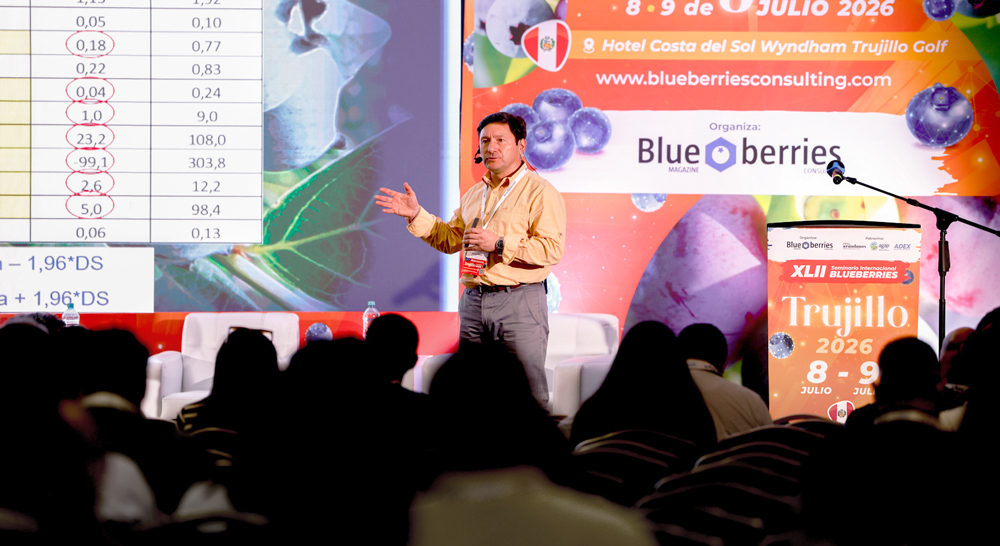
Juan Hirzel, at the International Blueberries Seminar Trujillo 2026. © Blueberries Consulting

The first corresponds to field trials with increasing doses of nutrients over several seasons, considered the most accurate method to determine the concentrations that allow maximizing yield and quality.
The second involves developing standards through statistical analysis of productive populations that have demonstrated high yields and good quality for several consecutive years.
Finally, he mentioned the method based solely on field observations, widely used by commercial companies. While it can provide useful information, he cautioned that it has less scientific backing and is insufficient for defining highly accurate nutritional programs.
According to Hirzel, Peru has a huge amount of information generated by foliar analysis and monitoring, but much of that data is not being used to build reliable management references.
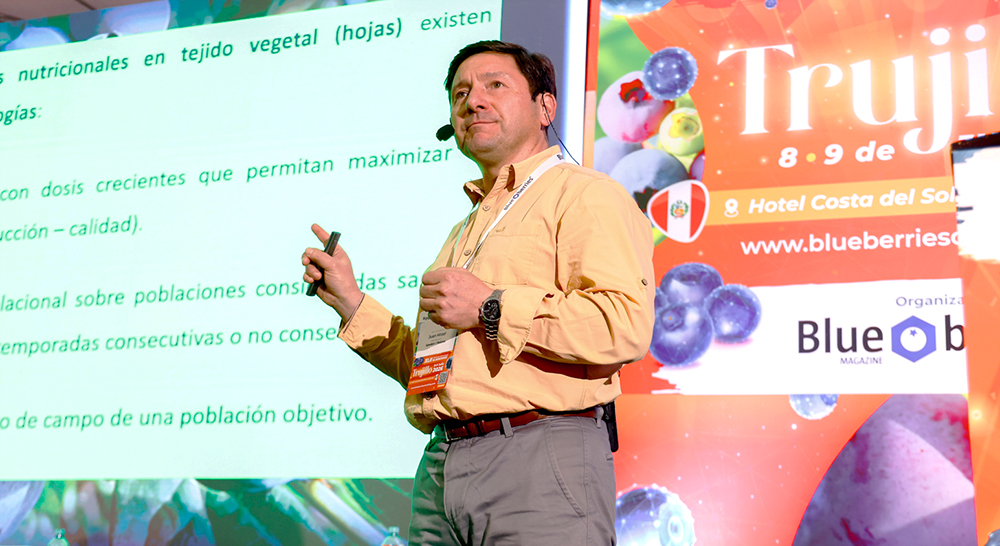
Juan Hirzel, at the International Blueberries Seminar Trujillo 2026. © Blueberries Consulting
Copying nutritional recipes can be expensive
Another aspect he questioned was the practice of replicating nutrient solutions developed for other production areas without first analyzing the characteristics of the irrigation water, soil, or substrate.
He explained that there are situations where the water already provides significant amounts of calcium and other nutrients, so continuing to add them through fertilization not only represents an unnecessary expense, but can also generate nutritional imbalances.
He even pointed out that an excess of calcium can decrease the availability of iron, directly affecting photosynthetic activity and reducing the plant's productive potential.
"Copying fertilization programs without knowing the particular conditions of the field is a common mistake," he said.
He also emphasized the importance of calculating the actual nutrient uptake per hectare. He presented studies showing that modern blueberry varieties produce around 20 tons per hectare while consuming significantly less nitrogen than many growers typically apply.
This information allows for the design of much more efficient fertilization programs, reducing costs and decreasing nutrient losses through leaching.

Biostimulants work, but they must be chosen correctly.
The second part of the conference was dedicated to the use of biostimulants, a segment that has grown significantly in modern agriculture.
Hirzel explained that these products work by activating metabolic processes and defense mechanisms of the plant, allowing it to better cope with different stress conditions or stimulate certain physiological processes.
However, he insisted that no biostimulant should be used solely based on commercial recommendations.
He presented a classification that groups these products into two main categories: those of microbial origin, such as beneficial bacteria and mycorrhizal fungi, and non-microbial ones, which include seaweed extracts, amino acids, peptides, humic acids, chitosans and other organic compounds.
Through various experimental trials, it was shown that different seaweed extracts increase the metabolic capacity of plants by increasing their free water content, although this effect does not necessarily translate into higher production when plants grow under stress-free conditions.
He also presented results obtained with amino acid applications, which can increase the sugar content in fruit. However, he cautioned that these applications also reduce acidity, which can negatively impact post-harvest life if the goal is to export long-lasting fruit.
"All products can be good, as long as they are used to solve the right problem," he noted.

Juan Hirzel, at the International Blueberries Seminar Trujillo 2026. © Blueberries Consulting
Silicon and microorganisms show promising results
Among the biostimulants evaluated, the researcher highlighted the behavior of silicon.
The trials showed that at least three applications before harvest significantly improved fruit firmness, especially in late harvests, without altering size or nutritional composition.
He also presented research on phosphorus-solubilizing bacteria, such as Pseudomonas fluorescens, capable of releasing phosphorus retained in the soil and simultaneously promoting the absorption of calcium by the plant.
Similarly, he presented results obtained with earthworm humus leachates rich in beneficial microorganisms, which favored the growth of plants established in soils affected by allelopathy problems.
These examples, he explained, show that biostimulants can become valuable tools as long as there is scientific evidence to support their use.

More research for an increasingly competitive industry
In the final part of his lecture, Hirzel called for strengthening applied research in the industry. blueberry.
He considered it essential that companies developing new varieties carry out specific nutritional response studies for each genetic strain and that these studies be conducted by universities or research centers with sufficient scientific backing.
He also recommended that agricultural companies build their own nutritional histories using high-yield, high-quality fruit production units, so that they can make decisions based on information generated under their own growing conditions.
Finally, he urged producers to demand scientific evidence before incorporating new biostimulants into their management programs.
"Recommendations must be supported by research and agronomic validations. Only in this way can we optimize nutritional management and harness the full potential of new varieties of blueberries"The researcher concluded."
Read also:
- Juan Hirzel: “In blueberries, no single nutrient is more important than another.”
- From data to decision: the workshops by Claudia Moggia and Juan Hirzel that organized criteria for Lima 2026
- Consistency, firmness and value: nutrition as the core of premium blueberries
- From root to fruit: the physiological and nutritional keys to today's blueberry
- María del Carmen Salas: “Nutritional balance and timely control are key in blueberry management”
- International Blueberry Seminars 2026: Blueberries travel through Peru, Chile, Mexico, Morocco and China
Previous article
Canadian blueberries will be allowed to enter the Philippine marketARTÍCULOS RELACIONADOS