The competitiveness of the blueberry is no longer just about what happens in the field.
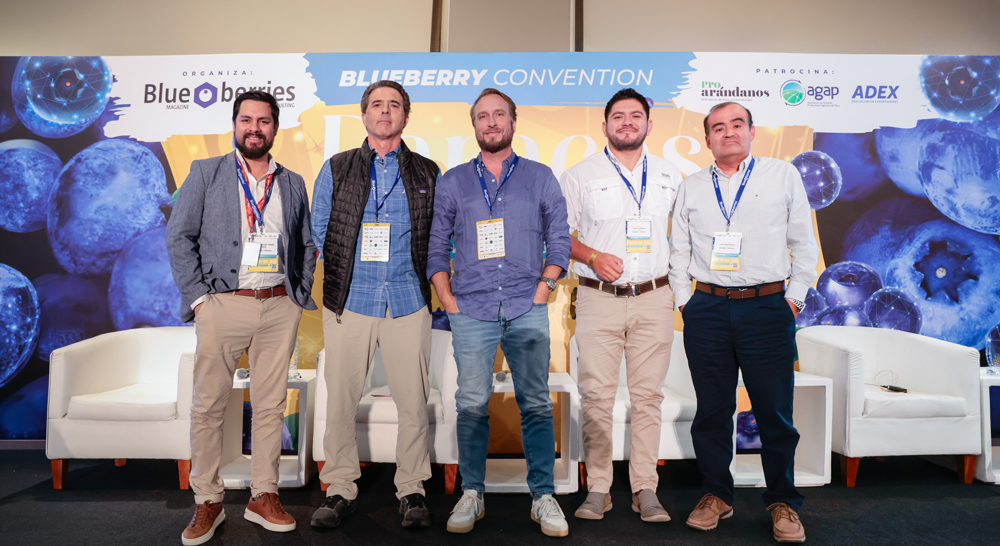
In Paracas, the Ica case opened a discussion that goes beyond a single region. In the industry of blueberryCompetitiveness depends on field performance or fruit quality, but also on the ability to move it efficiently from harvest to port.
As volumes increase, so does the pressure on roads, personnel transport, the entry of supplies, packaging, and port departures. Ica appears here as a concrete example of a broader problem: how to ensure that infrastructure and logistics keep pace with an industry that demands ever-increasing precision.
A pressure that grows along with production
Productive growth brings with it greater logistical demands. That was one of the ideas that emerged during the panel discussion.Peru moving forward: Projections and challenges of the blueberry industry in Ica”When agricultural tasks and fruit volume increase, everything surrounding the operation also becomes more sensitive, from the movement of personnel to the departure of the harvest to the packing plants and the port.
From Ica's perspective, this point is especially relevant because the region continues to expand its presence in the Peruvian blueberry market. But the same applies to other export hubs: in any area where production grows, the capacity to move fruit, people, and supplies with the speed and continuity that the business demands is ultimately tested.

Panel “Peru Moving Forward: Projections and Challenges of the Blueberry Industry in Ica” at Blueberry Convention Paracas 2026 © Blueberries Consulting

Road infrastructure is no longer a secondary issue
Luis Rodríguez, Operations Manager at Hass Perú SA, focused on road connectivity and travel times. He explained that journeys that normally take an hour and fifteen minutes can extend to nearly three hours during peak harvest times. This helps illustrate how much the operation can be strained when the infrastructure cannot keep pace with production.

Luis Rodríguez Hass Perú SA at Blueberry Convention Paracas 2026 © Blueberries Consulting
This increase in lead times not only affects the daily organization of the fields. It also impacts the transportation of workers, the delivery of supplies, and the shipment of fruit to the packing plants. Another observation raised in the conversation added to this: when internal projections fail, transportation and personnel planning becomes disorganized, ultimately increasing costs and making operations more unstable.
The discussion thus revealed that road infrastructure can no longer be considered a peripheral issue. As production increases, roads and access times begin to have a more direct impact on efficiency, coordination, and responsiveness.
Ports are beginning to play a more active role
At that regional level, the port perspective was later added. Rabi Hernán Vilela Ríos, Commercial Deputy Manager of Paracas Port, explained that the terminal has been strengthening its infrastructure and operations to meet the agricultural export demand from the south. He noted that since the concession began in 2014, the port has accumulated investments of over US$250 million, focusing on container handling and operational capacity.

In his remarks, Vilela also highlighted the model Paracas currently operates under, based on more integrated container management and coordination with shipping lines. The logic, he explained, is to concentrate more stages of the supply chain at a single point to reduce unnecessary movement and streamline the process of collecting empty containers, returning them with processed fruit, and dispatching new shipments.
In addition, a further expansion phase is planned for 2027, with new equipment to increase the terminal's operational capacity. More than just a departure point, Paracas emerged in the discussion as a key player seeking to gain importance within the region's export logistics.
Rabbi Hernan Vilela Rios of Puerto de Paracas at Blueberry Convention Paracas 2026 © Blueberries Consulting
Exportable quality also depends on the supply chain
The discussion also revealed that blueberry competitiveness cannot be considered solely in terms of field productivity or varietal selection. It also depends on the efficiency of the supply chain connecting harvesting, transportation, packing, and port. When this chain becomes inefficient, the resulting pressure quickly translates into increased costs, delivery times, and fruit condition.
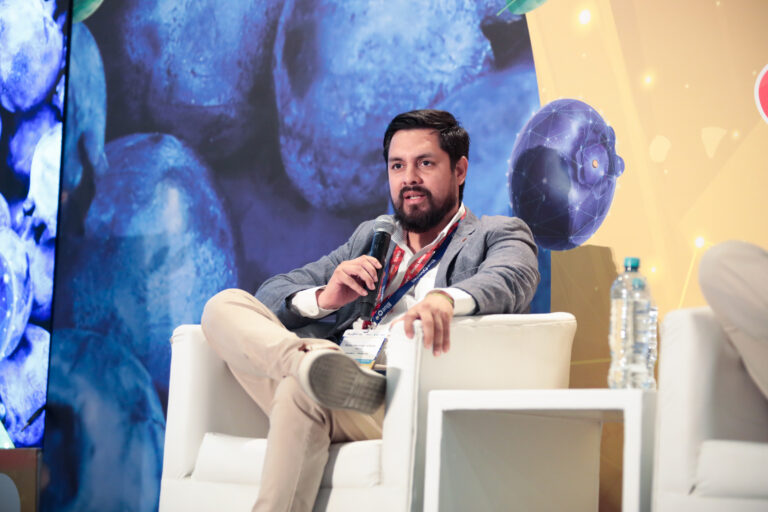
Juan Pablo Bentín, Production Manager at Family Farms Peru – MBO, reinforced this idea by emphasizing the need for better anticipation and more coordinated operations. In a rapidly expanding region like Ica, this foresight is crucial not only for production management but also for the logistics required to move fruit, personnel, and supplies more efficiently.
For producers and exporters, this intersection has a direct consequence, since exportable quality depends on the ability to synchronize harvesting, transport and shipment of fruit within a chain that functions with continuity and predictability.

Juan Pablo Bentín of Family Farms Peru at Blueberry Convention Paracas 2026 © Blueberries Consulting
A discussion that goes beyond a single region
The case of Ica revealed a pressure that could be repeated in other exporting regions of Latin America. In an industry that continues to grow, logistics is no longer just a support for production; it is increasingly impacting competitiveness.
For blueberry For exporters, this discussion is gaining traction. As volumes increase and market demands become more stringent, infrastructure, transit times, port capacity, and operational coordination are becoming as important as production itself.
Mexico 2026: Market, Competition and Value Capture
The open conversation in Paracas will be projected to the XLI International Blueberries Seminar Mexico 2026 from a complementary perspective: while in Ica the focus was on infrastructure, logistics and operational coordination, in Guadalajara the discussion will move towards Mexico's position in relation to other origins and the opportunities to capture greater value.
This theme will be addressed in the panel “Mexico vs. competitors—who will capture value in the next stage of blueberries?”, along with talks by Colin Fain, from Agronometrics, and Carlos Madariaga, from LATAM Berry Fresh, on prices, global competition, the evolution of Mexican blueberries and market dynamics.
The meeting will take place on the following days And May 27 28 by 2026. You can Purchase your tickets here y Check the full program here.
Companies interested in booths or sponsorships can contact the organizing team at contacto@blueberriesconsulting.com or +56 9 3469 3871

Read also:
Market, genetics and quality will set the agenda for Mexican blueberries at Blueberries Mexico 2026
Miguel Bentín places the Peruvian blueberry in a more demanding stage
ARTÍCULOS RELACIONADOS