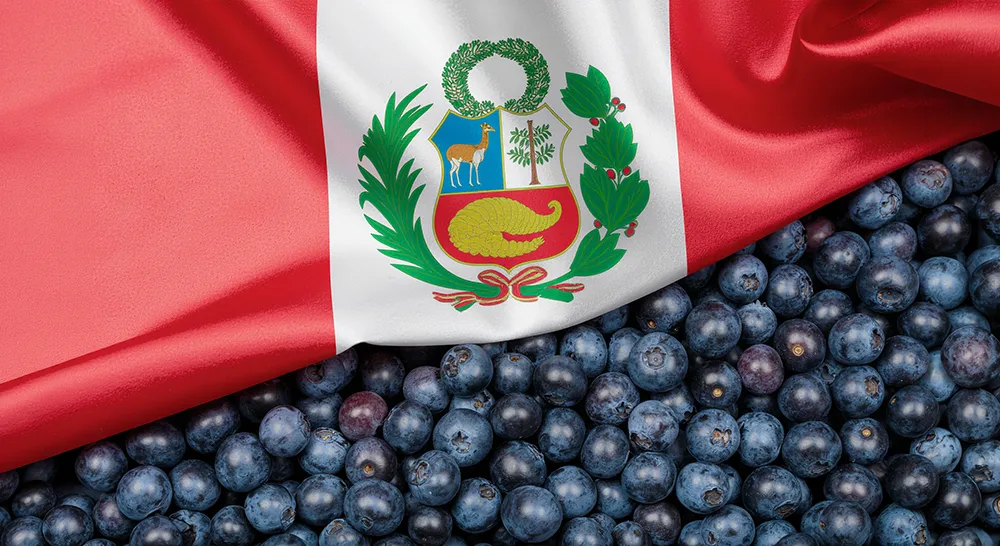
Chinese blueberries are gaining ground in Southeast Asia thanks to genetics, quality, and business strategy

The 2025/26 season marks a pivotal moment for the Chinese industry of blueberryAs production capacity continues to grow, the country's major exporters are advancing their international expansion and broadening their presence in Southeast Asian markets. In terms of volume, China's presence in the global market for blueberry It is now impossible to ignore.
“Currently, the planted area of blueberries in China "It ranks first globally, but at this stage most of the production is destined to supply the huge domestic market; exports are, rather, the result of a production surplus," said Dani Geng, director of the blueberry category at Joy Wing Mau Group (JWM).
Similarly, Sebastian Deng, a partner at Pengsheng, maintained that although the industry still faces gaps in export standardization and post-harvest handling, the pace of development has been extraordinary. “It is projected that in the next three to five years, China will become the world’s second-largest exporter of blueberries,” he stated.
Pengsheng is channeling that expansion into Thailand, Hong Kong, and Singapore, while exploring new opportunities in Russia and Central Asia. “Our export growth is, broadly speaking, in line with expectations, although the potential remains enormous,” Deng explained. “By collaborating with established export partners, we are securing market space for the Chinese cranberries outside the supply window of the Peruvian blueberries".

Location strategies
For Joyvio Blueberry, JWM's premium blueberry brand, one of the keys to its international expansion has been consistent positioning in the high-end segment. According to Geng, one of its main competitive advantages is the ability to offer localized service deeply tailored to Southeast Asian markets. “We have an experienced local team capable of providing full-service supply chain solutions, from customs clearance to shelf placement,” he explained.
This is complemented by a detailed understanding of consumption habits, holidays, and food preferences in each country. Through long-term strategic alliances with premium supermarkets in Southeast Asia, the company seeks to accelerate its market entry. Chinese cranberries and ensure them a prominent space on the shelf.
In terms of product, the group adapts varieties, packaging formats, and marketing strategies to each market, adjusting fruit size, durability, and shelf life to different consumption scenarios. According to Geng, this approach aims to learn from the domestic market, adapt it to local conditions, and incorporate consumer feedback to further optimize the product offering.
“Global sales of blueberries Joyvio has already exceeded 400 million boxes, which has allowed foreign consumers to gradually develop confidence in the quality and brand recognition of the 'premium Chinese berries',” he said.
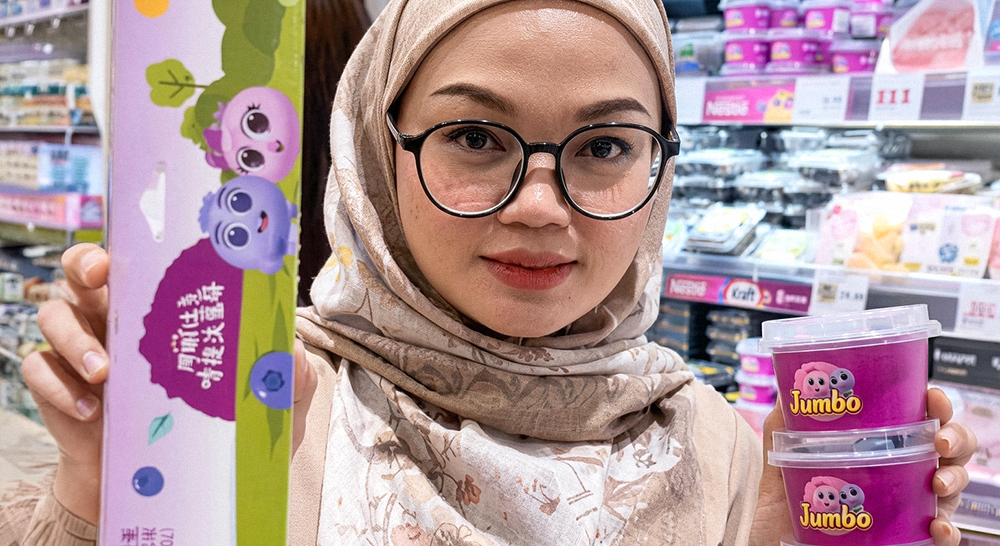
The Joyvio Blueberry brand is gaining recognition among consumers © Joy Wing Mau Group
Buyers' perceptions are changing
The perception of Chinese fruit among Southeast Asian buyers is also evolving in tandem with varietal renewal. Geng explained that JWM is opening new market opportunities based on a diversified portfolio of superior, legally protected varieties.
“We continue to incorporate world-leading varieties. Currently, JWM is the only Asian member of Sekoya and a Tier 1 member of MBO,” he commented. “Both varietal programs, after years of global selection and improvement, show significant advantages in firmness, Brix-to-acid ratio, and flavor profile. With legal varietal licenses and strategically located orchards, we can build a competitive advantage based on quality stability and continuity of supply.”

Even so, the industry still faces what Deng describes as “growing pains” in quality perception and cost management within traditional channels. He explained that many international buyers still see the cranberry primarily from the perspective of price and as a complement to the offer.
“Although the Chinese cranberries “Top-tier producers often exceed market requirements, while conventional channels still operate with older standards and are very price-sensitive,” Deng noted. “To remain competitive, some exporters end up shipping lower-quality fruit. Furthermore, because many Yunnan producers still lack commercial scale, inconsistent harvesting and post-harvest handling have contributed to the perception among foreign consumers that Chinese quality is unreliable.”
New supply windows are opening up
Despite this, Deng believes that geopolitical shifts and climate-related supply disruptions in the Middle East and Africa have opened a window of opportunity for Chinese exports. “This supply gap is allowing Chinese shipments to grow rapidly, and I think we will gradually be able to more fully cover the mid- and high-end market segments,” he said.
In his view, geopolitics operates as a “double-edged sword”: on the one hand, it disrupts established supply chains and opens up entry points for the Chinese cranberriesOn the other hand, it demands a more resilient supply chain. From that perspective, Deng believes that, in terms of long-term competitiveness and quality stability, the maritime cold chain remains the best option today.
“Currently, maritime transport offers better temperature control, ensuring more consistent quality upon arrival, whereas cold chain protection in air transport is not always complete along certain legs,” he noted. “Road transport is heavily dependent on road conditions, and rail transport of fresh produce still lacks sufficient stability. Therefore, maritime transport continues to offer more advantages, especially since profitability and competitiveness will become increasingly important as overall volumes stabilize.”
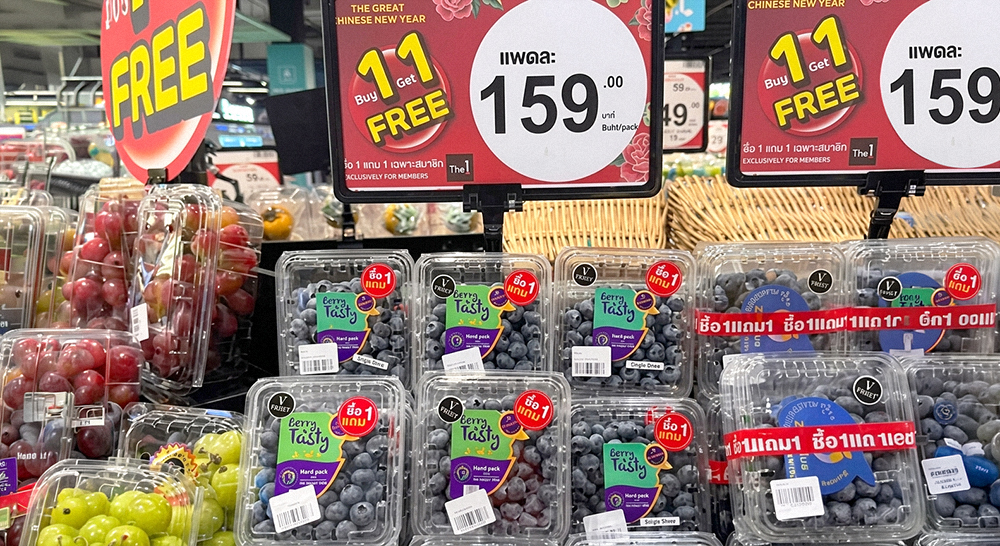
Lunar New Year promotion for Pengsheng at a supermarket in Thailand © Pengsheng

Air and sea freight, depending on the market and window.
Geng, for his part, explained that JWM flexibly combines air and sea transport, depending on demand, varietal characteristics, and cost structure. “The advantage of air transport is speed: the blueberries They can reach supermarket shelves in Southeast Asia from China in three days, ensuring maximum freshness. In contrast, maritime transport reduces costs through large-scale cold chains and improves market penetration,” he explained. “Generally speaking, it is necessary to combine both methods flexibly to find the optimal balance between efficiency and cost.”
Complement with South America
For Geng, the growth of the Chinese cranberries It should not be understood simply as a displacement of other origins in the global market, but also as a strategic complement to South American suppliers such as Peru and Chile, which have historically operated with export-oriented models and mature multinational chains.
“The supply of blueberries South Americans concentrate their migration in the autumn and winter of the northern hemisphere, while the blueberries "Chinese products are mainly supplied for spring and summer. Therefore, they don't compete with each other, but rather complement each other," Geng stated.
“As the Chinese cranberries If we continue to improve at every link in the supply chain—from genetics and post-harvest handling to cold chain logistics—we are very confident in securing a relevant position in the future global trade of blueberry".
Read also:
Opportunity or threat? Business lessons from the Chinese blueberry boom
China's blueberry industry launches growth strategy for high-quality development
China–United States in 2026: trade, technology and signals for blueberries
China's zero-tariff policy will boost Zimbabwe's blueberry exports
ARTÍCULOS RELACIONADOS