Miguel Bentín at Fruit Attraction 2026: “The peak of the Peruvian blueberry will be equal to or less than predicted”
By: Alejandro Yoshioka and Natalia Rubio Iversen

The Peruvian campaign of blueberries It began with volumes significantly higher than the previous year, but that momentum waned as the season progressed. The latest projection from Proarándanos, published on October 1st, reduced the estimate from the 382 tons projected in September to 366 tons, compared to the 404 tons considered in the initial comprehensive projection.
The most significant adjustment, however, is in the peak production window. Between weeks 39 and 45, the expected volume would be 31% lower than in the previous season, as explained by Miguel Bentín, president of Proarándanos, in a conversation with Blueberries Consulting during Fruit Attraction 2026, in Madrid.

The strong start loses momentum
Peru began the campaign with a surge that doubled the previous year's volumes during the first few weeks. This difference gradually narrowed, and by week 39, the cumulative total was around 18% higher than the previous campaign.
The change became more visible as the peak approached. Bentín points out that the volume ramp stopped growing at the expected rate and that, for now, the curve shows a flatter trend than anticipated.
By week 38, Peru had exported nearly 136 tons, 18,7% more than in the same period of the previous season. However, this advantage largely reflects the strong start to the season and not necessarily the performance expected in the following period. Attention now shifts to the period of peak supply.
The peak of the campaign is losing momentum
For Bentín, the behavior of the coming weeks will be crucial in understanding the end of the campaign. “Most likely, the peak in Peru will be as we indicated in the previous statement or lower,” he maintains.
The comparison with the full season may mask some of the change. Although the projection of 366 tons represents a reduction of nearly 4% compared to the previous year, the contraction is considerably greater precisely during the window where the Peruvian peak is traditionally concentrated.
This change in the curve also explains the successive adjustments of Pro-blueberriesThe first complete estimate pointed to about 404 tons; in September it dropped to 382 and, on October 1, it was corrected again to 366 tons.

Pro-Blueberries is preparing a new review
The variability of the season also led the industry to change the way it communicated its forecasts. Instead of working solely with a full-season estimate, Proarándanos began developing ten-week projections and decided to increase the frequency of updates.
Bentín indicated that a new review was scheduled for mid-October, approximately two weeks after the adjustment published on the 1st. He did not anticipate the outcome. “The feeling is that we are likely to see another adjustment, but we are not entirely certain about it at this time,” he explained.
The goal, he points out, is to deliver more consistent information to the market in a campaign whose evolution has shown significant changes even after several weeks of progress.
Early varieties explain part of the upswing
Part of the strong start to the season also has a varietal explanation. Bentín believes that some varieties showed particularly strong performance during the early stage and attributes part of that boost to Sekoya's production expansion, particularly in the northern regions of the country.
That contribution, however, ceased to sustain the curve with the same intensity as the campaign progressed and the effects of weather conditions began to manifest themselves.
Bentín points out that the good initial productions in the north no longer contribute the same volume, while other less affected regions have insufficient scale to materially compensate for that loss within the national curve.
The analysis is relevant because it avoids attributing the campaign's performance to a single factor. The initial success was also influenced by genetics and productive areas with strong early performance; the subsequent decline appears to be associated with a different combination of production and climatic conditions.
The weather keeps the uncertainty open.
Bentín finds similarities between the current curve's shape and what happened in 2023, when Yaku and El Niño Costero affected the Peruvian harvest. He clarifies, however, that the factors are not necessarily the same, although the observed effects on production trends show similarities.
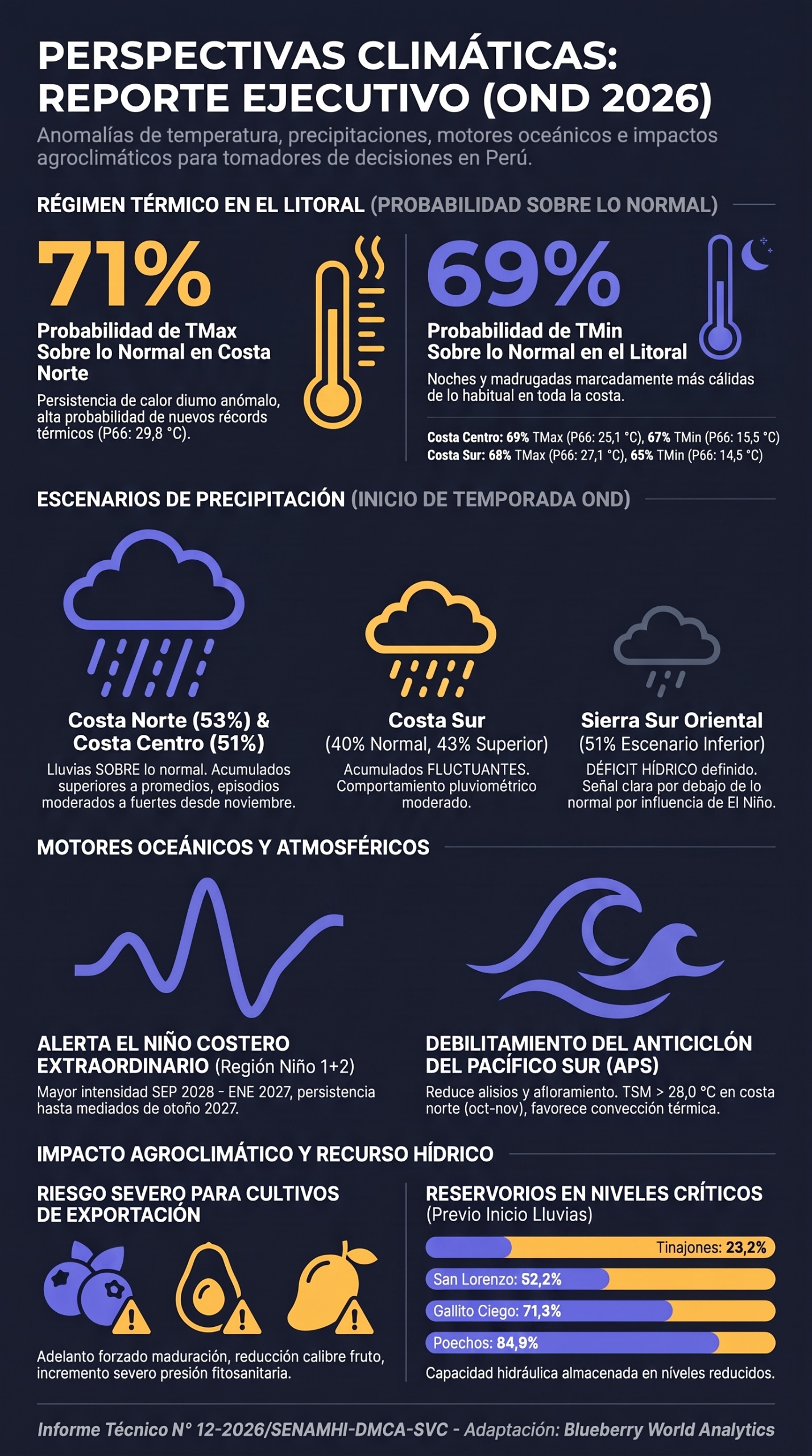
The concern is no longer limited to the end of the current season. It is also beginning to shift toward the start of the next production cycle. Bentín points out that temperatures are at unusually high levels and anticipates particularly warm conditions during November, December, and the Peruvian summer.
Given this scenario, the focus is shifting to management decisions that will reduce the impact on subsequent cycles. “We need to focus on identifying which factors we can control to mitigate the impact of these climatic conditions,” he states.
The Peruvian campaign thus enters a decisive stage. The strong start allowed them to maintain a higher cumulative total than last season, but the loss of momentum towards the peak changed the outlook for what lies ahead.
With the projection adjusted to 366 tons and a new update planned for October, attention is no longer focused solely on how much Peru will end up exporting, but on how the curve will evolve during the coming weeks and what conditions the crop will find when the next production cycle begins.
Blueberries Consulting at Fruit Attraction 2026
Blueberries Consulting will continue its presence at Fruit Attraction 2026, from October 6th to 8th in Madrid, meeting with companies and industry leaders to gain firsthand knowledge of the sector's production, technological, and commercial challenges and to advance the development of its 2027 international agenda. Companies interested in exploring opportunities for participation, positioning, and business development at upcoming events can schedule a meeting with the team during the trade fair.
Contact: contacto@blueberriesconsulting.com WhatsApp: +56 9 3469 3871
Read also:
- Blueberries Consulting kicks off its 2027 business agenda at Fruit Attraction
- Fruit Attraction 2026: Chilean blueberries redefine their competitiveness through genetics, condition, and new markets
- Gabriel Amaro (AGAP) at Fruit Attraction 2026: “Year after year there is greater competition in the blueberry sector”
- Proarándanos lowers its projection to 366 tons and anticipates a plateau in exports.
- Proarándanos reduces its projection for Peruvian blueberry exports to 382 tons
- The Peruvian blueberry industry faces climate uncertainty as El Niño advances
- Peruvian blueberries enter a new stage, with premium fruit at the center
Previous article
Gabriel Amaro (AGAP) at Fruit Attraction 2026: “Year after year there is greater competition in the blueberry sector”next article
ARTÍCULOS RELACIONADOS