More supply, less margin for error: blueberries are changing scale at Fruit Attraction 2026
By: Natalia Rubio Iversen

The global industry of blueberry It could add more than one million tons by 2029. That growth will come to a business where productivity, costs and quality are increasingly important, while the differences between standard and premium fruit are becoming more visible in the market.
Blueberries Consulting closely followed the IBO World Blueberry Forum During Fruit Attraction 2026, held on October 7 at IFEMA Madrid, Cort Brazelton presented the main findings of the IBO Global Blueberry Report 2026; Christoph Stricker focused on retail, the consumer experience, and repeat purchases; and the Global Leaders Panel brought together representatives from production, marketing, investment, and retail.
The forum linked these variables in a single chain: from genetics and field performance to arrival condition, marketing, and consumer response. This connection permeated the presentations and allowed for an examination of the growth of the supply from production to the supermarket shelf.
The market absorbed more volume without a corresponding drop in the average price.
During the presentation of the global report, Cort Brazelton of Fall Creek showcased an industry that continues its expansionary trajectory. Global production of blueberry Highbush cultivation reached 2,33 million tons in 2025, while the planted area reached 303.076 hectares, of which 257.971 were in production. This means that a significant proportion of orchards have not yet reached full commercial production.
This expansion has not, so far, been accompanied by an equivalent drop in the average price in international trade.
One of Brazelton's main messages was that demand has absorbed extraordinary supply growth, keeping average prices relatively stable. Cross-border trade data presented in Madrid show import volumes nearly three times higher than in 2016 and an average value of US$6,64/kg in 2025.
The analysis considers internationally traded fruit, so that value does not represent the price of the entire global blueberry production. Brazelton was explicit in pointing out that this is the data that can be most consistently tracked to observe trade between countries.
“If we adjust for inflation, the 2025 value is roughly at the same level as the 2016 peak. Average prices are stable,” Brazelton explained.
Supply, however, still has room to grow. The IBO model projects that combined global production of blueberries Fresh and processed products could exceed 3,36 million tons by 2029, slightly more than one million additional tons compared to 2025. This is an estimate from the model and not a guaranteed volume.
“I still think this one-million-ton increase is plausible,” Brazelton said. He immediately added a limit to that trajectory: “But after that, I don’t think this curve will hold.”
The IBO Global Blueberry Report 2026 also identifies growing constraints related to land, water, labor, and production costs, factors that may limit the ability to maintain that pace of expansion.
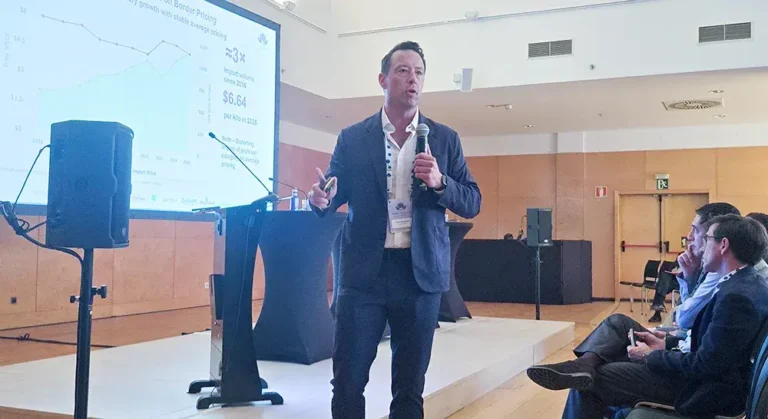
Cort Brazelton at the IBO World Blueberry Forum at Fruit Attraction. © Blueberries Consulting

More hectares do not mean greater productivity
The global average of blueberry The yield of cultivated highbush reached 9.045 kg/ha in 2025, while a significant part of the increase in volume was due to new land coming into commercial production.
Brazelton was particularly critical of that average. “That’s economic death, folks,” he said, referring to the approximately nine tons per hectare.
With that statement, he questioned the low global average performance and emphasized the room that still exists for productivity improvement; he did not present it as a universal profitability threshold. This interpretation aligns with the emphasis of his presentation on the potential for improvement in yields.
In addition to productivity, there is another variable: IBO observes signs of change in the comparative cost advantages between producing regions.
The IBO Global Blueberry Report 2026 suggests a potential shift away from these advantages. For much of the last decade, low- or zero-chilling-requirement areas grew thanks to rapid entry into production, lower labor costs, and attractive returns on capital. Today, they face rising input costs, water availability and cost restrictions, pest and disease pressure, higher labor costs, and logistical challenges.
During his presentation, Brazelton suggested that these dynamics could gradually lead to some kind of “unit cost equilibrium”.
The idea doesn't imply that origins like Peru, Mexico, or Morocco have lost their advantages. It suggests that the relative differences between regions may narrow as costs change and other countries improve their production efficiency. The transcript specifically presents this formulation as an initial indication, not as an already established convergence.
The average price is starting to mask a quality gap
The increase in volume isn't generating the same results for all fruit. Brazelton focused on what he called "next-level quality," a category that differs from the standard product in both consumer experience and price. "There's a significant price difference that's starting to appear in the end market," he stated.
The IBO Global Blueberry Report 2026 provides concrete evidence of this segmentation. In a 104-week analysis of European and North American markets, the lowest weekly shipping price observed for standard fruit was 42% lower than that of comparable premium fruit.
The data does not represent an average price difference nor does it mean that all premium fruit receives a 42% premium.
For IBO, moreover, premium doesn't simply mean larger size. The category is associated with a better consumer experience—with attributes such as flavor, texture, and firmness—and a new generation of cultivars that is raising quality expectations.
Brazelton summarized it by noting that this type of fruit typically exhibits "better flavor and texture" and is associated with a small group of newer genetics. The technical transcript and report support this association without reducing premiumization to berry size.
It also showed a marked seasonal variation in the presence of this category. In the comparison presented by Brazelton during the forum, “next-level quality” fruit reached between 30% and 40% of the supply in certain weeks at the end of October and November and fell below 1% during the summer.

Retail shifts the discussion towards repeat purchases
The price segmentation proposed by Brazelton later found a clear parallel in retail. In his presentation, “Winning Blueberries: What Drives, Hinders, and Encourages Repurchase in Modern Food Retail,” Christoph Stricker of EDEKA shifted the focus to the consumer: what motivates purchases, what might discourage them, and what makes them choose the same product again. blueberries“Price, price, price. I say that price is important,” he said.

Christoph Stricker of EDEKA, during his presentation “Winning Blueberries,” which focused on the factors that drive, hinder, and encourage blueberry repurchases in modern retail. © Blueberries Consulting
But his argument didn't end there. In the clearest parts of his presentation, Stricker linked repeat purchases to the quality and condition of the product, its presentation, and the brand's ability to deliver on its promises to the consumer.
An attractive price, he essentially argued, doesn't compensate for poor quality when the product fails to meet expectations and some of the contents end up being discarded. He further emphasized that a brand loses value when it doesn't deliver on its promises.
He also highlighted the versatility of blueberry and the need to communicate it beyond its health benefits. Its ease of consumption and the various times it can be incorporated into the diet are part of the value the buyer receives. “I’m also willing to pay more if I’m going to have a good experience,” Stricker stated.
The retail sector's perspective aligns with one of the trends highlighted in the IBO Global Blueberry Report: higher-quality fruit encourages repeat purchases, allows for category segmentation, and opens up new formats and consumption occasions. The report also emphasizes the need for shoppers to better understand the differences between cultivars and the impact that improved quality can have on repeat purchases.
Taken together, the exhibitions revealed a connection between field and market: the experience that the consumer ultimately evaluates begins with the varietal choice and production management, continues in harvest and post-harvest, and ends in the condition in which the fruit arrives at the supermarket shelf.
From data to industry decisions
The forum then brought these topics to the Global Leaders Panel, reviving a format that IBO had previously developed in Madrid.
Moderated by Mario Steta, the panel included Nicolás Moller, Executive Chairman; Miguel Bentín, President of ProArándanos; Vicente Jiménez, COO of Surexport; Aritza Rodero, partner at Grupo Atitlan; and Christoph Stricker, of EDEKA. The official panel composition is recorded in the forum's registration.
The panel's composition brought together different positions within the business: Nicolás Moller from the leadership of a global company; Miguel Bentín from ProArándanos and the trade association representation of the Peruvian industry; Vicente Jiménez from the Surexport operation; Aritza Rodero from Grupo Atitlan and investment; and Christoph Stricker from European retail.

Nicolás Moller, of Hortifrut; Miguel Bentín, president of Proarándanos; Vicente Jiménez, COO of Surexport; and Aritza Rodero, partner of Grupo Atitlan, during the Global Leaders Panel of the IBO World Blueberry Forum 2026 in Madrid. © Blueberries Consulting
Steta set the tone he was looking for from the beginning for the exchange and asked for a “very open, very direct and challenging” conversation, also inviting participants to ask difficult questions.
The intention, as explained by Steta, was to move beyond formal presentations and foster dialogue among stakeholders with different positions within the supply chain. Thus, the topics raised during the forum—supply, productivity, costs, quality, and consumer response—reached a discussion table that brought together representatives from production, industry, operations, investment, and retail.
The data presented in Madrid shows a category that still has room to grow, but where the result no longer depends solely on volume: yield, costs and fruit profile increasingly determine the position of the different origins.
From the retail perspective, the requirement is equally concrete: that quality must reach the consumer consistently to sustain repeat purchases.
The Global Leaders Panel closed the forum by bringing these variables to the same table, with representatives from production, marketing, investment and retail.
Check out our coverage of Fruit Attraction 2026
- Miguel Bentín at Fruit Attraction 2026: “The peak of the Peruvian blueberry will be equal to or less than predicted”
- Málaga Fruit Day: more blueberries and better genetics raise the logistical demands
- Blueberries Consulting kicks off its 2027 business agenda at Fruit Attraction
- Fruit Attraction 2026: Chilean blueberries redefine their competitiveness through genetics, condition, and new markets
- Fruit Attraction 2026: Mexico seeks greater value for its blueberries through segmentation, quality, and market.
- Fruit Attraction 2026: Agualima and Euroandes chart new opportunities for Peruvian blueberries
- Juan Luis Becerril at Fruit Attraction: “Our obsession must be that the customer makes money”
- Fruit Attraction 2026: Surexport warns that blueberry production is growing faster than consumption
- Gabriel Amaro (AGAP) at Fruit Attraction 2026: “Year after year there is greater competition in the blueberry sector”
Previous article
Juan Luis Becerril at Fruit Attraction: “Our obsession must be that the customer makes money”next article
ARTÍCULOS RELACIONADOS