Fall Creek tests new blueberry genetic selections in southern Africa
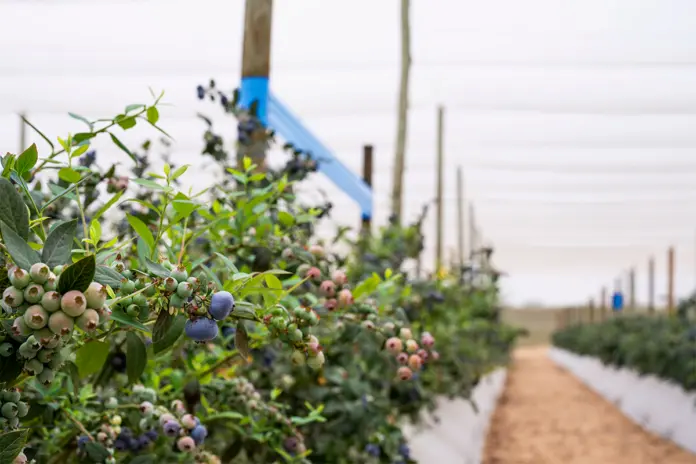
Blueberries on display during Fall Creek Connect, held on September 23 at the company's nursery in Paarl. The event brought together growers and industry representatives to discuss new blueberry genetics, nursery practices, plant quality, and the importance of adapting varieties to different growing regions and market requirements.
FCM20-002 was described as a high-yielding Mexican selection with a relatively concentrated peak harvest, sweet flavor, and medium post-harvest life. Kotzé noted that the performance data presented comes from Mexico or Spain and still needs to be validated under southern African conditions.
The trial data also compared the developing selections with established cultivars such as Apex (FCM14-057), AzraBlue (FCM14-031), and Sekoya Pop (FCM14-052). Ventura was also used as a reference cultivar in the FCE19-018 trial data.

Genetic improvement for diverse growing conditions
The discussion about genetics comes at a time when export prospects are changing and producers are facing increasing pressure to diversify their markets. On September 8, the Department of Agriculture reported that negotiations to allow South African blueberries access to China were at an advanced stage, after China submitted a draft import protocol.
The process was intended to be completed before the end of the year. Meanwhile, the International Blueberry Organization (IBO) has reported a shift from expansion driven primarily by volume to increasing competition based on fruit quality, consistency, and the consumer experience.
Kotzé explained that blueberry genetic improvement requires years of work and involves a large number of selections. A variety typically takes between eight and fifteen years to progress from the initial crosses to commercialization.
The Fall Creek breeding program makes approximately 300 crosses per year and around 30.000 seedlings are annually evaluated, before a progressively smaller number of selections advance to external trials.
Therefore, breeders must anticipate future market and production needs several years in advance, using information from producers, marketers, and consumers.

Kotzé noted that applied research allows for the evaluation of promising genetic materials in different regions and climate zones, while simultaneously developing management recommendations. Fall Creek uses row trials and works with growers to test these new selections under local conditions.
This process is particularly demanding in southern Africa, a region that extends from Kenya, near the equator, to the Western Cape, between 32° and 34° south latitude, and which presents significant differences in latitude, altitude and climate.
According to Kotzé, it cannot be assumed that a team that performed well in Mexico or Spain will perform the same way under local conditions.
FCE21-024 has been selectively distributed in Zimbabwe and Kenya, but not yet in South Africa. Kotzé believes this strain could have greater potential in the Western Cape than in the northern regions.
In his view, the region's complexity also presents an opportunity, as its diversity could allow for a supply during a broad window throughout the year. The challenge lies in finding the right genetics for each production area.
Adapting genetics to market demands
Yolandi Copeland, area sales manager for southern Africa, who participated in place of Teun Leenders, commercial manager for EMEA, noted that adapting genetics to the region, climate, production system and market requirements is a central element of the company's approach.
Copeland indicated that Fall Creek has a presence in South Africa, Namibia, Zimbabwe and Kenya, and that its first plants had already arrived in Zambia.
As he explained, retailers are increasingly looking for resilient sourcing from more than one country of origin, which opens up an opportunity for South African fruit.
“The opportunity isn’t simply about producing more blueberries. It’s about producing the right blueberries, in the right place, for the right market, and at the right time,” he said.
Andries van Rhyn, operations manager at Fall Creek South Africa, pointed out that having the right genetics is not enough: it must arrive in the field in the form of healthy, uniform plants with strong root systems and the correct varietal identity.
As he explained, nursery selection, traceability, and biosecurity directly impact crop establishment and long-term performance.
Producing a nursery plant ready for establishment takes approximately 14 to 18 months, depending on the time of year and the availability of plant material, so advance planning is essential.
“Quality plants do not guarantee a successful crop, but poor quality plants can limit your performance even before production begins,” he said.
Previous article
Proarándanos lowers its projection to 366 tons and anticipates a plateau in exports.next article
ARTÍCULOS RELACIONADOS