Morocco is approaching 90 tons of blueberries and is gaining ground in Europe
By: Natalia Rubio Iversen
With exports approaching 90 tons, the Moroccan industry is currently operating at a volume that raises demands regarding supply, consistency, and market access. In this context, proximity to Europe represents a significant logistical advantage.
For reference, Rhenus reports transit times of 48 to 72 hours on its service between Spain and Morocco, with regular departures from Barcelona to Casablanca and Tangier. While these times don't specifically correspond to blueberry transport, they provide an indication of the existing connectivity between Morocco and Europe.
For a fresh fruit industry, operating with relatively tight timeframes can offer greater flexibility in managing business programs.

The United Kingdom reflects the largest Moroccan presence in Europe
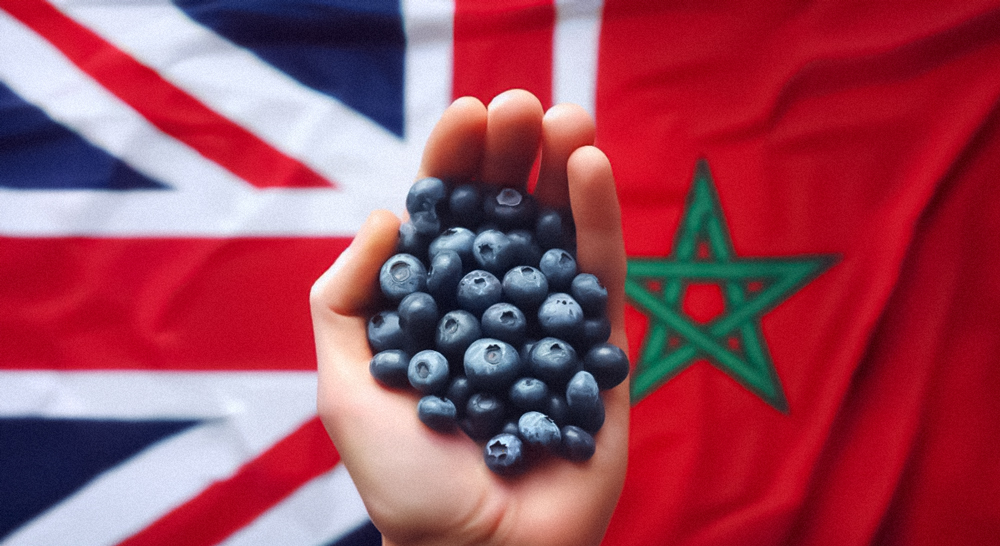
The United Kingdom offers one of the clearest examples. Between July 2024 and June 2025, Morocco exported 19.000 tons of blueberries to that market, 44% more than in the previous season.
With that volume, it became the main supplier to the British market and accounted for nearly a quarter of its imports. During April, coinciding with a period of high availability of Moroccan fruit, its share reached approximately 75% of monthly imports.
In the UK, Morocco already holds a significant position in the blueberry supply. This growth is due to a combination of available volume, market window, and supply capacity, in addition to its proximity to the European market.

More exports, but a demanding campaign
In various production areas, adverse weather conditions disrupted the development of the harvest during 2025/26.
In Larache, episodes of wind, low temperatures, and storms initially delayed production. At the end of March, producers estimated that the peak would shift to the beginning of April. Subsequent rains again affected availability and reduced volume forecasts.
The pressure didn't come solely from the fields. During April, the arrival of the Spanish peak season increased competition and put downward pressure on prices. Towards the end of the season, the Moroccan sector also reported increased international supply and difficulties related to labor availability.
Morocco ended up exporting more blueberries, but the increased volume coexisted with production problems and a more demanding commercial environment.
Managing a new export scale
The challenge is no longer just about increasing shipments. With exports nearing 90 tons, the industry needs to maintain quality, consistency, and commercial compliance while competition among origins intensifies.
Proximity to Europe remains a relevant asset, but its value depends on the ability to respond consistently to buyer demands and to maintain supply programs even in more complex campaigns.
That balance between export scale, logistics, quality, and market will be part of the context of XLIII International Seminar on Red Fruits Morocco 2026, which Blueberries Consulting will carry out September 16 at the Royal Tulip City Center Hotel in Tangier. Producers, specialists, and companies will analyze the main production, technological, and commercial challenges currently facing the Moroccan industry.
Tickets are now available HERE

Read also:
- Morocco Data Club: data to anticipate the blueberry market
- Morocco becomes Norway's top supplier of berries
- Morocco: the new berry giant that now faces the challenge of consolidating its leadership
- Tangier will be the meeting point for a rapidly expanding berry industry
- Fruits of Chile celebrates the signing of an agreement between Chile and Morocco to strengthen health cooperation and facilitate food trade
- ProChile invites Chilean agricultural suppliers to explore business opportunities in Morocco
- Chile is betting on Morocco to open up a market for its fresh fruit in North Africa
- International Blueberry Seminars 2026: Blueberries travel through Peru, Chile, Mexico, Morocco and China
Previous article
Morocco Data Club: data to anticipate the blueberry marketARTÍCULOS RELACIONADOS