SENAMHI warns that the heat will be the main risk for the Peruvian blueberry campaign

The Coastal El Niño phenomenon is expected to maintain a strong intensity until October of this year and will continue until the summer of 2027, according to projections presented by engineer Martín López Ríos, an agrometeorology specialist at the National Meteorology and Hydrology Service of Peru (SENAMHI), during the webinar. "Current conditions (Coastal El Niño) and climate outlook for the agro-industry" organized by Proarándanos.
During his presentation, the specialist explained that the most recent statement from the Multisectoral Commission in charge of the National Study of the El Niño Phenomenon (ENFEN) maintains the alert for Coastal El Niño due to the high probability that the warming of the sea off the Peruvian coast will continue during the coming months.
"The Coastal El Niño will extend until the summer of 2027, with a higher probability of being of a strong magnitude until the month of October," López Ríos noted when analyzing the official projections.

Coastal El Niño and Global El Niño
The specialist emphasized the importance of differentiating between the Coastal El Niño and the Global El Niño, as both have distinct characteristics and impacts on Peruvian territory. He explained that the Coastal El Niño corresponds to the warming of ocean waters off the Peruvian and Ecuadorian coasts, a phenomenon that typically brings heavy rainfall when it coincides with the summer season. In contrast, the Global El Niño develops in the central Pacific and affects Peru indirectly through atmospheric teleconnections, primarily causing rainfall deficits in the southern highlands and parts of the Amazon.
According to López Ríos, current conditions also indicate the development of a Global El Niño event, which is expected to begin this year and reach peak intensity between August 2026 and February 2027. "Everything points to a strong Global El Niño developing, and that's worrying because it would be fueling this Coastal El Niño," he stated. He explained that both phenomena could reinforce each other, increasing ocean warming and altering climatic conditions in different regions of the country.
Kelvin waves strengthen the warm-up
López Ríos explained that the current warming of the sea is being driven by successive warm Kelvin waves, masses of water that move from the western Pacific toward South America. The third of these waves, considered the most intense of the current episode, caused a sustained increase in sea surface temperature since May, while a fourth is already forming and is expected to reach the Peruvian coast between the end of July and August.
Measurements taken off the Peruvian coast show anomalies of between four and six degrees Celsius above normal values in some areas of the northern and central coast. This situation directly impacts air temperatures and alters climatic conditions in key agricultural regions. Furthermore, it was noted that there is a significant accumulation of warm water at depth off the coasts of Peru and Ecuador, a condition that contributes to the persistence of this phenomenon.

Martín López Ríos, specialist in Agrometeorology at SENAMHI.

The biggest threat to blueberries
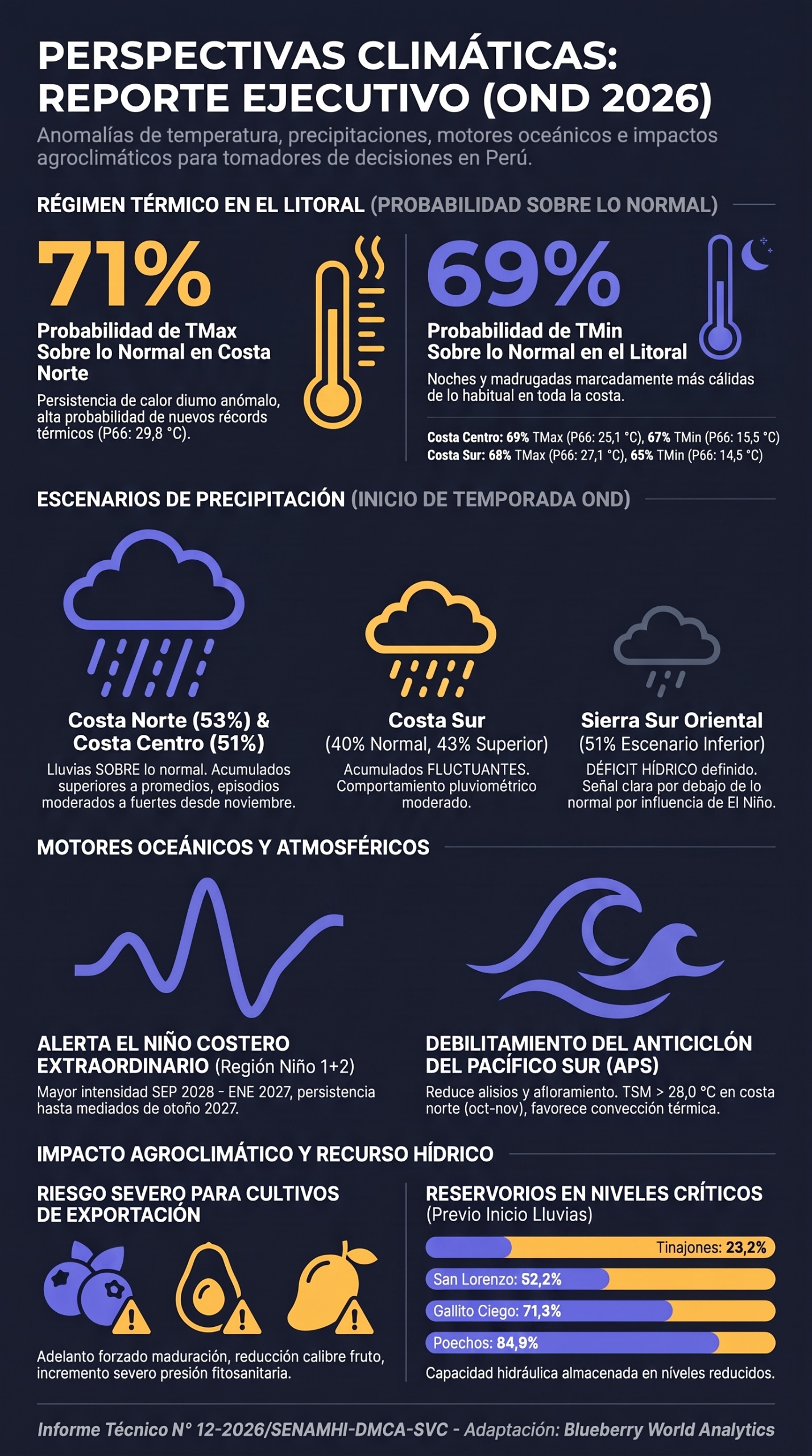
Although the El Niño phenomenon is usually associated with heavy rains, the specialist explained that the main risk for the Peruvian agro-industry during the coming months would not necessarily be the rainfall, but the sustained increase in maximum and minimum temperatures.
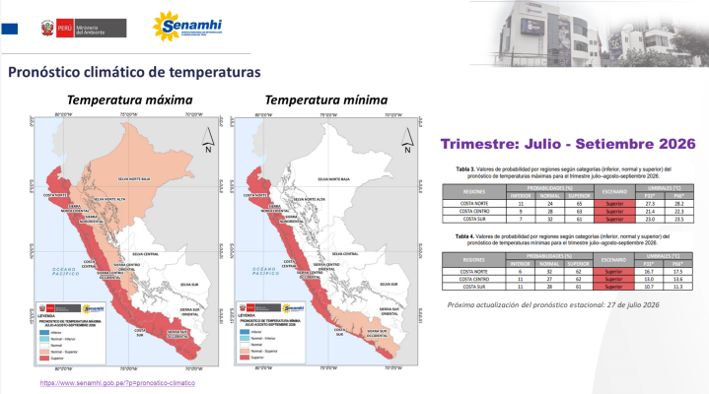
Seasonal projections from SENAMHI indicate that rainfall between July and September will remain within normal ranges; however, temperatures will continue to be above historical averages along virtually the entire Peruvian coast. This situation is of particular concern to the industry of blueberrywhose production is mainly concentrated in La Libertad, Lambayeque and part of Áncash, regions where the heat already shows anomalies greater than three and even five degrees.
During June, for example, weather stations recorded increases of up to 4,6 degrees in Guadalupe (La Libertad), 4,1 degrees in Jallanca (Lambayeque) and five degrees in Campo de Marte, while minimum temperatures also remained well above their historical averages.
From an agronomic perspective, these conditions can disrupt flowering, reduce fruit set, accelerate fruit development, and affect key export attributes such as size, firmness, and post-harvest life. Furthermore, the increase in nighttime temperatures limits the plants' physiological recovery, exacerbating heat stress during a crucial growing season for Peru's main agricultural export.
Lessons from the Child 2023
López Ríos recalled that the Coastal El Niño event of 2023-2024 severely impacted various agricultural activities due to the extraordinary rainfall in Piura, Lambayeque, and La Libertad. However, he emphasized that the current event presents significant differences.
So far, the warming of the sea has not generated extraordinary rainfall like that observed in 2017 or 2023. "Thank God it was only concentrated slightly above normal in February, and since then, rainfall has been predominantly scarce," he explained. However, he warned that the persistence of high temperatures alone constitutes a risk factor for intensive agriculture.
A decisive second half of the year
The specialist noted that the second half of the year accounts for the majority of Peruvian exports. blueberries towards the United States, Europe and Asia, so he recommended that companies permanently incorporate meteorological and climatic information into the planning of their operations.
"The second half of the year is crucial for the agricultural export sector," he emphasized. He also noted that in the previous season, production on the northern coast experienced a slight decline, while the strong performance of the southern producing regions and high international prices partially offset that decrease.
He also recommended monitoring the behavior of the Global El Niño in other producing countries. blueberriessince weather conditions could alter the global supply and generate changes in international prices.
Finally, López Ríos urged producers and exporters to stay tuned to updates issued by ENFEN and SENAMHI, as oceanic and atmospheric conditions continue to be monitored constantly.
"We always recommend that decision-makers obtain official information to assess how the agricultural export sector's campaign is developing, because there is already some evidence of complications, especially on the northern coast," he concluded.
Read also:
- El Niño takes Peruvian blueberries from alert to campaign planning
- El Niño 2026: the test of maturity for the Peruvian blueberry
- The Peruvian blueberry industry faces climate uncertainty as El Niño advances
- El Niño could affect the upcoming Chilean cherry and blueberry season
- El Niño creates uncertainty in the global blueberry market
- The potential development of El Niño in 2026 is once again putting pressure on the blueberry industry in South America.
- The 2026 Coastal El Niño: a test of maturity for the Peruvian blueberry
ARTÍCULOS RELACIONADOS