Walter Apaza: Managing plant stress will be key to dealing with diseases during El Niño
El Niño will once again strain the health management of blueberry Peruvian. Not only because of the possible occurrence of rain, still uncertain in intensity and distribution, but also because of the effect of high temperatures on plant stress and its ability to respond to diseases.
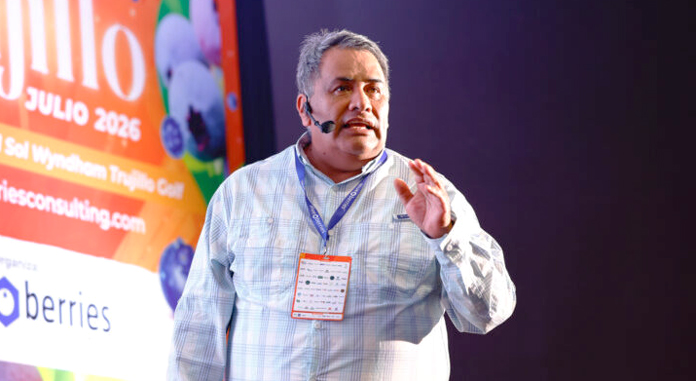
That was the focus of the conference “Strategies against the El Niño phenomenon: How does it affect disease control?”, presented by Walter Apaza during the XLII International Blueberry Seminar Trujillo 2026where he analyzed how the climate can modify the pressure of Rust, Powdery mildew, Botrytisroot diseases and wood fungi in production fields.
According to the specialist, crop health cannot be addressed solely through chemical control. The plant's physiological condition will be the determining factor.
“Stress management accounts for 80% to 95% of integrated disease management. Chemical control helps, but it won't solve the problem if the plant remains stressed,” he emphasized.
A campaign marked by stress, variety, and the production system
Apaza explained that ocean warming is already raising minimum and maximum temperatures above normal, with effects on key crop processes such as floral induction, budding, and fruit development.
The impact, he warned, will not be uniform throughout the season. It will depend on temperature trends, the occurrence and intensity of rainfall, the production area, the variety, and the physiological state of the plants at the time of planting.
In this scenario, varieties highly dependent on accumulated chilling hours, such as Ventura, may experience production delays, smaller fruit size, and reduced yield. The effect can be more severe in northern regions, where minimum temperatures remain higher, and will vary depending on the pruning time, the production cycle, and the plant's condition.
The specialist also distinguished between soil-based and potted systems. In soil, root development conditions are often more complex under stress; in pots, on the other hand, there is greater flexibility to manage oxygenation, drainage, and root health. This difference can be significant in scenarios of heat, saturation, or rainfall.
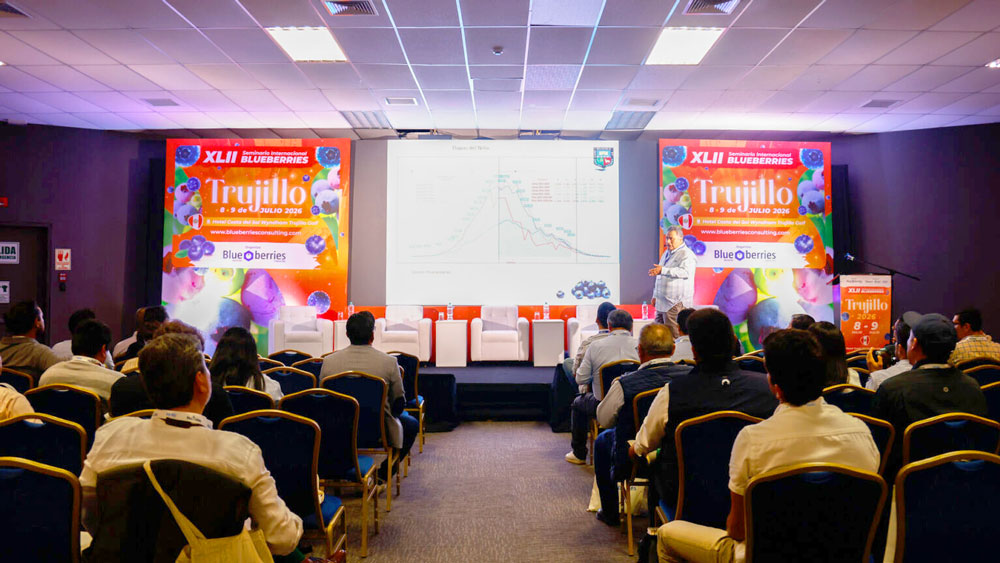
Walter Apaza International Blueberries Seminar Trujillo 2026 © Blueberries Consulting

Rust: inoculum, defoliation and susceptible varieties
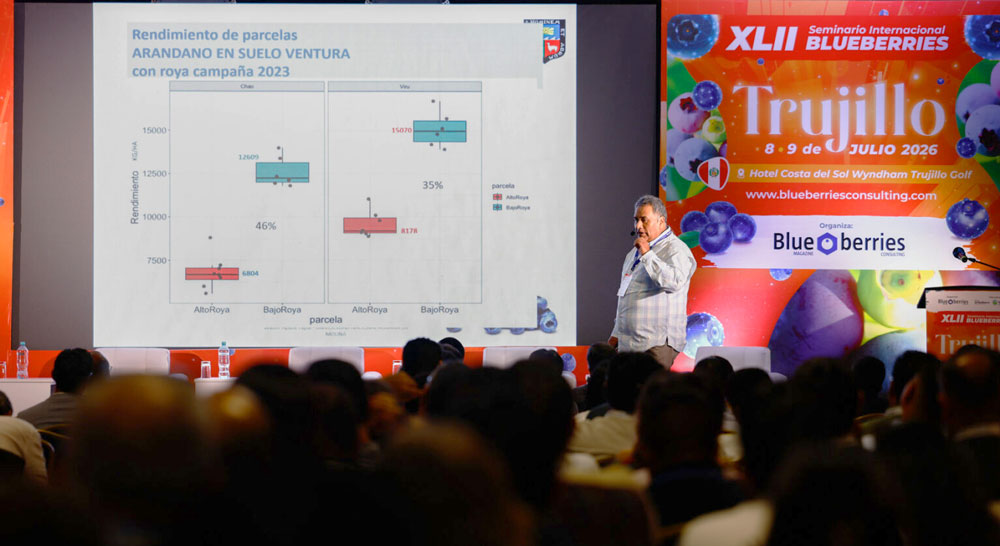
Coffee rust was a central theme of the presentation. Apaza recalled that the 2023 experience showed how high temperatures can accelerate defoliation caused by this disease, with a direct impact on production.
According to results presented in commercial fields, rust reduced yield by up to 46% when defoliation occurred during critical stages of the crop.
The risk, he explained, is not the same in all areas or varieties. In areas with susceptible varieties, high continuity of fields, and the presence of infected leaves, the uredial phase can keep the inoculum active and facilitate the recycling of the disease between plots.
Therefore, he recommended promptly reducing sources of inoculum, removing infected leaves, avoiding so-called "green bridges" between plots, and strengthening preventive programs before symptoms become more prevalent in the field.
Early defoliation is the most critical point. When the plant loses leaves during fruit differentiation or development stages, the balance between leaf area and productive load is disrupted, affecting fruit size and yield.
Walter Apaza International Blueberries Seminar Trujillo 2026 © Blueberries Consulting
Powdery mildew: severity, resistance, and diverse strategies
Powdery mildew presents a different challenge. Under warm conditions and with susceptible tissue, the disease can shorten its life cycle and progress more rapidly. Although it doesn't usually cause leaf drop, it can affect fruit firmness and increase dehydration when it reaches high levels of severity.
Apaza explained that the attack usually begins on the underside of the leaf and that the problem becomes more complex when the disease progresses toward the upper surface, a sign of increased stress on the crop. He also highlighted the varietal component: some varieties are less susceptible, while others can experience high levels of the disease if not controlled promptly.
The specialist warned of signs of strobilurin resistance in powdery mildew isolates in Peru and urged against relying on a single control tool. In this context, he mentioned biological products, sulfur, and bicarbonates as part of more diverse strategies, especially in organic systems, where available alternatives are often less effective than traditional chemical products.
The point, he insisted, is not to replace one tool with another, but to structure broader programs, with rotation, appropriate frequency, and decisions adjusted to the level of pressure in the field.

Walter Apaza International Blueberries Seminar Trujillo 2026 © Blueberries Consulting

Botrytis and harvest: fruit condition at destination
About Botrytis, Apaza was more cautious. He didn't project it as the main problem under a warm scenario, unless there is rain or high humidity. Even so, he noted that latent infections and fungi at the destination require working with climatic and field indicators before deciding on applications.
Harvest management will be another critical point. High temperatures can accelerate fruit ripening and reduce the period between flowering and harvest, forcing adjustments to harvesting frequencies.
If this adjustment does not occur, the risks of over-ripeness, loss of condition, and fungal growth increase during transport to export markets.
For Apaza, harvest management—frequency, timing, and labor availability—will be a competitive advantage, especially if the heat concentrates or disrupts production curves. Harvesting at the right time, avoiding the accumulation of ripe fruit, and reducing waiting times will be crucial decisions for protecting firmness, health, and post-harvest shelf life.

Walter Apaza International Blueberries Seminar Trujillo 2026 © Blueberries Consulting
Roots, Phytophthora and wood fungi
The specialist also addressed diseases associated with excessive moisture, especially those linked to Phytophthora. In roots, the risk will be concentrated in systems with saturation, lack of root oxygenation, and prolonged waterlogging, where this pathogen can thrive.
Apaza pointed out that potted plants can offer more flexibility in managing these events, provided there is adequate control of drainage, substrate, and root oxygenation. In soil, however, the scenario can be more complex when rainfall, anoxia, and root stress combine.
In wood fungi, he paid special attention to Lasiodiplodia, which thrives in high temperatures and can affect arms, vascular tissues, and, in more severe cases, the crown of the plant.
Unlike foliar diseases, this type of problem can directly affect the crop's productive structure. If the pathogen progresses to the crown, it compromises a key organ for the plant's survival and reduces its chances of recovery.
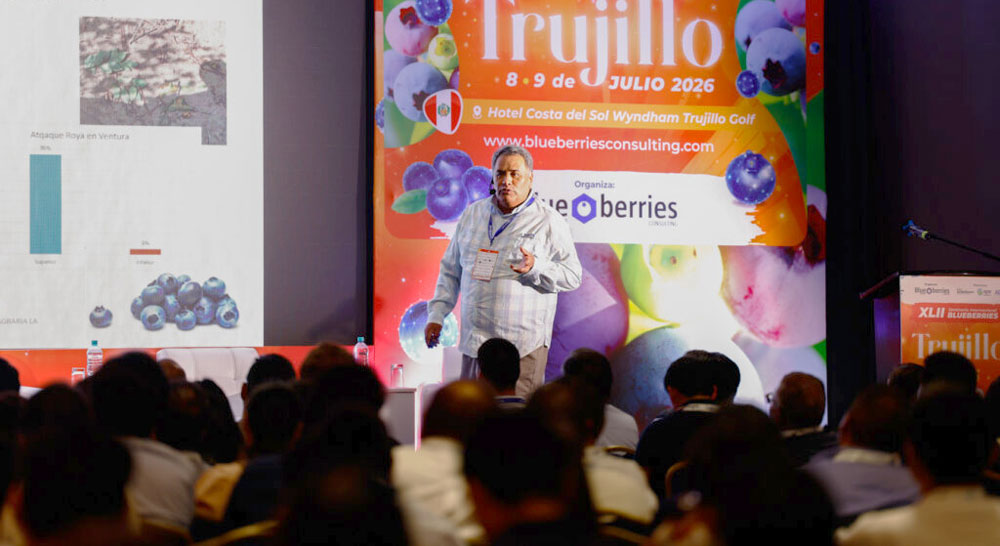
Walter Apaza International Blueberries Seminar Trujillo 2026 © Blueberries Consulting
Pruning, ventilation and prevention before the symptom
In pruning, the message was to avoid severe interventions under very high temperatures, work with active roots, protect wounds, and manage system ventilation to reduce microclimates of heat and stress.
Apaza recommended protecting cuts with pruning sealant, avoiding low pruning in high-risk areas, improving crop ventilation, raising shade nets in greenhouse systems, and carefully managing the substrate to reduce root stress. He also emphasized the importance of preparing the plant before pruning and following up with appropriate post-pruning management.
Prevention, he emphasized, is not just a general recommendation. In the trials presented, the effectiveness of control dropped sharply when applications were made after the disease had already taken hold, while preventative strategies showed better results.
“Prevention will always be more effective than trying to control a disease once it is already established,” he noted.
Facing El Niño, the health of blueberry Success won't depend solely on application. It will also depend on achieving less stressed plants, lower inoculum levels, more timely harvests, active roots, and preventative measures tailored to each field condition.
For growers and consultants, the message is that disease control must begin before symptoms appear. In a season with greater weather pressure, anticipation will be just as important as choosing the right product.
Walter Apaza International Blueberries Seminar Trujillo 2026 © Blueberries Consulting
Read also:
- Productivity, climate, and commercial consistency will define the new blueberry genetics
- "El Niño isn't fought when it arrives; the resilience of the blueberry is built throughout the entire season."
- Networking and innovation consolidate Trujillo as a meeting point for the blueberry industry
- “Understanding the plant to face climate change”, Jorge Retamales’ proposal for the new blueberry agriculture
- Luis Miguel Vegas: Peru doubles blueberry production, but El Niño forces cautious projections
- International Blueberry Seminars 2026: Blueberries travel through Peru, Chile, Mexico, Morocco and China
ARTÍCULOS RELACIONADOS